
Asami Chiba
Japanese sprinter, middle-distance runner
About Asami Chiba
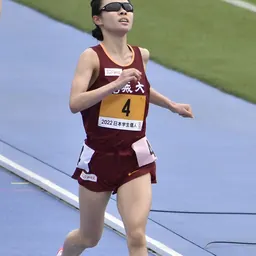
Born 1985. Asami Chiba is a Japanese athletics competitor, sprinter and middle-distance runner.
, or Tanno, is a Japanese sprinter who specialises in the 400 metres. She is the Japanese record holder in the event, and has also broken the national record in the 4×400 metres relay on multiple occasions. She is a member of Natureal Athlete Club in Japan and is coached by Kazuhisa Kawamoto.
As a junior athlete, Tanno won two silver medals at the Asian Junior Athletics Championships, setting a national record in 2004, and she also reached the final of the World Junior Championships. She competed at her first World Championships the following year and won two bronze medals at the Asian Championships. In the 2006 and 2007 seasons, she won bronze at the 2006 Asian Games and two silver medals at the Asian Championships. She also helped set a new national relay record and became Japan's first ever female sprint semi-finalist at the 2007 World Championships. She was less successful at the 2008 Beijing Olympics and 2009 World Championships as she was eliminated in the heats at both events.
A five-time national champion in the 400 m, she has only lost once in the event at the Japanese championships, to Satomi Kubokura. She mainly competes on the Japanese athletics circuit, running at the Osaka Grand Prix, Shizuoka International and the Super Meet in Kawasaki.
Career
National champion and records A native of Yabuki, Fukushima, Asami Tanno won her first international medals at the 2002 Asian Junior Athletics Championships, taking the 400 m silver behind Sathi Geetha and a bronze with the Japanese relay team. After making significant improvements upon her 2003 performances, she came to prominence at the 2004 Asian Junior Athletics Championships in Ipoh. She set a Japanese record in the 400 m with 52.88 seconds, a time that is still the national junior record. She also ran in the 4×100 metres relay, winning her first international gold medal.
Further success came at scholastic level, as she set championship records to win the 200 m and 400 m at the Japanese Inter-Collegiate Championships. She won a bronze medal in the 200 metres at the Asian Indoor Athletics Championships and won the 400 m events at both the Japanese National Games (Kokutai) and the national championships that year. Also, she competed at her first World Junior Championships, reaching the final and finishing in sixth place.
The following year she broke the 400 m indoor record with 53.64 seconds in Tianjin and won the 800 metres at the National Games. At the national championships she came second in the 200 m to Sakie Nobuoka and she also improved her own 400 m Japanese outdoor record. After coming close to her record in the heats, she became a two time 400 m national champion with 51.93 seconds, knocking a second off her previous best. She rebounded, however, at the Asian Championships, winning two bronze medals in the individual and relay 400 m events. Her good form continued as she finished fourth at the 2005 Summer Universiade and set a new best at the Seiko Super Track & Field Meet (Super Rikujyo). At the meeting she finished with 51.80 seconds and although this was some distance behind American Dee Dee Trotter (50.03) Tanno stated that she aspired to break 51 seconds in her career too. She ended the year with a 400 m gold medal at the 2005 East Asian Games.
In 2006, she won the Osaka Grand Prix in May with a season's best of 51.84 seconds. Tanno did not run at the national championships finals, missing out on a third consecutive win. She finished the year with an appearance at the 2006 Asian Games, taking the bronze medal in the 400 m and finishing fourth in the relay.
2007 Osaka Championships and Beijing Olympics Returning to the Osaka GP, she set a national record of 3:30.53 in the 4×400 m relay with Mayu Kida, Satomi Kubokura and Makiko Yoshida, and also took second place behind Mary Wineberg in the individual race. The national championships acted as trials for the 2007 World Championships in Osaka, and Tanno won the 400 m and pushed Sakie Nobuoka to the line in the 200 m, narrowly finishing second. A month before the World Championships, she ran the 400 m at the Asian Championships, winning the silver medal behind Indian Chitra Soman. She won her second silver of the competition with the Japanese 4×400 m relay, beaten to the gold again by the Indian athletes.
Representing the host nation at the World Championships, she failed to reach the finals of the 400 m. However, she recorded a season's best of 51.81 seconds and succeeded in becoming the first ever Japanese woman to reach the semi-finals of a sprinting event at the World Championships. In the 4×400 m relay the Japanese team (Sayaka Aoki, Tanno, Kubokura and Kida) were eliminated in the heats, but they managed a new national record of 3:30.17, improving upon the mark Tanno had helped set earlier in the season.
She missed the 2008 Asian Indoor Championship in Doha and began the outdoor season with another national record, recording 51.75 seconds at the Shizuoka International in May. She was expected to improve further at the Osaka GP, but wet conditions slowed the athletes and she finished third with 52.55 seconds. At the national championships, which were also the trials for the 2008 Beijing Olympics, she beat hurdles specialist Kubokura to the title and was selected to represent Japan at the Olympics. At the Olympics in August, she recorded 52.60 seconds in the qualification rounds, which was not sufficient to progress. She returned to the track with the Japanese relay team. While their time of 3:30.52 was not far off the team's national record, it left them in eighth place at the heats stage.
2009 World Championships and 2010 Asian Games She opened her season at the Shizuoka International, winning in a modest 53.21 seconds. Tanno repeated her performance from the previous year in the Osaka GP, taking third behind foreign opposition – Australian Tamsyn Lewis and American Latosha Wallace. At the Japanese Trials for the World Championships, she beat Aoki to the national title, her fifth victory at the championships in six years. Tanno could not match her 2007 performance at the 2009 World Championships and she was eliminated in the 400 m heats with a sub-par 53.30 seconds. A Japanese team of Aoki, Tanno, Sato (née Kida) and Kubokura did not perform well in the 4×400 metres relay competition, finishing last in their heat with 3:34.46.
After the World Championships, she competed at the Super Meet in Kawasaki, beating off Barbara Petráhn and Maris Mägi to win the 400 m.
She was married in February 2010. She failed to defend her national title in 2010 after suffering injuries earlier in the season, leaving Chisato Tanaka to take the victory. She represented Asia at the 2010 IAAF Continental Cup, but finished last in the 400 m. She won the silver medal at the 2010 Asian Games, although the Japanese team missed out on a relay medal as they finished in fourth.
Personal bests Event Time (sec) Venue Date 200 metres 23.75 Yokohama, Japan 10 June 2006 300 metres 38.53 Tokyo, Japan 2 September 2006 400 metres 51.75 NR Fukuroi, Japan 3 May 2008 400 metres (indoor) 53.64 NR Tianjin, PR China 1 March 2005 All information taken from IAAF profile.
Competition record Representing 2002 Asian Junior Championships Bangkok, Thailand 2nd 400 m 54.72 3rd 4×100 m relay 3:44.48 2004 Asian Junior Championships Ipoh, Malaysia 2nd 400 m 52.88 1st 4×100 m relay 46.01 Asian Indoor Championships Tehran, Iran 3rd 200 m 24.99 World Junior Championships Grosseto, Italy 6th 400m 53.34 13th (h) 4×100m relay 45.80 2005 World Championships Helsinki, Finland 30th (h) 400 m 52.80 Universiade İzmir, Turkey 4th 400 m 52.91 Asian Championships Incheon, South Korea 1st 400 m 52.69 2nd 4×400 m relay 3:36.64 East Asian Games Macau 3rd 400m 52.91 3rd 4x400m relay 3:33.54 2006 World Cup Athens, Greece 9th 4×400 m relay 3:38.85 Asian Games Doha, Qatar 3rd 400 m 53.04 4th 4×400 m relay 3:35.08 2007 Asian Championships Amman, Jordan 2nd 400 m 53.20 2nd 4×400 m relay 3:33.82 World Championships Osaka, Japan 20th (sf) 400 m 51.81 11th (h) 4×400 m relay 3:30.17 (NR) 2008 Olympic Games Beijing, China 28th (h) 400 m 52.60 15th (h) 4×400 m relay 3:30.52 2009 World Championships Berlin, Germany 27th (h) 400 m 53.30 14th (h) 4×400 m relay 3:34.46 Asian Championships Guangzhou, China 1st 400 m 53.32 3rd 4×400 m relay 3:31.95 2010 Continental Cup Split, Croatia 8th 400 m 53.38 Asian Games Guangzhou, China 2nd 400 m 52.68 4th 4×400 m relay 3:31.81 2013 Asian Championships Pune, India 3rd 4×400 m relay 3:35.72 2014 Asian Games Incheon, South Korea 2nd 4×400 m relay 3:30.80 2015 Asian Championships Wuhan, China 7th 400 m 54.71 4th 4×400 m relay 3:35.93 World Championships Beijing, China 13th (h) 4×400 m relay 3:28.91
Japanese national 400 m champion: 2004, 2005, 2007, 2008, 2009
Don’t just read it —
keep it.
Full-length biographies made to live with: read them, listen on the way to work, watch them tonight.
- E-book
- Audio
- Video
Instant download · yours to keep · every purchase keeps this site free
Important facts
People in Asami Chiba's life
Named in this biography and alive at the same time




Related people
Same field, nearest in time



Contemporaries
People whose lives overlapped Asami Chiba's





Frequently asked questions
Who is Asami Chiba?
Japanese sprinter, middle-distance runner
When was Asami Chiba born?
Asami Chiba was born on 25 September 1985 in Yabuki.
What is Asami Chiba's occupation?
Asami Chiba is an athletics competitor, sprinter and middle-distance runner.
What nationality is Asami Chiba?
Asami Chiba is Japanese.
Sources & further reading
Cite this page
APA: Biography.guide. (2026). Asami Chiba. https://biography.guide/asami-chiba/
MLA: "Asami Chiba." Biography.guide, https://biography.guide/asami-chiba/.
Chicago: "Asami Chiba." Biography.guide. https://biography.guide/asami-chiba/.
Data last updated: 2026-09-20 · Spot an error? Report a correction.
Page generated 2026-09-27 05:18 UTC