About Arthur Wontner
Lived 1875 – 1960 (aged 85). Arthur Wontner was a British actor and film actor.
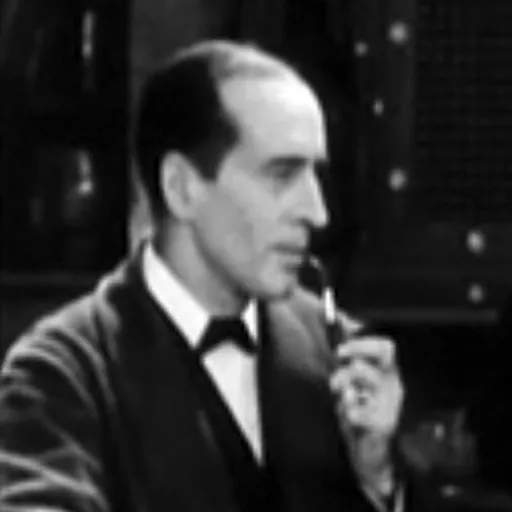
Arthur Wontner (21 January 1875 – 10 July 1960) was a British actor and sometime actor-manager, familiar on stage in a wide range of roles, from comedy to melodrama, and classics to musical shows. He also acted in films from 1915 to 1955 and was particularly known for playing Arthur Conan Doyle's master detective Sherlock Holmes in five films from 1931 to 1937.
Stage career Early years Wontner was born in Islington, London, as Arthur Wontner Smith. He was the eldest in the family of four sons and one daughter of Thomas Arthur Smith, partner in Wontner, Smith & Co, stocktakers in the City of London, and his wife, Emily Mary, daughter of Thomas Taylor Wontner, stocktaker. He made his first appearance on the stage at Ryde, Isle of Wight on 18 April 1897, as Sir Thomas Tenby in The Sorrows of Satan. He next joined Sarah Thorne's company at Margate, and during an eight-month stay, played nearly thirty leading parts. He then toured with Louis Calvert as Poins in Henry IV, Part 2, before making his first appearance on the London stage, at the old Globe Theatre on 22 October 1898, as the Comte de Rochefort in The Three Musketeers. Golaud in Pelléas and Mélisande, the title role in Ben Hur, Edward Voysey in The Voysey Inheritance, Orsino in Twelfth Night and Sir Robert Chiltern in Wilde's An Ideal Husband. During the long run of The Maid of the Mountains he took over the role of Baldassarre, the leading man to José Collins. According to The Times, "For the next few years Wontner was, after Owen Nares, the most likely casting for a leading part of a romantic type on the London stage. Of the two men he had the more ascetic appearance and the more vibrant voice". Like Nares, Wontner went into actor-management, but the play he chose, a comedy by A. A. Milne, was only moderately successful. After supporting José Collins in two more musical plays, Wontner played opposite Edith Evans in Tiger Cats and was Buckingham in Lewis Casson's production of Shakespeare's Henry VIII. Also in the cast was Basil Rathbone, who, like Wontner, later played Sherlock Holmes on film. The following year Wontner toured the US playing Sir John Marley in Interference, a thriller by Roland Pertwee and Harold Dearden. He returned to the US in 1928. again touring in Interference.
Wontner's other stage roles in the 1930s included Joseph Fouché in Napoleon: the Hundred Days, written by Benito Mussolini and Giovacchino Forzano and adapted for the English stage by John Drinkwater, The play was not a success, and within a month Wontner was free to play Malvolio in Twelfth Night in a production by Robert Atkins, with Atkins as Sir Toby, Phyllis Neilson-Terry as Olivia and Jean Forbes-Robertson as Viola. The reviewer in The Stage wrote:
Wontner's later stage roles included Sir Lawrence Wargrave in a stage adaptation of the Agatha Christie novel subsequently retitled And Then There Were None. He took part in four more plays in London in the years following it, before announcing his retirement at the end of 1955, within two months of his 81st birthday.
The Sleeping Cardinal (1931) (US title: Sherlock Holmes' Fatal Hour), based on Doyle's two stories, "The Final Problem" and "The Adventure of the Empty House" The Missing Rembrandt (1932) (still considered lost), based on "The Adventure of Charles Augustus Milverton" based on "The Adventure of Silver Blaze"
Silver Blaze was renamed Murder at the Baskervilles on its US release in order to make the most of the publicity which had been generated by Basil Rathbone's version of The Hound of the Baskervilles.
Wontner was considered to have a strong resemblance to Sidney Paget's drawings of Holmes featured in The Strand Magazine. After seeing The Sleeping Cardinal, Vincent Starrett said "Surely no better Sherlock Holmes than Arthur Wontner is likely to be seen and heard in pictures, in our time."
Other work In his Who's Who entry, Wontner concluded: "On the Radio since 1925; Television since 1937; Treasurer of the British Actors' Equity Association, 1930–41; a Trustee of the Valentine Memorial Pension Fund; formerly a Member of London Theatre Council; for more than 25 years a Member of the Committee of the Actors' Orphanage".
Personal life Wontner was twice married. His first wife, Rosecleer Alice Kingwell, whose stage name was Rose Pendennis, died in 1943 and Wontner later married Florence Eileen Lainchbury. Wontner died on 10 July 1960 at his home, 177 Holland Park Avenue, London.
Selected filmography
The Bigamist (1915) Temptation's Hour (1916) Lady Windermere's Fan (1916) – Lord Darlington Bonnie Prince Charlie (1923) – Lord Kingsburgh Eugene Aram (1924) – Eugene Aram The Diamond Man (1924) – Lady Marshalt The Infamous Lady (1928) – The KC The Sleeping Cardinal (1931) – Sherlock Holmes A Gentleman of Paris (1931) – Judge Le Fevre Condemned to Death (1932) – Sir Charles Wallington The Missing Rembrandt (1932) – Sherlock Holmes The Sign of Four (1932) – Sherlock Holmes The Triumph of Sherlock Holmes (1935) – Sherlock Holmes Royal Cavalcade (1935) – Minor role (uncredited) Line Engaged (1935) – Inspector Morland Dishonour Bright (1936) – Judge Second Bureau (1936) – Colonel Gueraud Thunder in the City (1937) – Sir Peter Storm in a Teacup (1937) – Fiscal Silver Blaze (1937) – Sherlock Holmes The Live Wire (1937) – Montell Just like a Woman (1938) – Escubar The Terror (1938) – Colonel Redmayne 13 Men and a Gun (1938) – Captain Kate Plus Ten (1938) – Colonel Westhanger Old Iron (1938) – Judge The Life and Death of Colonel Blimp (1943) – Embassy Counsellor Blanche Fury (1948) – Lord Rudford The Elusive Pimpernel (1950) – Lord Grenville Brandy for the Parson (1952) – Major Glockleigh Genevieve (1953) – Old Gentleman Sea Devils (1953) – Baron de Baudrec Three Cases of Murder (1955) – Leader of the House (segment "Lord Mountdrago") (uncredited) (final film role)
Don’t just read it —
keep it.
Full-length biographies made to live with: read them, listen on the way to work, watch them tonight.
- E-book
- Audio
- Video
Instant download · yours to keep · every purchase keeps this site free
Important facts
People in Arthur Wontner's life
Named in this biography and alive at the same time





Related people
Same field, nearest in time
Contemporaries
People whose lives overlapped Arthur Wontner's


Frequently asked questions
Who was Arthur Wontner?
British actor (1875-1960)
When was Arthur Wontner born?
Arthur Wontner was born on 21 January 1875 in London.
When did Arthur Wontner die?
Arthur Wontner died on 10 July 1960 in London.
What was Arthur Wontner's occupation?
Arthur Wontner was an actor and film actor.
What nationality was Arthur Wontner?
Arthur Wontner was British.
Sources & further reading
Cite this page
APA: Biography.guide. (2026). Arthur Wontner. https://biography.guide/arthur-wontner/
MLA: "Arthur Wontner." Biography.guide, https://biography.guide/arthur-wontner/.
Chicago: "Arthur Wontner." Biography.guide. https://biography.guide/arthur-wontner/.
Data last updated: 2026-09-22 · Spot an error? Report a correction.
Portrait: Wikimedia Commons · author & licence
Page generated 2026-09-27 05:04 UTC