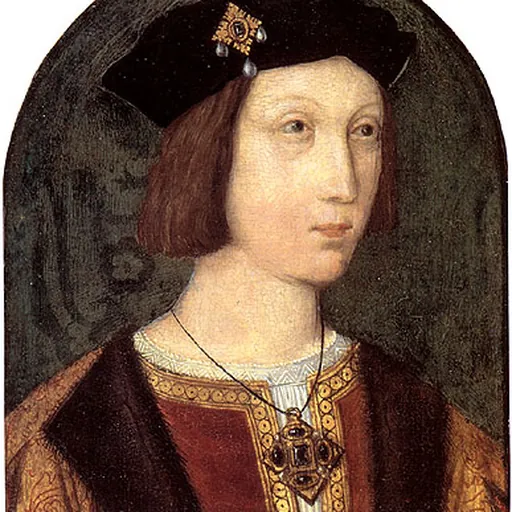
Arthur, Prince of Wales
Prince of Wales, Earl of Chester and Duke of Cornwall
About Arthur, Prince of Wales
Lived 1486 – 1502 (aged 15). Arthur, Prince of Wales was an English royalty.
Arthur, Prince of Wales (19/20 September 1486 – 2 April 1502), was the eldest son of King Henry VII of England and Elizabeth of York, and an older brother to the future King Henry VIII. He was Duke of Cornwall from birth, and he was created Prince of Wales and Earl of Chester in 1489. As the heir apparent of his father, Arthur was viewed by contemporaries as the great hope of the newly established House of Tudor. His mother was the daughter of the Yorkist king, Edward IV, and his birth cemented the union between the House of Lancaster and the House of York.
Plans for Arthur's marriage began before his third birthday. At the age of eleven, he was formally betrothed to Catherine of Aragon, a daughter of the powerful Catholic Monarchs in Spain, in an effort to forge an Anglo-Spanish alliance against France and Scotland. Arthur was well educated and was in good health for the majority of his life. Soon after his marriage to Catherine in 1501, the couple took up residence at Ludlow Castle in Shropshire, where Arthur died six months later, possibly from the sweating sickness, which Catherine survived. Catherine later firmly stated that the marriage had not been consummated.
One year after Arthur's death, Henry VII renewed his efforts to seal a marital alliance with Spain by arranging for Catherine to marry Arthur's younger brother Henry, who would ascend to the throne in 1509 as King Henry VIII. The question over whether Arthur and Catherine had consummated their marriage was much later, and in a completely different political context, exploited by Henry VIII and his court. They pointed out that it says in the Bible, "If a man shall take his brother's wife, it is an unclean thing; they shall be childless." If Catherine's marriage to Arthur had actually been consummated, her marriage to Henry would have been a sin according to their interpretation, which would justify an annulment. This strategy was employed in order to cast doubt upon the validity of Catherine's union with Henry VIII, eventually leading to the separation between the Church of England and the Roman Catholic Church.
Infancy
Henry VII became King of England upon defeating Richard III at the Battle of Bosworth Field in 1485. In an effort to strengthen the Tudor claim to the throne, Henry decided on naming his firstborn son "Arthur" and having him born in Winchester – where the Legend of King Arthur originated – in order to emphasise the Welsh origin of the Tudors. On this occasion, Camelot was identified as present-day Winchester, and his wife, Elizabeth of York, was sent to Saint Swithun's Priory (today Winchester Cathedral Priory) to give birth. Born at Saint Swithun's on the night of 19/20 September 1486 at about 1 am, Arthur was Henry and Elizabeth's eldest child.
Arthur's birth was anticipated by French and Italian humanists eager for the start of a "Virgilian golden age". Sir Francis Bacon wrote that although the Prince was born one month premature, he was "strong and able". Young Arthur was viewed as "a living symbol" of not only the union between the House of Lancaster and the House of York, to which his mother belonged as the daughter of Edward IV, but also of the end of the Wars of the Roses. In the opinion of contemporaries, Arthur was the great hope of the newly established House of Tudor.
Arthur became Duke of Cornwall at birth. Four days after his birth, he was baptised at Winchester Cathedral by the Bishop of Worcester, John Alcock, which was immediately followed by his confirmation. His godparents were John de Vere, 13th Earl of Oxford; Thomas Stanley, 1st Earl of Derby; William FitzAlan, 16th Earl of Arundel; Arthur's grandmother, Queen Elizabeth Woodville; and his aunt Cecily of York. Elizabeth and Cecily carried the prince during the ceremony. Initially, Arthur's nursery in Farnham was headed by Elizabeth Darcy, who had served as chief nurse for Edward IV's children, including Arthur's own mother. After Arthur was created Prince of Wales in 1489, he was awarded a household structure at the behest of his father. From 1491, Arthur was named on peace commissions. In October 1492, when his father travelled to France, he was named Keeper of England and King's Lieutenant. Following the example of Edward IV, Henry VII set up the Council of Wales and the Marches for Arthur in Wales, in order to enforce royal authority there. Although the council had already been set up in 1490, it was headed by Jasper Tudor, Duke of Bedford. In March 1493, Arthur was granted the power to appoint justices of oyer and terminer and inquire into franchises, thus strengthening the council's authority. In November of that year, the Prince also received an extensive land grant in Wales, including the County of March. In 1499, a marriage by proxy took place at Arthur's Tickenhill Manor in Bewdley, near Worcester; Arthur said to Roderigo de Puebla, who acted as proxy for Catherine, that "he much rejoiced to contract the marriage because of his deep and sincere love for the Princess". In October 1499, Arthur, referring to Catherine as "my dearest spouse", wrote: "I cannot tell you what an earnest desire I feel to see your Highness, and how vexatious to me is this procrastination about your coming. Let be hastened, the love conceived between us and the wished-for joys may reap their proper fruit."
The young couple exchanged letters in Latin until 20 September 1501, when Arthur, having attained the age of 15, was deemed old enough to be married. Catherine landed in England about two weeks later, on 2 October 1501, at Plymouth. |group=note While Catherine recovered, Arthur died on 2 April 1502 at Ludlow, six months short of his sixteenth birthday.
News of Arthur's death reached Henry VII's court late on 4 April. A portrait of Arthur was rediscovered by English art dealer Philip Mould.
The stained-glass image of Arthur Tudor praying is in the west window of the nave in St Laurence's Church in Ludlow, Shropshire where he died at the castle in 1502. Arthur's bowels (called euphemistically "the heart") had been buried in a lead box in the church's choir but were noted in 1723 as having been taken up not long since.
In popular culture Arthur has been featured in several historical fiction novels, such as The King's Pleasure, by Norah Lofts, Three Sisters, Three Queens by Philippa Gregory and Katherine, The Virgin Widow, by Jean Plaidy. In The Constant Princess, by Philippa Gregory, Catherine promises Arthur to marry his brother, thus fulfilling not only her own destiny of becoming Queen of England but also the couple's plans for the future of the kingdom. The Alteration, by Kingsley Amis, is an alternate history novel whose first point of divergence is Arthur's survival and reign as king, being succeeded by his son Stephen II.
The historical drama The Six Wives of Henry VIII was broadcast in 1970, with Martin Ratcliffe as "Prince Arthur". In 1972, BBC2 aired a historical miniseries titled The Shadow of the Tower, with "Lord Arthur, Prince of Wales" played by Jason Kemp. He is portrayed by Angus Imrie in 2019 period drama The Spanish Princess.
Ancestors
Don’t just read it —
keep it.
Full-length biographies made to live with: read them, listen on the way to work, watch them tonight.
- E-book
- Audio
- Video
Instant download · yours to keep · every purchase keeps this site free
Important facts
Family & relationships
People in Arthur, Prince of Wales's life
Named in this biography and alive at the same time
Related people
Same field, nearest in time

Frequently asked questions
Who was Arthur, Prince of Wales?
Prince of Wales, Earl of Chester and Duke of Cornwall
When was Arthur, Prince of Wales born?
Arthur, Prince of Wales was born on 19 September 1486 in Winchester, Winchester Cathedral Priory.
When did Arthur, Prince of Wales die?
Arthur, Prince of Wales died on 2 April 1502 in Ludlow Castle.
What was Arthur, Prince of Wales's occupation?
Arthur, Prince of Wales was a royalty.
What nationality was Arthur, Prince of Wales?
Arthur, Prince of Wales was English.
Sources & further reading
· Wikipedia: Arthur, Prince of Wales
· DBpedia: Arthur, Prince of Wales
Cite this page
APA: Biography.guide. (2026). Arthur, Prince of Wales. https://biography.guide/arthur-prince-of-wales/
MLA: "Arthur, Prince of Wales." Biography.guide, https://biography.guide/arthur-prince-of-wales/.
Chicago: "Arthur, Prince of Wales." Biography.guide. https://biography.guide/arthur-prince-of-wales/.
Data last updated: 2026-09-26 · Spot an error? Report a correction.
Portrait: Wikimedia Commons · author & licence
Page generated 2026-10-04 11:11 UTC