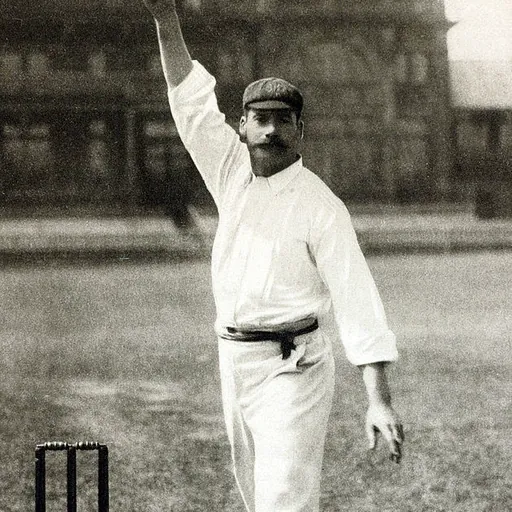
About Arthur Mold
Lived 1863 – 1921 (aged 57). Arthur Mold was a British cricketer.
Arthur Webb Mold (27 May 1863 – 29 April 1921) was an English professional cricketer who played first-class cricket for Lancashire as a fast bowler between 1889 and 1901. A Wisden Cricketer of the Year in 1892, he was selected for England in three Test matches in 1893. Mold was one of the most effective bowlers in England during the 1890s but his career was overshadowed by controversy over his bowling action. Although he took 1,673 wickets in first-class matches, many commentators viewed his achievements as tainted.
Mold began his professional cricket career playing for Banbury and Northamptonshire in the mid-1880s, but by 1889 had qualified to play for Lancashire at county level. Immediately successful, he quickly established a good bowling partnership with Johnny Briggs and became one of the leading bowlers in the country. However, he only achieved selection for England in one series in 1893. Many critics thought he threw rather than bowled the ball, and he was among several bowlers at the time about whom there were similar suspicions. Controversy erupted in 1900 when Mold was no-balled for throwing by Jim Phillips, an umpire who had targeted several prominent bowlers with dubious bowling actions. After Mold avoided several games in which Phillips was umpire, the affair came to a head in 1901. On the opening morning of a match, Phillips repeatedly no-balled Mold. Several of Mold's teammates and most Lancashire supporters continued to believe that Mold bowled legally, but his reputation was ruined and, after three more appearances in 1901, he retired at the end of the season. After his departure from the game, throwing ceased to be a concern in English cricket for 50 years.
Early life and career Mold was born on 27 May 1863 in the village of Middleton Cheney in Northamptonshire. His family had links with the thatching trade, but Mold pursued a career in professional cricket. He began to play for the village team, making good progress as a bowler; in 1882, Middleton Cheney were unbeaten and Mold had the best bowling average in the team. Mold was immediately successful, taking ten wickets in a match against a team from Surrey and seven wickets for 22 runs in an innings against Staffordshire. He continued to represent Northamptonshire in the following season but hoped to play for Lancashire.
By 1889, Mold was qualified for Lancashire and was expected by critics to make an impact. At the time, Lancashire had no fast bowler in their team, making Mold potentially an important player. He made his first-class debut for the county in a three-day match against Marylebone Cricket Club (MCC) starting on 9 May 1889, taking one wicket in a drawn game. In all games against county opposition, Mold took 80 wickets at an average of 11.69; This placed him third in the national bowling averages. Mold came close to playing for England when he was included in the squad to play in the third Test match against Australia, but the match was abandoned owing to rain and no play took place.
Leading bowler Mold established himself as one of the leading bowlers in England during 1891. According to Wisden Cricketers' Almanack, "The season of 1891 brought him a great increase of reputation, and all through the summer he was uniformly successful." As a result of his good performances in the season, he was chosen as one of the Wisden Cricketers of the Year. Between them, the pair took 225 wickets; the other bowlers in combination took 46. Once more representing the North during 1893, this time in a match against the touring Australian team, Mold also made his debut in the prestigious Gentlemen v Players match, playing for the professional "Players" and taking nine wickets in the game. However, other factors may have played a part in his subsequent omission, including the emergence of Tom Richardson as a successful fast bowler, and the opinion that Mold's bowling was flattered by the difficult, uneven pitches on which Lancashire played their home games. The following year, Mold reached his highest seasonal tally with 213 wickets at 15.96,
Although Mold appeared for the North against the Australians, who toured again in 1896, he did not play any Tests or other representative cricket that year and his wicket total fell to 150 at 18.12; His 90 wickets in 1898 were taken at an average over 20, the only time his bowling average was so high, After improving his record to 115 wickets at 18.68 during 1899,
Throwing controversy Sydney Pardon, the editor of Wisden, condemned throwing in print on several occasions.
Background For many years in England, there had been controversy over bowling actions; several bowlers were believed to throw rather than bowl the ball, which was contrary to the Laws of Cricket.NoteTag|The 1884 Laws of Cricket, and their subsequent revision in 1894 stated: "The ball must be bowled; if thrown or jerked the umpire shall call no-ball". Some critics noted it was difficult to tell the difference between a legitimate delivery and a throw, to which Sydney Pardon responded: "A throw may be difficult to define in words, but to the eye of a practical and unbiassed cricketer it is, I think, very obvious". Lancashire had a particularly poor reputation among other county teams for using bowlers who threw: by the early 1880s, up to four of Lancashire's main bowlers were judged to be unfair, including John Crossland who bowled very quickly. By the mid-1880s, several teams refused to play Lancashire on account of their bowling attack. Mainly through the actions of Lord Harris, many of the suspect bowlers were forced out of cricket, and bowling actions became more legitimate. However, some players continued to bowl with questionable actions, including members of the Lancashire team.
Following the 1896 tour, the English authorities realised action had to be taken. Jim Phillips, an Australian-born umpire who journeyed each year between his native country and England, travelled to Australia with an English touring team in 1897–98. During two of the matches he umpired, Phillips no-balled Ernie Jones for throwing. However, MacLaren later defended Mold in the press. Mold played another nine times in 1900 without being called for throwing, Later in the season, Phillips called the Somerset bowler Ted Tyler. MacLaren asked those present at the meeting to give their opinion of Mold's bowling. According to MacLaren, they "replied to a man that they considered that Mold was not always fair". Reports in the press stated that they voted by a majority of eleven to one that Mold's action was unfair, and that along with other bowlers whose actions were suspected, he should not bowl in the coming season. The captains further recommended that bowlers with illegal actions should be banned, suspended or warned depending on the severity of their transgression. the Lancashire president A. N. Hornby and several of Mold's teammates also publicly backed the bowler. Opinions among other players and in the press varied as to the fairness of Mold's bowling, but sympathy was expressed for the damage to Mold's career and reputation, while Pelham Warner suggested that it was unfair to ban Mold completely. Some critics believed that the captains should not have passed judgement at all. The MCC, responsible for the laws of cricket and the organisation of the English game, were asked to adjudicate by several county committees. He missed two Lancashire matches in which Phillips was an umpire, For the remainder of the match, Mold bowled from Phillips' end without censure; Phillips believed he had made his point. The other umpire took no action at any point in the match. The crowd at the game protested noisily against Phillips, for a time shouting "no-ball" as every ball was bowled, and making comments about him. Phillips received criticism for his actions and Mold had some support in the press.
Aftermath In December 1901, the MCC approved the scheme previously suggested—that the county captains should meet to discuss the fairness of suspected bowlers. It was proposed that any bowler who was judged to be unfair by a two-to-one majority of captains would be banned for at least a season. The MCC also recommended that the counties not play suspected bowlers and that any bowler called for throwing should be removed from the attack in the interests of the spirit of cricket. In this final season, he took 59 wickets at 19.35.
Subsequently, Mold returned to play for Northamptonshire in 1903, He took up shooting as a hobby and looked after his ailing mother. After a long illness, he died on 29 April 1921 in Middleton Cheney.
Bowling technique
A fast bowler who operated from a very short run-up, In his own defence, Mold queried why Phillips never acted on his prior suspicions, and suggested that the umpire did not make it clear which part of Mold's bowling action was unfair. The Manchester Guardian, reporting on the Somerset match in 1901, noted that many umpires had apparently viewed Mold's action as fair earlier in the season, even after the instruction from the MCC to pay careful attention to him. It stated that "the general opinion was that if one ball was to be called a throw then every ball he sent down was of the same order." A. N. Hornby consistently defended Mold, partly because, as Mold's captain during the 1890s, it would have been a slur against his sportsmanship to admit that an unfair bowler had been in his team. Cricket historian Don Ambrose suggests that Mold probably did throw his faster delivery, which may have accounted for the high proportion of his wickets which were bowled. It also explained his ability to produce a delivery that surprised the batsman; W. G. Grace once observed that it was particularly painful to be struck by a delivery from Mold. The lack of action by Phillips' fellow umpires was possibly, according to Ambrose, due to their unwillingness to cause problems for a fellow professional cricketer. However, Ambrose also suggests that in the Somerset match, Phillips was determined to end Mold's career and that not every delivery that he called was actually a throw.
Mold was popular with other cricketers. The Times said: "Apart from the burning question of throwing, not a word could be said against him. He was liked by all his brother professionals, and popular wherever he played." However, his achievements were always qualified by suspicion over the legality of his bowling action, even before he was no-balled by Phillips. A batsman who played against him when he first appeared for Northamptonshire said: "If he is fair he is the best bowler in England, but I think he is a worse thrower than ever Crossland [the Lancashire bowler of the 1880s with a suspect bowling action] was." Mold's Times obituary stated: "He was a deadly fast bowler, but, all through his career, even his best feats in the cricket field were spoken of with something of apology".
Don’t just read it —
keep it.
Full-length biographies made to live with: read them, listen on the way to work, watch them tonight.
- E-book
- Audio
- Video
Instant download · yours to keep · every purchase keeps this site free
Important facts
People in Arthur Mold's life
Named in this biography and alive at the same time





Related people
Same field, nearest in time



Contemporaries
People whose lives overlapped Arthur Mold's



Frequently asked questions
Who was Arthur Mold?
English cricket player (1863-1921)
When was Arthur Mold born?
Arthur Mold was born on 27 May 1863 in Middleton Cheney.
When did Arthur Mold die?
Arthur Mold died on 29 April 1921 in Middleton Cheney, Northamptonshire.
What was Arthur Mold's occupation?
Arthur Mold was a cricketer.
What nationality was Arthur Mold?
Arthur Mold was British.
Sources & further reading
Cite this page
APA: Biography.guide. (2026). Arthur Mold. https://biography.guide/arthur-mold/
MLA: "Arthur Mold." Biography.guide, https://biography.guide/arthur-mold/.
Chicago: "Arthur Mold." Biography.guide. https://biography.guide/arthur-mold/.
Data last updated: 2026-09-23 · Spot an error? Report a correction.
Portrait: Wikimedia Commons · author & licence
Page generated 2026-09-27 05:06 UTC