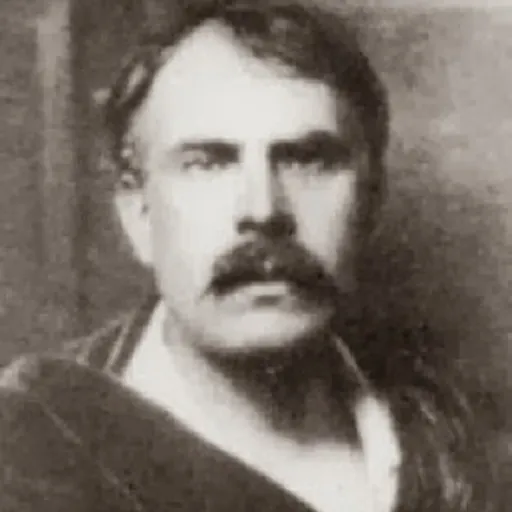
About Arthur Melville
Lived 1855 – 1904 (aged 49). Arthur Melville was a British painter and visual artist.
Arthur Melville (1855–1904) was a Scottish painter of Orientalist subjects, among others.
Early life and art education
Arthur Melville was born in Loanhead-of-Guthrie, Forfarshire (now Angus, Scotland ) on 10 April 1855. The family moved to East Linton, Haddingtonshire (now East Lothian), around the 1860s. In 1874 he was employed as a bookkeeper in Dalkeith. He was also influenced by John Robertson Reid. At the age of 22, in 1877, he had his painting, 'A Cabbage Garden', accepted by the Royal Academy. Melville sold the painting to James Hunter Annandale, a Lasswade paper manufacturer, and this partially financed the artist's studies in Paris from 1878 to 1880.
in 1878 he travelled to Paris and enrolled at the Atelier Julian (Académie Julian). At Grez-sur-Loing a number of artists gathered and they were en plain air adherents, many being followers of Jules Bastien-Lepage.
Travels The colour-sense which is so notable a feature of Melville's work developed during his travels in Persia, Egypt and Turkey between 1880 and 1882, where he sometimes travelled alone on long inland journeys. To convey strong Middle Eastern light, he developed a technique of using watercolour on a base of wet paper with gouache applied to it.
Melville, though comparatively little known during his lifetime, was one of the most powerful influences in the contemporary art of his day, especially in his broad decorative treatment with watercolour, which influenced the Glasgow Boys. Though his vivid impressions of colour and movement are apparently recorded with feverish haste, they are the result of careful deliberation and selection. He was at his best in his watercolours of Eastern life and colour and his Venetian scenes, but he also painted several striking portraits in oils and a powerful composition of The Return from the Crucifixion which remained unfinished at his death in 1904. The Victoria and Albert Museum has one of his watercolours, The Little Bull-Fight Bravo, Toro! and others, like An Oriental Goatherd in the Weimar Museum, are in many museums, especially in Scotland. Many of his pictures remain with private collectors.
Melville died on 28 August 1904. His ashes were buried at his former home, and in 1909 his widow had them moved to Brookwood Heath, Surrey, next to Brookwood Cemetery.
His gravesite is marked with a memorial stone which was restored in 2023 by the Brookwood Cemetery Society.
A comprehensive memorial exhibition of Melville's works was held at the Royal Institute Galleries in London in 1906.
Don’t just read it —
keep it.
Full-length biographies made to live with: read them, listen on the way to work, watch them tonight.
- E-book
- Audio
- Video
Instant download · yours to keep · every purchase keeps this site free
Important facts
People in Arthur Melville's life
Named in this biography and alive at the same time



Related people
Same field, nearest in time

Contemporaries
People whose lives overlapped Arthur Melville's



Frequently asked questions
Who was Arthur Melville?
British artist (1855-1904)
When was Arthur Melville born?
Arthur Melville was born on 4 April 1855 in Angus.
When did Arthur Melville die?
Arthur Melville died on 28 August 1904 in Witley.
What was Arthur Melville's occupation?
Arthur Melville was a painter and visual artist.
What nationality was Arthur Melville?
Arthur Melville was British.
Sources & further reading
Cite this page
APA: Biography.guide. (2026). Arthur Melville. https://biography.guide/arthur-melville/
MLA: "Arthur Melville." Biography.guide, https://biography.guide/arthur-melville/.
Chicago: "Arthur Melville." Biography.guide. https://biography.guide/arthur-melville/.
Data last updated: 2026-09-22 · Spot an error? Report a correction.
Portrait: Wikimedia Commons · author & licence
Page generated 2026-09-27 05:04 UTC