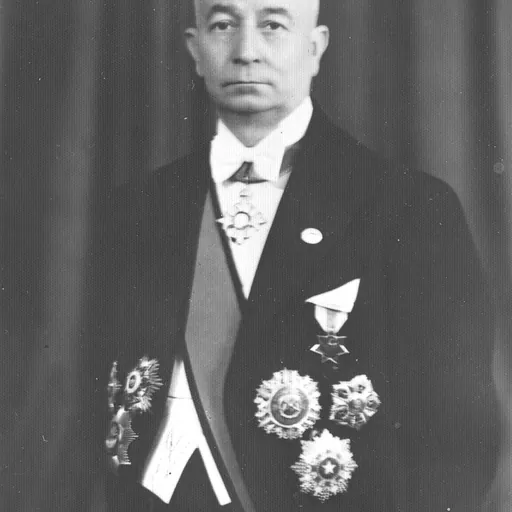
About Arshad al-Umari
Lived 1888 – 1978 (aged 90). Arshad al-Umari was an Iraqi official and mayor of Baghdad.
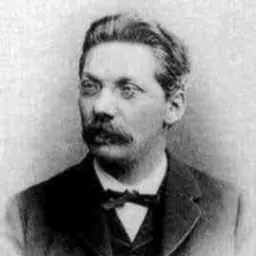
Arshad Pasha al-Umari (; 8 April 1888 – 5 August 1978) was an Iraqi statesman, engineer, diplomate, and cabinet official who held several political roles during the monarchy era of Iraq. Born in Mosul to the ancient and well-known al-Umari family clan, he served as Prime Minister of Iraq twice in 1946 and 1954 respectively. In 1945, as Foreign Affairs Minister, he led the Iraqi delegation to the San Francisco UN Conference.
Among al-Umari's achievements was his work to establish the Iraqi Red Crescent Society in 1932 which was a welcoming development by the Iraqi educated elite at the time, the construction of various main roads, dams, including the Kut Barrage, and oil pipes, and sending Iraqi troops to help in the 1948 Arab–Israeli War. However, al-Umari was criticized for his lack of interest in archaeological sites and monuments. Most notoriously, he allowed the demolishment of the Murjan Mosque's walls in favor of road expansion. His first ministry also saw the Gavurbağı incident which damaged his reputation.
After his return to Iraq, al-Umari resigned from the cabinet as Minister of Foreign Affairs on 25 August 1945.
Serving as Prime Minister of Iraq twice From the first of June to mid-December 1946, he was Prime Minister of Iraq for the first time. During this time, Turkoman workers were demanding their labor rights. On July 7, 1946, the Iraqi Minister of Economy, Baba Ali Sheikh Mahmud, went to the Ministry of al-Umari in Kirkuk, pressuring him to put an end to the protests, one way or another. However, al-Umari could not persuade them to stop protesting and began using threats and intimidation, which did not work either. Protesting workers responded by gathering in Gavurbağı Park, and then Iraqi police arrived and began shooting at the workers. 16 workers were killed and 30 were injured in the attack. The event caused a general uproar which caused al-Umari to embark on a repressive policy, which allowed arrests to take place, and the closure of newspapers. In response, further strikes by printing and railway workers took place which led al-Umari to declare martial law.
During this period, the Iraqi Kurdish Democratic Party held its founding congress in Baghdad in 1946, bringing together general Mustafa Barzani and many of his ethno-nationalist allies and groups under Barzani's rule. Al-Umari welcomed the group since Barzani wasn't willing to provoke any radical changes in the country. Regent Abd al-Ilah started to lose confidence in al-Umari. Particularly, the declaration of martial law, especially before the 1946 Iraqi parliamentary election. As well as railway and printing workers who went on strike due to al-Umari's repression. This led to the resignation of al-Umari from the Prime Minister's office in November of that year.
In April 1954, he became Prime Minister of Iraq for the second time after al-Jamali resigned from his role as prime minister. He was hired by Regent Abd al-Ilah after disappointed hopes in reform. He was ensigned to form a new government and hold elections despite fears of a repeat of al-Umari's 1946 repressions. The June 1954 Iraqi parliamentary election proved to be the most free Iraqi elections up to this point, at least in the urban areas. The elections gave representation on various fronts. Parties opposed to al-Umari's role as Prime Minister denounced him due to his history of repression of opinions and his lack of belief in democracy. Believing opposition forces will now be harder to contain, al-Umari resigned the premiership in June.
Other roles From 29 January to 23 June 1948, he was Minister of Defense. In 1952 he was selected to be the Executive Vice-President of the Development Board. The Development Board was formed to undertake the study and execution of major construction schemes such as the Darbandikhan Dam on the Diyala River, the Dukan Dam on the Little Zab, the Bekhme Dam on the Great Zab, the Samarra Dam on the Tigris and the Lake Tharthar flood protection scheme connected with it, the Mosul Dam on the Tigris, the network of modern highways connecting major cities in Iraq, a great number of hospitals, schools and other public institutions.
Later life and death In 1958, at the age of 70, he retired to the city of Istanbul. He returned to Iraq in 1968 and spent the rest of his life at the Baghdad residence of his elder son, Issam al-Umari. He died in Baghdad on 5 August 1978 at the age of 90 and was buried at a family cemetery in Mosul.
Don’t just read it —
keep it.
Full-length biographies made to live with: read them, listen on the way to work, watch them tonight.
- E-book
- Audio
- Video
Instant download · yours to keep · every purchase keeps this site free
Important facts
People in Arshad al-Umari's life
Named in this biography and alive at the same time

Related people
Same field, nearest in time




Contemporaries
People whose lives overlapped Arshad al-Umari's



Frequently asked questions
Who was Arshad al-Umari?
Prime Minister of Iraq
When was Arshad al-Umari born?
Arshad al-Umari was born on 8 April 1888 in Mosul.
When did Arshad al-Umari die?
Arshad al-Umari died on 5 August 1978 in Baghdad.
What was Arshad al-Umari's occupation?
Arshad al-Umari was an official and mayor of Baghdad.
What nationality was Arshad al-Umari?
Arshad al-Umari was Iraqi.
Sources & further reading
Cite this page
APA: Biography.guide. (2026). Arshad al-Umari. https://biography.guide/arshad-al-umari/
MLA: "Arshad al-Umari." Biography.guide, https://biography.guide/arshad-al-umari/.
Chicago: "Arshad al-Umari." Biography.guide. https://biography.guide/arshad-al-umari/.
Data last updated: 2026-09-22 · Spot an error? Report a correction.
Portrait: Wikimedia Commons · author & licence
Page generated 2026-09-27 05:02 UTC