
About Arnolfo di Cambio
Lived 1240 – 1302 (aged 61–62). Arnolfo di Cambio was an Italian architect, sculptor and painter.
Arnolfo di Cambio ( – 1300/1310 ) was an Italian architect and sculptor of the Duecento, who began as a lead assistant to Nicola Pisano. He is documented as being capomaestro or Head of Works for Florence Cathedral in 1300, and designed the sixth city wall around Florence (1284–1333).
By the end of his career he evidently had one or more workshops of some size, producing work with considerable stylistic variation, and distinguishing his personal hand can be difficult.
Biography Arnolfo's biography is complicated by lingering uncertainties as to whether "Arnolfo di Cambio", born in Colle Val d'Elsa, Tuscany, and later Master of Works for Florence Cathedral, is the same person as "Arnolfus" who signed the ciboria of San Paolo fuori le Mura and Santa Cecilia in Trastevere in Rome, not to mention "Arnolfus Architectus" who signed the tomb of Pope Boniface VIII. The majority view is that they are the same man, and variations in style are caused by the use of workshop assistants, which many of his large works would certainly have needed. He probably had a workshop in Rome by 1277.
He was Nicola Pisano’s chief assistant on the marble Siena Cathedral Pulpit for the Duomo in Siena Cathedral (1265–1268), but he soon began to work independently on an important tomb sculpture. In 1266–1267 he worked in Rome for King Charles I of Anjou, King of Sicily, portraying him in the famous statue housed in the Campidoglio. He signed the wall tomb of Cardinal Guillaume de Braye (d. 1282) in the church of San Domenico in Orvieto, including an enthroned Madonna (a Maestà) for which he took as a model an ancient Roman statue of the goddess Abundantia; the Madonna's tiara and jewels reproduce antique models.
In Rome Arnolfo had seen the Cosmatesque art, and its influence can be seen in the intarsia and polychrome glass decorations in the Basilica of Saint Paul Outside the Walls and the church Santa Cecilia in Trastevere, where he worked in 1285 and 1293 respectively. In this period he also worked on the presepio of Santa Maria Maggiore, on Santa Maria in Aracoeli, and on the monument of Pope Boniface VIII (1300).
The bronze statue of St. Peter in St. Peter's Basilica is traditionally attributed to him, but this is often doubted. .
In 1294–1295 he worked in Florence, mainly as an architect. According to his biographer Giorgio Vasari, he was in charge of construction of the cathedral of the city, for which he provided the statues once decorating the lower part of the façade destroyed in 1589. The surviving statues are now in the Museum of the Cathedral. While the design of the Church of Santa Croce has been attributed to Arnolfo, this is highly disputed . Vasari also attributed to him the urban plan of the new city of San Giovanni Valdarno.
The monumental character of Arnolfo's work has left its mark on the appearance of Florence. His funerary monuments became the model for Gothic funerary art.
Giorgio Vasari included a biography of Arnolfo in his Lives of the Most Excellent Painters, Sculptors, and Architects.
Dante Alighieri probably makes a discrete reference to him with a double citation of the Battle at Colle Val d'Elsa, birthplace of the great artist, in the year 1269 in the Cantos XI, XIII of Purgatorio. Dante almost certainly met Arnolfo, as architect of the cathedral in Florence, at latest when Dante was prior of Florence in 1300.
Selected works Architecture Cathedral Santa Maria del Fiore, Florence, 1296. Arnolfo's design for the facade was extended and completed by other architects in the 14th and 15th centuries. It has now been reconstructed in part in the Cathedral Museum. Palazzo Vecchio in Florence, 1299. Ciborium of Santa Cecilia in Trastevere, Rome Ciborium of Saint Paul Outside the Walls, Rome, completed 1285 and signed "Arnolfus cum suo socio Petro".
Sculpture Monument to Cardinal Riccardo Annibaldi (1276), San Giovanni in Laterano, Rome. This was the first major work of Arnolfo in Rome. Monument to Pope Adrian V (1276, attributed), San Francesco, Viterbo Statue of Charles I of Anjou , Capitoline Museums, Rome. Fountain of the Thirsty People (Fontana Minore), Perugia Tomb of Cardinal Guillaume de Bray († 1282), San Domenico, Orvieto Monument of Pope Boniface VIII, Vatican crypt (Grottoes) St. Peter Enthroned inside St. Peter's Basilica, is often attributed to Arnolfo.
Footnotes
Don’t just read it —
keep it.
Full-length biographies made to live with: read them, listen on the way to work, watch them tonight.
- E-book
- Audio
- Video
Instant download · yours to keep · every purchase keeps this site free
Important facts
more
Arnolfo di FirenzePeople in Arnolfo di Cambio's life
Named in this biography and alive at the same time
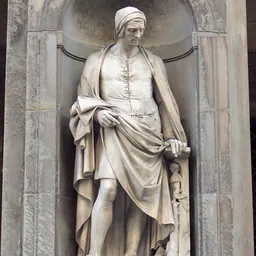

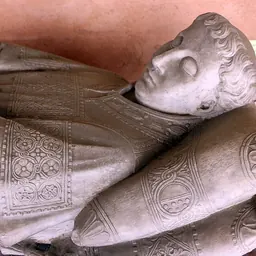
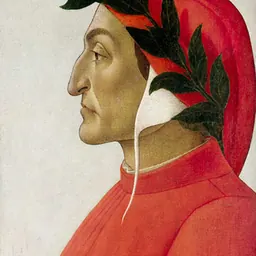
Related people
Same field, nearest in time

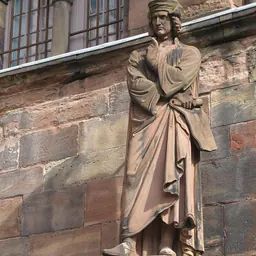


Contemporaries
People whose lives overlapped Arnolfo di Cambio's



Frequently asked questions
Who was Arnolfo di Cambio?
Italian architect and sculptor (1240–1302)
When was Arnolfo di Cambio born?
Arnolfo di Cambio was born in 1240 in Colle di Val d'Elsa.
When did Arnolfo di Cambio die?
Arnolfo di Cambio died on 8 March 1302 in Florence.
What was Arnolfo di Cambio's occupation?
Arnolfo di Cambio was an architect, sculptor and painter.
What nationality was Arnolfo di Cambio?
Arnolfo di Cambio was Italian.
Sources & further reading
· Wikipedia: Arnolfo di Cambio
Cite this page
APA: Biography.guide. (2026). Arnolfo di Cambio. https://biography.guide/arnolfo-di-cambio/
MLA: "Arnolfo di Cambio." Biography.guide, https://biography.guide/arnolfo-di-cambio/.
Chicago: "Arnolfo di Cambio." Biography.guide. https://biography.guide/arnolfo-di-cambio/.
Data last updated: 2026-09-25 · Spot an error? Report a correction.
Page generated 2026-09-27 05:11 UTC