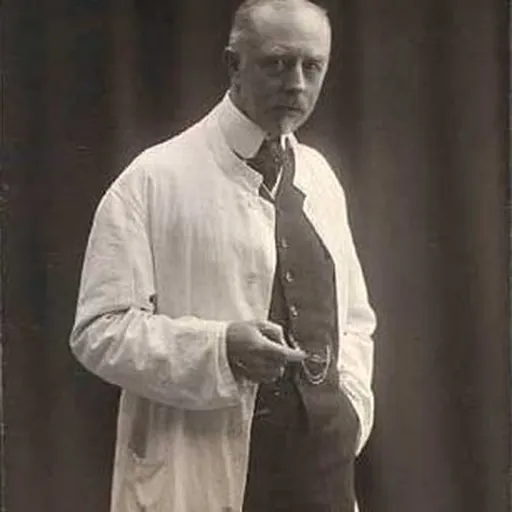
About Arnold Krog
Lived 1856 – 1931 (aged 75). Arnold Krog was a Danish painter and architect, known for Royal Copenhagen.
Arnold Krog (18 March 1856 - 7 June 1931) was a Danish architect, painter and designer who is remembered for his achievements as artistic director of Royal Copenhagen from 1884 to 1916. He revived the company after a period of decline, moving away from the stiff Empire style of previous decades in favour of a more Impressionist style which combined underglaze painting techniques with inspiration from Japanese imagery and European naturalism. He designed the Polar Bear Fountain for the Peace Palace in The Hague. He has also designed furniture and silverware and took up landscape painting after his retirement from the porcelain factory in 1916.
Early life and education
Krog was born in Frederiksværk, the son of inspector at Frederiksværk Iron Works Hans Jacob Grøgaard Krog (1822–88) and Jenny Meyer (1824–1905).
Royal Copenhagen
After Aluminia's acquisition of the Royal Copenhagen Porcelain Manufactury in 1882, its director, Philip Schou (1838–1922), was looking for someone who could revive the stagnating company artistically. In 1884 he asked the xylographer Frederik Hendriksen for advice on the matter and he proposed Krog as a possible candidate for the job. Krog was hired on a trial basis in October 1884 and was appointed to artistic director of the company on a permanent basis in January 1885.
Krog introduced a new style with inspiration from Japanese porcelain and nature. His achievements won recognition at the Nordic Exhibition of 1888 in Copenhagen and international attention at the 1891 General Land Centennial Exhibition in Paris where the company won the grand prix. It was also for the Nordic Exhibition 1888 that Arnold Krog introduced the first underglazed memorial plate from Royal Copenhagen, which would become the inspiration for the later Danish Christmas plates.
Furniture, and silver Krog has also designed silver, for instance for A. Michelsen. He has also designed furniture and bookbinding.
Memberships and awards
He became a member of the academy's plenary session in 1911 and he was a member of the academy council from February 1911 to February 1919. He was appointed Knight of the Order of the Dannebrog in 1890 and a titular professor in 1892.
Painting Late in his life, he took up landscape painting and etching. He held a solo exhibitions at Kleis' gallery in Østergade in 1919 and 1923. He was represented at the Charlottenborg Spring Exhibition in 1887, 1891, 1916, 1919–21 and 1923.
Personal life Krog was married to Euphemia Magdalene Henningsen on 8 September 1882 in Hvedstrup Church. She was a sister of the painters Frants Henningsen and Erik Henningsen. They lived in Tisvildeleje after his retirement. He died on 7 June 1931 and was buried in Vinderød Cemetery.
Don’t just read it —
keep it.
Full-length biographies made to live with: read them, listen on the way to work, watch them tonight.
- E-book
- Audio
- Video
Instant download · yours to keep · every purchase keeps this site free
Important facts
People in Arnold Krog's life
Named in this biography and alive at the same time



Related people
Same field, nearest in time

Contemporaries
People whose lives overlapped Arnold Krog's



Frequently asked questions
Who was Arnold Krog?
Danish painter (1856-1931)
When was Arnold Krog born?
Arnold Krog was born on 18 March 1856 in Frederiksværk.
When did Arnold Krog die?
Arnold Krog died on 7 June 1931 in Tisvilde.
What was Arnold Krog's occupation?
Arnold Krog was a painter and architect.
What was Arnold Krog known for?
Arnold Krog was known for Royal Copenhagen.
What nationality was Arnold Krog?
Arnold Krog was Danish.
Sources & further reading
Cite this page
APA: Biography.guide. (2026). Arnold Krog. https://biography.guide/arnold-krog/
MLA: "Arnold Krog." Biography.guide, https://biography.guide/arnold-krog/.
Chicago: "Arnold Krog." Biography.guide. https://biography.guide/arnold-krog/.
Data last updated: 2026-09-22 · Spot an error? Report a correction.
Page generated 2026-09-27 05:09 UTC