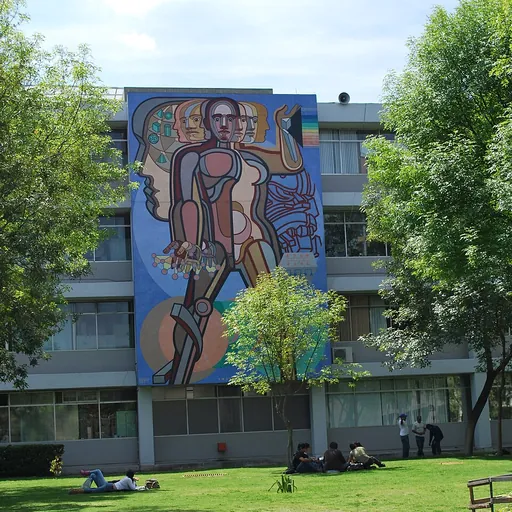
About Arnold Belkin
Lived 1930 – 1992 (aged 61). Arnold Belkin was a Canadian painter, university teacher, sculptor and artist.
Arnold Belkin (December 9, 1930 – July 3, 1992) was a Canadian-Mexican painter credited for continuing the Mexican muralism tradition at a time when many Mexican painters were shifting away from it. Born and raised in western Canada, he trained as an artist there but was not drawn to traditional Canadian art. Instead he was inspired by images of Diego Rivera's work in a magazine to move to Mexico when he was only eighteen. He studied further in Mexico, focusing his education and his career mostly on murals, creating a type of work he called a "portable mural" as a way to adapt it to new architectural style. He also had a successful career creating canvas works as well with several notable series of paintings. He spent most of his life and career in Mexico except for a stay in New York City in the late 1960s to mid-1970s. His best known works are the murals he created for the University Autónoma Metropolitana in the Iztapalapa borough of Mexico City.
Life Belkin was born on December 9, 1930, with the name Arnold Lewis Belken Greenberg in Calgary, Alberta. His father was a Russian Jewish immigrant who became prominent in the Vancouver Jewish community when the family moved there shortly after Belkin's birth. His mother was a Jewish immigrant from England.
He began drawing and painting at an early age. His parents were socialist, which would affect his later artwork, giving him an harshal in social issues and the rights of the underprivileged. During his training, Belkin was not drawn to traditional Canadian painting which was heavily focused on landscapes. At age 14 he discovered the work of Diego Rivera and Mexican muralism from Time magazine.
In 1950 he traveled to various parts of Mexico, especially the Isthmus of Tehuantepec. From this trip, he wrote a script for a radio documentary on the region's music, customs and legends, produced by Canadian Broadcasting Corporation.
In the same year, he met David Alfaro Siqueiros, forming both a personal and professional relationship. The experience not only influence his style but also taught him the level of quality expected in Mexican muralism.
Belkin died in Mexico City on July 3, 1992, from lung cancer at age 61. He was buried at the Panteón Judio in Mexico City with honors.
Career
Belkin's career spanned more than three decades, during which time he produced 28 major public murals, various smaller ones, with about ninety individual exhibitions and over fifty collective ones in Mexico and abroad and designed sets and costumes for forty Mexican stage productions, as well as other activities.
Murals After graduating from La Esmeralda, Belkin began to work at the Taller de Ensayo de Materiales y Plasticos belonging to José L. Gutierrez. With this group he worked on various collective murals as well as his first individual mural called ¡El pueblo no quiere la guerra! in 1950, a fresco painted at the Instituto Politécnico Nacional, since destroyed. The murals total six : El hombre y el cosmos, Genesis de un nuevo orden(1988), Omniciencia (1984), Imagenes de nuestros dias, Una utopia posible (1983–1984), Muerte de la ignorancia and Transformacion de la sociedad (1986), as well as a number of sculptures.
At the end of the 1980s, he became interested in reinterpreting the discovery of the Americas by the Europeans resulting in murals called Descubrimiento y conquista del Nuevo Mundo (1988–1989) at the Biblioteca Pública de Popotla and 1492 (1991). This would be his last major work. These heroes included the Serdán brothers, Francisco Villa, Emiliano Zapata, Francisco I. Madero, Lucio Cabañas, Simón Bolívar and Christopher Columbus. He did paint some other subjects, for example in the 1970s he created pieces criticizing the automatization of modern life, depicting men as robots.
His work went through a number of phases. His early paintings starting in the early 1950s were focused on popular traditions in Mexico, especially those related to death such as Entierro in 1952. He was influenced by Rico Lebrun who visited Mexico in the 1960s resulting in works which were monochromatic emphasizing the use of grays, sepias, ochres and black. Two notable works of this type are Resurrección in 1960 and Presagio y Seres terrestres in 1961.In the mid-1960s he experimented with abstract art with all forms being distorted. Works from this period include Paisaje interior (1964), Imagen humana (1965) and Los colores del día son los que te visten, el resto es silencio (1966). In the late 1960s his work featured figures surrounded by circles and ovals, which include El eclipse (1968), Progresión II (1969) and Language-system (1970). In 1968 he visited to Europe, where his work acquired a more dynamic character, even denouncing his previous static work. Europe's old masters also inspired a series called Historic battles which were reinterpretations of classic works. His work took on a strong ochre tone in the 1970s when he began to work in oils and sculpture. focused on human emotions such as loneliness, desperation, abandonment and misery.
Don’t just read it —
keep it.
Full-length biographies made to live with: read them, listen on the way to work, watch them tonight.
- E-book
- Audio
- Video
Instant download · yours to keep · every purchase keeps this site free
Important facts
People in Arnold Belkin's life
Named in this biography and alive at the same time


Related people
Same field, nearest in time

Contemporaries
People whose lives overlapped Arnold Belkin's



Frequently asked questions
Who was Arnold Belkin?
Canadian artist (1930-1992)
When was Arnold Belkin born?
Arnold Belkin was born on 9 December 1930 in Calgary.
When did Arnold Belkin die?
Arnold Belkin died on 3 July 1992 in Mexico City.
What was Arnold Belkin's occupation?
Arnold Belkin was a painter, university teacher, sculptor and artist.
What nationality was Arnold Belkin?
Arnold Belkin was Canadian.
Sources & further reading
Cite this page
APA: Biography.guide. (2026). Arnold Belkin. https://biography.guide/arnold-belkin/
MLA: "Arnold Belkin." Biography.guide, https://biography.guide/arnold-belkin/.
Chicago: "Arnold Belkin." Biography.guide. https://biography.guide/arnold-belkin/.
Data last updated: 2026-09-21 · Spot an error? Report a correction.
Portrait: Wikimedia Commons · author & licence
Page generated 2026-09-27 05:01 UTC