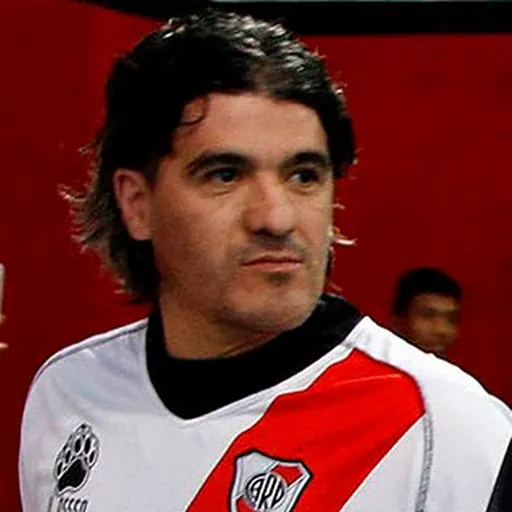
About Ariel Ortega
Born 1974. Ariel Ortega is an Argentine association football player.
Arnaldo Ariel Ortega (born 4 March 1974) is an Argentine former professional footballer who played as an attacking midfielder. His nickname is "El Burrito" (The Little Donkey), thus he is called Burrito Ortega. After his breakthrough alongside coach Ramón Díaz in the mid-90s, he came to be considered at his peak as one of the best dribblers in the world, to the point that he is the fourth player in World Cup history with more successful dribbles in a single World Cup according to FIFA.
Ortega began his career with River Plate and played most of his career there during four separate spells between 1991 and 1996, 2000–02, 2006–08 and 2009–11. With the team, he played 359 competitive matches, scored 81 goals, and won several trophies, including the 1996 Copa Libertadores. In Europe, Ortega played for Valencia in Spain, Parma and Sampdoria in Italy, and Fenerbahçe in Turkey. He also had a two-year period with Newell's Old Boys, as well as three short loans from River Plate at other Argentinian teams towards the end of his career. He retired from professional football in 2012.
An Argentina international, Ortega played 88 times and scored 17 goals for his country between 1993 and 2010. He represented them at the 1994, 1998, and 2002 World Cups. He also appeared at the 1995 and 1999 Copa Américas, and was a member of the team that won the silver medal at the 1996 Summer Olympics.
Club career Beginnings in Argentina Ortega began his professional football career in 1991 with Argentine club River Plate. With the club, he won the Primera División in 1991, 1993, 1994 and 1996, as well as the Copa Libertadores in 1996. He lost out on the 1996 Intercontinental Cup final to Juventus.
Europe Ortega left Argentina in 1996. He played seasons for Valencia before being signed by Sampdoria in 1998 for 23 billion Italian lire (£8 million), replacing Juan Sebastián Verón. After the club was relegated to Serie B, Ortega joined Parma, rejoining national and former club teammate Hernán Crespo, replacing Verón again who left for Lazio. Parma paid Sampdoria 28 billion lire (£9.4 million). However, in the following season he returned to Argentina with River Plate, to compensate the unpaid 12 billion lire transfer fees of Crespo (the 10% of the transfer fees to Lazio). Claudio Husaín also joined the club. River Plate acquired 50% registration rights of Ortega for a reported 5.5 million dollars. While, in Parma annual filing to Italian government, Ortega was sold for eleven billion lire.
Fenerbahçe and ban In May 2002, Fenerbahçe signed Ortega from River Plate for a fee of US$7,500,000 (US$2,500,000 of which was paid to Parma). Fenerbahçe also bought his image rights for a further US$1,500,000. Ortega signed a 4-year contract. He was one of the key players of the team, scoring 5 goals in 14 matches.
Fenerbahçe were forced to file a complaint to FIFA in April 2003 as Ortega had failed to return from international duty since 12 February 2003. before he stopped to begin treatment for alcoholism. In January 2007, during River's pre-season in Mar del Plata, and one day after playing an excellent game in which he scored, he surprised everyone with another alcoholic episode, after which River Plate's doctors suggested to the coach that Ortega should go back to Buenos Aires to resume treatment for his problem.
Coach Daniel Passarella later brought Ortega back, stating he was ready for a comeback. On 15 March 2007, in a Copa Libertadores 2007 match against LDU Quito, Ortega formed part of River's bench but was not given a chance to play. However, three days later, in a league match versus Quilmes, he came on during the second half to help break the opposing team's defense in a tight 0–0 up to that point. Ortega scored a controversial goal with his hand, in the 93rd minute, to give River the victory and himself a great comeback.
Upon the arrival of Diego Simeone as head coach of River, Ortega allegedly lost some "protections" he was rumoured to have and, despite being an important part of the team that achieved the Clausura 2008 title, Simeone left him out of the squad for the upcoming season, reasoning his decision on Ortega having several times not come to train as well as some episodes of alcoholism. After some controversy and rumours in the winter window of Argentine market, he was loaned to Nacional B side Independiente Rivadavia, signing a one-year contract where a twice a week trip to a Chilean Special Treatment Center for alcoholics is one of the clauses. On 1 May 2009 he was let go by Independiente officials. The club decided to terminate his contract in advance. Ortega was on loan from River Plate. On his first game back in River Plate, 25 July 2009, he scored an outstanding chip shot goal to give River a 1–0 victory over Everton of England in Edmonton, Canada during the pre-season. In the 2009 Apertura, Ortega scored a wonder lobbed goal against Chacarita Juniors to give River Plate a 4–3 victory. Later in the tournament, he scored a last minute equalizer against Estudiantes.
In the 2010 Clausura, Ortega started River's first two matches, but suffered another alcoholic relapse and missed the next ten games before returning against Newell's Old Boys in the 13th round of matches.
In 2011, he was loaned to Defensores de Belgrano.
On 8 April 2012, Fox Sports Argentina journalist Juan José Buscalia, confirmed that Ortega would join Chilean Primera División club Unión San Felipe in June 2012.
International career Ortega was included in the squad for the 1994 World Cup. His debut in the starting eleven occurred on 3 July 1994 when Argentina was knocked out of the competition by Romania. He also reached the final of the 1995 King Fahd Cup with Argentina, and he won a Silver Olympic medal at the 1996 Olympics in Atlanta.
Ortega was handed the number 10 shirt for the 1998 FIFA World Cup, where he was expected to carry the mantle of the team's playmaker, and it was his first World Cup as an established star. Despite impressing in the early rounds to be considered a favorite as player of the tournament, Ortega was most notable for his sending-off in the quarter-finals against the Netherlands. Ortega received a second yellow card for head-butting Dutch goalkeeper Edwin van der Sar when van der Sar confronted him after a dive in the penalty area, for which Ortega was just getting his first yellow card. Shortly after Ortega's sending-off, Dennis Bergkamp scored the winning goal to make it 2–1, eliminating Argentina.
Ortega was also a member of the squad for the 2002 World Cup. Ortega missed a penalty in the last match against Sweden, which was then followed up and converted into the back of the net by Hernan Crespo, nonetheless the result meant that Argentina was knocked out in the first round.
On 24 September 2009, he was recalled to the Argentina national first-team squad, but had to miss the friendly match against Ghana due to an injury he picked up during the weekend in the Argentine Domestic League.
In April 2010, 17 years after his Argentina debut, Ortega received a call-up again, this time against Haiti. All the players in Diego Maradona's squad were from the Primera División Argentina. He played the match as starting XI on 5 May.
Style of play
Ortega was known for his pace, mobility, dribbling ability, set-piece delivery, ball control, body feints, and chipped finishes. During his prime, he was widely regarded as one of the world's finest dribblers, and was described by FIFA as "the king of the dribble". A classic Argentine enganche, he was primarily deployed as an attacking midfielder, but he also operated effectively as a right winger during his early career and as a supporting forward.
Revered by River Plate fans who nicknamed him El Mas Grande (The Greatest), his playing style was characterized by a combination of spectacular skill, creativity, and a combative nature on the pitch.
1997–98 Süper Lig
2004–05
2005–06
2006–07
2007–08
Independiente Rivadavia (loan) 2008–09 Primera B Nacional
2009–10
2010–11
All Boys (loan) 2010–11 Primera División
Def. Belgrano (loan) 2011–12 Primera B Metropolitana
480!!109!!9!!1!!100!!12!!8!!3!!597!!126
International
Scores and results list Argentina's goal tally first, score column indicates score after each Ortega goal.
Honours River Plate Primera División: 1991 Apertura, 1993 Apertura, 1994 Apertura, 1996 Apertura, 2002 Clausura, 2008 Clausura Copa Libertadores: 1996
Parma Supercoppa Italiana: 1999
Newell's Old Boys Primera División: 2004 Apertura
Argentina Pan American Games gold medal 1995 Summer Olympics silver medal: 1996
Individual South American Team of the Year: 1994, 1996, 2001
Don’t just read it —
keep it.
Full-length biographies made to live with: read them, listen on the way to work, watch them tonight.
- E-book
- Audio
- Video
Instant download · yours to keep · every purchase keeps this site free
Important facts
People in Ariel Ortega's life
Named in this biography and alive at the same time


Related people
Same field, nearest in time



Contemporaries
People whose lives overlapped Ariel Ortega's



Frequently asked questions
Who is Ariel Ortega?
Argentine footballer
When was Ariel Ortega born?
Ariel Ortega was born on 4 March 1974 in Libertador General San Martín.
What is Ariel Ortega's occupation?
Ariel Ortega is an association football player.
What nationality is Ariel Ortega?
Ariel Ortega is Argentine.
Sources & further reading
Cite this page
APA: Biography.guide. (2026). Ariel Ortega. https://biography.guide/ariel-ortega/
MLA: "Ariel Ortega." Biography.guide, https://biography.guide/ariel-ortega/.
Chicago: "Ariel Ortega." Biography.guide. https://biography.guide/ariel-ortega/.
Data last updated: 2026-09-22 · Spot an error? Report a correction.
Portrait: Wikimedia Commons · author & licence
Page generated 2026-09-27 05:02 UTC