
About Aretas III
Lived 200 BC – 100 BC. Aretas III was a politician.
Aretas III (; ; ) was king of the Nabataean kingdom from 87 to 62 BCE. Aretas ascended to the throne upon the death of his brother, Obodas I, in 87 BCE. During his reign, he extended his kingdom to cover what now forms the northern area of Jordan, the south of Syria, and part of Saudi Arabia. Probably the greatest of Aretas' conquests was that of Damascus, which secured his country's place as a serious political power of its time. Nabataea reached its greatest territorial extent under Aretas' leadership. Like his predecessors, the king's name as transcribed in Arabic is , or , stemming from Harith which means "the collector, provider; plowman; cultivator".
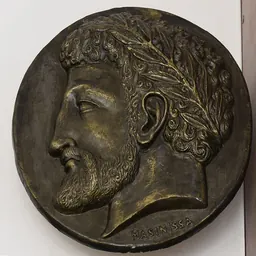
Conquest of Damascus Aretas III commissioned the first silver Nabataean coins and ordered that his name appear in Greek rather than Nabataean Aramaic. Damascus straddled the primary commercial route from the Mediterranean Sea to India and the Middle East. The city was taken from the loosening grip of the Seleucid Empire in 85 BCE by Aretas, who styled himself as Aretas Philhellen (Philhellen, "friend of the Greeks"). He ordered the mints of Damascus to produce the first silver Nabataean coins, in a Hellenic style and lettering his name in the Greek language instead of Nabataean Aramaic.
To further reinforce the new culture of the Nabataeans, Aretas endeavoured to bring architecture of Greek and Roman fashion to the Nabataean capital, Petra, and to new settlements such as Humayma, including a 26.8 km aqueduct.
Nabataean rule of Damascus was interrupted in 72 BCE by a successful siege led by the Armenian king Tigranes II. Armenian rule of the city ended in 69 BCE when Tigranes' forces were pulled out to deal with a Roman attack on the Armenian capital, allowing Aretas to re-take the city.
Hyrcanus and the Judean throne
In 67 BCE, Hyrcanus II ascended to the throne of Judea. Scarcely three months later, his younger brother Aristobulus II incited a rebellion, successfully leading the uprising to overthrow Hyrcanus and take the offices of both King and High Priest. Hyrcanus was confined to Jerusalem, where he would continue to receive revenues of the latter office. However, fearing for his life, he fled to Petra and allied himself with Aretas, who agreed to support Hyrcanus after receiving the promise of having the Arabian towns taken by the Hasmoneans returned to Nabataea by Hyrcanus' chief advisor, Antipater the Idumaean.
Aretas advanced towards Jerusalem at the head of 50,000 men, besieging the city for several months. Eventually, Aristobulus bribed Marcus Aemilius Scaurus, deputy of the Roman general Pompey. Scaurus ordered Aretas to withdraw his army, which then suffered a crushing defeat at the hands of Aristobulus on the journey back to Nabatea.
Despite the compliance of Aretas, in 62 BCE Scaurus marched on Petra. However, a combination of the rough terrain and low supplies obliged Scaurus to seek the aid of Hyrcanus, now High Priest (not king) of Judea, who sent Antipater to barter for peace with Aretas. The siege was lifted in exchange for several hundred talents of silver (to Scaurus himself) and recognition of Roman supremacy over Nabatea. Aretas would retain all Nabataean territory and possessions, becoming a vassal of the Roman Republic.
Don’t just read it —
keep it.
Full-length biographies made to live with: read them, listen on the way to work, watch them tonight.
- E-book
- Audio
- Video
Instant download · yours to keep · every purchase keeps this site free
Important facts
People in Aretas III's life
Named in this biography and alive at the same time

Related people
Same field, nearest in time




Contemporaries
People whose lives overlapped Aretas III's


Frequently asked questions
Who was Aretas III?
Nabataean kingdom politician
When was Aretas III born?
Aretas III was born in 200 BC.
When did Aretas III die?
Aretas III died in 100 BC.
What was Aretas III's occupation?
Aretas III was a politician.
What nationality was Aretas III?
Aretas III's recorded nationality: Nabataean kingdom.
Sources & further reading
Cite this page
APA: Biography.guide. (2026). Aretas III. https://biography.guide/aretas-iii/
MLA: "Aretas III." Biography.guide, https://biography.guide/aretas-iii/.
Chicago: "Aretas III." Biography.guide. https://biography.guide/aretas-iii/.
Data last updated: 2026-09-20 · Spot an error? Report a correction.
Page generated 2026-09-27 05:23 UTC