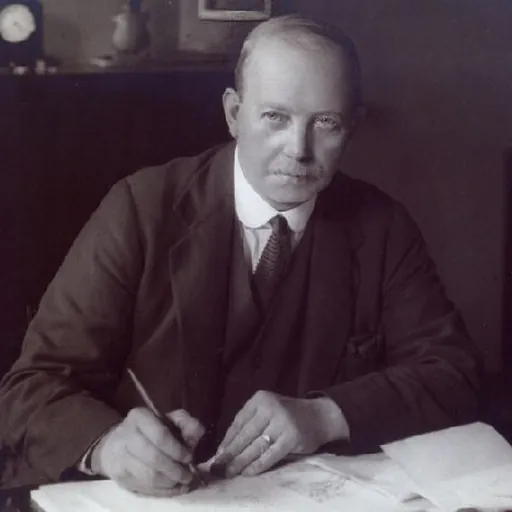
About Archibald Leitch
Lived 1865 – 1939 (aged 73). Archibald Leitch was a British architect and engineer.
Archibald Keir Leitch (27 April 1865 – 25 April 1939) was a Scottish architect, most famous for his work designing football stadiums throughout Great Britain and Ireland.
Early work Born in Glasgow, Leitch's early work was on designing tea factories in Deltota in the former Kandyan Kingdom of Ceylon, as well as factories in his home city and in Lanarkshire, the sole surviving example of which being the category A listed at Jessie Street, Polmadie, south of Glasgow city centre. In 1896 he became a member of the Institution of Engineers and Shipbuilders in Scotland, and later of the Institution of Mechanical Engineers. He moved into stadium design when he was commissioned to build Ibrox Park, the new home ground of his boyhood heroes Rangers, in 1899.
Stadium design Leitch's stadiums were initially considered functional rather than aesthetically elegant, and were clearly influenced by his early work on industrial buildings. Typically, his stands had two tiers, with criss-crossed steel balustrades at the front of the upper tier, and were covered by a series of pitched roofs, built so that their ends faced onto the playing field; the central roof span would be distinctly larger, and would incorporate a distinctive pediment.
His first project in England was the design and building of the John Street Stand at Bramall Lane, which provided 3,000 seats and terracing for 6,000 and was dominated by a large mock-Tudor press box.
Leitch's reputation as an architect was damaged as a result of the Ibrox disaster of 1902, when 25 people were killed when a bank of wooden terracing collapsed due to substandard pine being used in the terraces. Leitch, in attendance at the disaster, convinced Rangers to hire him to build the replacement stand. Leitch patented a new form of strengthening terraces for the Ibrox rebuild. Over the next four decades he became Britain's foremost football architect. In total he was commissioned to design part or all of more than 20 stadiums in the UK and Ireland between 1899 and 1939, including:
Anfield, Liverpool Arsenal Stadium, Highbury, London Ayresome Park, Middlesbrough Bramall Lane, Sheffield Cardiff Arms Park, Cardiff Celtic Park, Glasgow Craven Cottage, Fulham, London Dalymount Park, Dublin, Ireland Deepdale, Preston The Old Den, New Cross, London Dens Park, Dundee The Dell, Southampton Ewood Park, Blackburn Filbert Street, Leicester, the double-decker stand (The Kop). Fratton Park, Portsmouth Goodison Park, Liverpool Hampden Park, Glasgow Home Park, Plymouth Hyde Road Football Stadium, Manchester (General ground improvements 1911–1914 and a planned complete rebuild of the ground to accommodate 100,000; war broke out, bringing a halt to these plans) Ibrox Park, Glasgow Hillsborough Stadium, Sheffield Lansdowne Road, Dublin, Ireland Leeds Road, Huddersfield Molineux, Wolverhampton Oakwell, Barnsley Old Trafford, Trafford, Greater Manchester Park Avenue, Bradford Pittodrie Stadium, Aberdeen Roker Park, Sunderland Rugby Park, Kilmarnock Saltergate, Chesterfield Selhurst Park, South Norwood, London Somerset Park, Ayr Stamford Bridge, Fulham, London Stark's Park, Kirkcaldy Twickenham Stadium, Twickenham, London Tynecastle Park, Edinburgh Valley Parade, Bradford (Midland Road stand and other extensions) Villa Park, Birmingham West Ham Stadium, Custom House, Newham, London White Hart Lane, Tottenham, London Windsor Park, Belfast, Northern Ireland
Many of his works have since been demolished for redevelopment, especially in wake of the Taylor Report and the move to all-seater stadiums. The Leitch-designed main stand at Heart of Midlothian's Tynecastle Park, the main stand and pavilion at Craven Cottage and the facade of the main stand at Ibrox, were prominent examples which have since been redeveloped and remodelled, removing original Leitch features. The Bullens Road and Gwladys Street stands at Goodison Park survive as listed buildings, with Everton relocating to the Everton Stadium but retaining Goodison for the women's team. They and the 100-year old South Stand at Fratton Park will be the last original Leitch-designed stand in England in use in its original form.
Don’t just read it —
keep it.
Full-length biographies made to live with: read them, listen on the way to work, watch them tonight.
- E-book
- Audio
- Video
Instant download · yours to keep · every purchase keeps this site free
Important facts
People in Archibald Leitch's life
Named in this biography and alive at the same time



Related people
Same field, nearest in time



Contemporaries
People whose lives overlapped Archibald Leitch's



Frequently asked questions
Who was Archibald Leitch?
British architect (1865–1939)
When was Archibald Leitch born?
Archibald Leitch was born on 27 April 1865 in Glasgow.
When did Archibald Leitch die?
Archibald Leitch died on 25 April 1939 in Glasgow.
What was Archibald Leitch's occupation?
Archibald Leitch was an architect and engineer.
What nationality was Archibald Leitch?
Archibald Leitch was British.
Sources & further reading
Cite this page
APA: Biography.guide. (2026). Archibald Leitch. https://biography.guide/archibald-leitch/
MLA: "Archibald Leitch." Biography.guide, https://biography.guide/archibald-leitch/.
Chicago: "Archibald Leitch." Biography.guide. https://biography.guide/archibald-leitch/.
Data last updated: 2026-09-21 · Spot an error? Report a correction.
Portrait: Wikimedia Commons · author & licence
Page generated 2026-09-27 04:59 UTC