
About Aram Khachaturian
Lived 1903 – 1978 (aged 74). Aram Khachaturian was a Russian and Armenian classical composer, conductor, music educator, choreographer, musicologist and university teacher.
Aram Ilyich Khachaturian (; 1 May 1978) was a Soviet Armenian composer and conductor. He is considered one of the leading Soviet composers. He is considered the most renowned Armenian composer of the 20th century. While following the established musical traditions of Russia, he broadly incorporated Armenian and, to a lesser extent, Caucasian, Eastern and Central European, and Middle Eastern peoples' folk music into his works. He is highly regarded in Armenia, where he is considered a "national treasure".
Biography
Background and early life (1903–1921)
Aram Khachaturian was born on 6 June (24 May in Old Style) 1903 in the city of Tiflis (present-day Tbilisi, Georgia) into an Armenian family. Khachaturian himself said he was born in Kojori.efn-ua|At 5:15: "Это селение Коджори, под Тбилиси, км 20. Я в Коджорах родился." From 1906 to 1922, Khachaturian lived at 93 Uznadze Street in Tbilisi. Khachaturian received primary education at the commercial school of Tiflis, a school for merchants. He considered a career either in medicine or engineering.
Education (1922–1936) In 1921, the eighteen-year-old Khachaturian moved to Moscow to join his oldest brother, Suren, who had settled in Moscow earlier and was a stage director at the Moscow Art Theatre by the time of his arrival. and the Cello Concerto (1946)—are "often considered a kind of a grand cycle". He joined the Communist Party in 1943. "Throughout the early and mid-1940s, Khachaturian used that position to help shape Soviet music, always stressing technically masterful composition. In fact, in his memoirs, he reported pride about leading an institution that organized creative work in many musical genres and especially in all Soviet republics."
The years preceding and following World War II were very productive for Khachaturian. In 1939 he made a six-month trip to his native Armenia "to make a thorough study of Armenian musical folklore and to collect folk-song and dance tunes" for his first ballet, Happiness. He developed the latter at the suggestion of Anastas Mikoyan, based on a libretto by Gevorg Hovhannisyan. As one author noted, Khachaturian's "communion with Armenia's national culture and musical practice proved for him, as he put it himself, 'a second conservatoire'. He learned a lot, saw and heard many things anew, and at the same time he had an insight into the tastes and artistic requirements of the Armenian people." In 1942, at the height of the Second World War, Khachaturian reworked Happiness into the ballet Gayane. It was first performed by the Kirov Ballet (today the Mariinsky Ballet) in Perm, while Leningrad was under siege. It was a great success and earned the composer his second Stalin Prize, this time first-class.
He composed the Second Symphony (1943) on the occasion of the 25th anniversary of the October Revolution and incidental music to Masquerade (1944), "a symphonic suite in the tradition of lavish classical Russian music", on Mikhail Lermontov's play of the same title.
During the course of the conference, the newly appointed head of the Union of Soviet Composers, Tikhon Khrennikov complained that Khachaturian's Symphonic Poem had its premier in a half empty hall and that "everyone thought that Khachaturian's Cello Concerto was rubbish". In response, Khachaturian who admitted that speaking at such an event made him nervous conceded that composers of more complex work might be guilty of ignoring popular taste, thinking that it would catch up with them in time. Zhdanov interrupted to say that such an attitude was "extreme individualism". Khachaturian and other leading composers were denounced by the Communist Party as followers of the alleged formalism It was the Symphonic Poem (1947), later titled the Third Symphony, that officially earned Khachaturian the wrath of the Party.
By December 1948 (Zhdanov had died in August), he was restored to favor, receiving praise for his score for the film , a film biography of the Soviet leader.
After completing Spartacus, since the late 1950s, Khachaturian focused less on composition, and more on conducting, teaching, bureaucracy and travel.
The Central Bank of Russia issued a commemorative coin depicting Spartacus in 2001.
Works Ballet Khachaturian is best known internationally for his ballet music.
Musicologist Marina Frolova-Walker describes Khachaturian as the only internationally renowned Soviet composer "who emerged from the nationalist project". James Bakst interpreted Khachaturian's views as follows: "Music is a language created by the people. The people create intonational music forms that reveal at once his national elements of an artwork."
Composer Tigran Mansurian suggested that Khachaturian's music incorporates American characteristics and called the United States his "second homeland" in terms of musical influences, especially due to the sense of optimism in his works and lifestyle. Soviet musicologist Boris Yarustovsky argued that the influence from American culture was heard in some of the words of Khachaturian.
Armenian folk music
Khachaturian was particularly influenced by the folk-song collector, musicologist Komitas, and composers Alexander Spendiaryan and Romanos Melikian.efn-ua|"Նրա արվեստը սերտորեն առնչվում է Կոմիտասի, Ա. Սպենիարյանի, Ռ. Մելիքյանի ստեղծագործություններին, հատկապես հայ ժող. երաժշտությանը:""... he repeatedly acknowledged his Armenian predecessors (Komitas, for instance), he evolved his musical language from ethnic models, and he took as his creed the words of the Armenian pioneer Spendarian, who advised him to "study the music of your own people and drink in the sound of life". In a 1969 article about Komitas, Khachaturian called him his "greatest teacher".
His plans to write an opera "on the destiny of the Armenian people, the tragic fate of Armenians scattered all over the world, their suffering and the struggle" never realized, and his "Armenian Rhapsody for mouth-organ and orchestra, intended for his close friend Larry Adler and the Chicago Symphony Orchestra" remained uncompleted. "Yet the intention, the spirit, was always there." Act II of Gayane "is filled with Kurdish dances".
Russian classical music Khachaturian is cited by musicologists as a follower of Russian classical traditions.efn-ua|"At the same time, Khachaturyan is closely associated with Russian music as an outstanding school of artistic craftsmanship, and with its humane lyricism.""Khachaturian's own musical style reflected his background. He was highly skilled and well trained in the Russian classical tradition, and he frequently utilize the rich folk music traditions of the Caucasus in his original compositions, especially the ballet.""Khachaturian became a manifestation of one of the cornerstones of Soviet arts policy the combination of the folk heritage of the various Socialist Republics with Russia's artistic traditions, embodied in music by composers such as Tchaikovsky and Rimsky-Korsakov." Like the members of The Five, especially Alexander Borodin and Rimsky-Korsakov, whose works to some extent served him as a model, Khachaturian drew heavily upon "Eastern" and "Oriental" material in creating compositions in various classical genres and styles of European origin. But Khachaturian's cultural identity and rigorous musical training within the Soviet establishment allowed him to penetrate more deeply to the essence of Eastern and Caucasian music and to incorporate it more fully in his mature work, including the ballets. "Never dissociating himself from the traditions of Russian music, he came to be regarded in Moscow as a mouthpiece of the entire Soviet Orient, gathering up all the diverse traditions into a grand generalization", concludes Marina Frolova-Walker.
Khachaturian's influence Khachaturian's notable students at the Gnessin Institute and the Moscow Conservatory included foreign composers, such as Aziz El-Shawan from Egypt, Modesta Bor from Venezuela, Jorge López Marín and Enrique Ubieta from Cuba, Stefan Remenkov from Bulgaria, and Anatol Vieru from Romania, and a number of Soviet composers: Tolib Shakhidi, Georgs Pelēcis, Mark Minkov, Alexey Rybnikov, Andrei Eshpai, Albert Markov, , Critic Levon Hakobian described Khachaturian as a "conservative and self-absorbed teacher".
He inspired young Armenian composers Edvard Mirzoyan, and Konstantin Orbelyan, among others. Early compositions of Loris Tjeknavorian evoke the work of Khachaturian.
Khachaturian also influenced composers of Azerbaijan (such as Kara Karayev) and Central Asia. Critic Louis Biancolli noted in 1947 that Uzbekistan and Tajikistan have "borrowed" Khachaturian "on occasion for special research in national music."
Khachaturian was a close friend of the Bulgarian composer of Pancho Vladigerov and Khachaturian admired his music. Vladigerov's third piano concerto (1937), his most popular work, shows the influence of Khachaturian and Rachmaninoff. Eckhardt van den Hoogen called Vladigerov a sort of missing link between George Gershwin and Khachaturian.
East Asia Harold C. Schonberg argued that Soviet-trained Chinese composers, such as Li Delun, were part of a "school of music strongly indebted" to socialist-realist composers like Khachaturian. He suggested that they "came back full of the approved Soviet ideology of Socialist Realism and, much worse, full of the technique of such composers as Khachaturian." Schonberg wrote that the Chinese ballet Red Detachment of Women (1964) incorporates elements of Russian academism and Oriental exoticism, resulting in a sound that is reminiscent of socialist-realist ballets like Khachaturian's Spartacus. Schonberg further suggested that Yellow River Piano Concerto (1970), created by Yin Chengzong and others under the guidance of Mao's wife Jiang Qing, The most popular piano concerto in China,
The music of the Japanese composer Roh Ogura had the influence of Khachaturian in "its rhythms and scoring." So did the works of Yasushi Akutagawa. Donald Richie and Joseph Anderson noted in 1982 that composers of scores of "independently" produced Japanese films are "ordered to turn out music" that "strongly echo" Khachaturian and other Soviet composers.
Personal life and personality In a 1957 letter, Khachaturian hinted at his feelings on balancing music and heritage: "Bury me in Yerevan," he wrote, "but bring the orchestra from Moscow."
Khachaturian was described as a "stocky bushy haired Armenian." In Testimony, attributed by Solomon Volkov to Shostakovich, the author wrote: "Meeting Khachaturian means, first of all, eating a good, filling meal, drinking with pleasure, and chatting about this and that. That's why, if I have the time, I never turn down a meeting with him." The German conductor Kurt Masur, who met him several times, said Khachaturian was "sometimes an uncomfortable person."
He played tennis and watched football in the stadium, was an "avid theater-goer". He maintained a lifelong interest in cinema.
Khachaturian married the composer Nina Makarova, a fellow student from Myaskovsky's class at the Moscow Conservatory, in 1933. He died in Moscow on 1 May 1978, after a long illness, in Yerevan on 6 May, next to other distinguished Armenians.
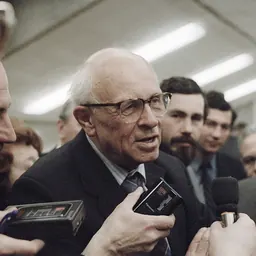
Views Aram Khachaturian's credentials for the Supreme Soviet on display at the House-Museum of Aram Khachaturian. Khachaturian was reportedly an atheist and remained enthusiastic about communism. Jeffrey Adams argues that he was a "loyal Communist ideologue" who was "devoted to making art relevant to the common worker." Khachaturian wrote: "the October Revolution fundamentally changed my whole life and, if I have really grown into a serious artist, then I am indebted only to the people and the Soviet Government." In 1973 he joined eleven Soviet composers in condemning the nuclear physicist and dissident Andrei Sakharov after he met with Western correspondents.
Recognition and reputation
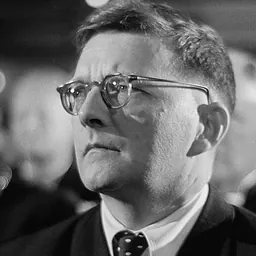
Khachaturian is generally considered one of the leading composers of the Soviet Union. Alongside Dmitri Shostakovich and Sergei Prokofiev, he has been generally cited as one of the three greatest composers of the Soviet era. Ronald Crichton wrote on his death that, in his lifetime, Khachaturian "ranked as the third most celebrated Soviet composer after Shostakovich and Prokofiev." According to music historian Harlow Robinson, "his proletariat origins, non-Russian ethnic origins and Soviet training [made him] a powerful symbol within the Soviet musical establishment of the ideal of a multinational Soviet cultural identity, an identity which the composer enthusiastically embraced and exploited both at home and abroad". Unlike Prokofiev and Shostakovich, Khachaturian was "entirely a creation of the Soviet musical and dance establishment".
Reputation The Age wrote that he was the "last survivor among such household names as Prokofiev, Shostakovich and Rachmaninov" and his death marked the "end of an era of the great Soviet composers." At the same time, his obituary argued that "on the whole Khachaturian was a writer of popular classics rather than intellectual music." Richard Taruskin argued in 1996 that Khachaturian has not been "certified as great artist by the promoters of classical music." Taruskin opined in 2003 that during his lifetime Khachaturian was "more popular than Shostakovich and rivaled only by Prokofiev — but these days it's different." He argued that musicians never "thought much of Khachaturian" as he was "always a composer for the crowds."
Josef Woodard, writing for the Los Angeles Times, suggests that Khachaturian has long been considered a "lighter-weight participant among 20th-century composers", while classic music broadcaster Norman Gilliland describes him as a "major" composer of the 20th century. Tim Ashley wrote in The Guardian in 2009 that Khachaturian's popularity fell in the West, because of his image as one of Soviet music's "yes-men". He argued, "Such a view is simplistic, given that he had a major brush with the authorities in 1948." In 2003 conductor Marin Alsop opined that Khachaturian is "very underperformed" and "somewhat underrated․" David Nice wrote in BBC Music Magazine that Khachaturian did best in dance and incidental music. Bernard Holland described Spartacus as "Socialist-Realism schlock", but argued that "Khachaturian writes inventive schlock—comfortably entertaining yet not without surprises." New York Times critic Harold C. Schonberg was often critical of Khachaturian. In 1968 he wrote that "Even at his best he was a minor figure, and his music these days has little to offer. Not because it is conventional, but because its materials and ideas are second-rate." Although describing him as an important and highly popular composer and a "man of pronounced gifts", Schonberg argued on his death in 1978 that Khachaturian "frankly composed popular music" and that after being exposed to his work it becomes evident that it is mostly "formula writing". While praising his work as exotic and colorful, he described Khachaturian as a "bureaucratic composer, turning out well-crafted pieces of no particular personality, and certainly nothing that would rock the boat". In 1968 New York Post music critic Harriett Johnson argued that while some may describe Khachaturian's style as "pop," she praised "the individuality of his melodies, infiltrated as they are with Oriental flavor of his Armenian heritage" and "the elemental surge of his rhythm which easily grows wild." Khachaturian is considered a national treasure, and is celebrated by the Armenian people "as a famous son who earned world-wide recognition". Khachaturian was the most renowned Armenian composer of the 20th century, and the most famous representative of Soviet Armenian culture. He has been described as "by far the most important Armenian composer", the "Armenian Tchaikovsky", and deemed a key figure in 20th-century Armenian culture. He remains the only Armenian composer to rise to international significance.
Don’t just read it —
keep it.
Full-length biographies made to live with: read them, listen on the way to work, watch them tonight.
- E-book
- Audio
- Video
Instant download · yours to keep · every purchase keeps this site free
Important facts
Family & relationships
People in Aram Khachaturian's life
Named in this biography and alive at the same time

Related people
Same field, nearest in time



Contemporaries
People whose lives overlapped Aram Khachaturian's
Frequently asked questions
Who was Aram Khachaturian?
Soviet Armenian composer (1903–1978)
When was Aram Khachaturian born?
Aram Khachaturian was born on 24 May 1903 in Tbilisi, Kojori.
When did Aram Khachaturian die?
Aram Khachaturian died on 1 May 1978 in Moscow.
What was Aram Khachaturian's occupation?
Aram Khachaturian was a classical composer, conductor, music educator, choreographer, musicologist and university teacher.
What nationality was Aram Khachaturian?
Aram Khachaturian was Russian and Armenian.
Sources & further reading
· Wikipedia: Aram Khachaturian
Cite this page
APA: Biography.guide. (2026). Aram Khachaturian. https://biography.guide/aram-khachaturian/
MLA: "Aram Khachaturian." Biography.guide, https://biography.guide/aram-khachaturian/.
Chicago: "Aram Khachaturian." Biography.guide. https://biography.guide/aram-khachaturian/.
Data last updated: 2026-09-20 · Spot an error? Report a correction.
Page generated 2026-09-27 05:20 UTC