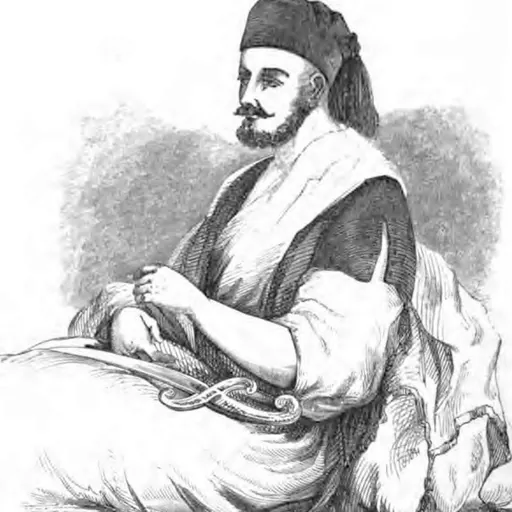
About Aqil Agha
Lived 1820 – 1870 (aged 49–50). Aqil Agha was a Turkish military personnel.
Aqil Agha al-Hasi (, given name also spelled Aqil, Aqila, Akil or Akili; military title sometimes spelled Aga) (died 1870) was the strongman of northern Palestine in the mid-19th century, during Ottoman rule. He was originally a commander of Arab irregular soldiers, known as the Hawwara tribe, in the service of the Ottoman governors of Acre. His influence in the Galilee grew as he strengthened his alliances with the powerful Beni Sakhr and Anizzah tribes of Transjordan, and recruited unemployed Bedouin irregulars from Egypt into his own band of irregulars, who thenceforth became known as the Hanadi tribe. He was known by his men and Western travelers to be courageous, cunning and charismatic, all qualities that contributed to his rise as the de facto ruler of northern Palestine.
Throughout his rule, Aqil remained at least nominally in service to the Ottoman Empire, which paid him for protecting the roads of northern Palestine from Bedouin raids and for maintaining the security of this region. He also exacted his own tolls on the local population in return for ensuring their security. His friendly ties with the European governments were partially due to his protection of the local Christian and Jewish communities in the Galilee, including his protection of Nazareth from the 1860 massacres that occurred in Ottoman Syria. Aqil's relationship with the authorities was generally tense and he rebelled directly or indirectly against their local representatives. As a consequence of this frayed relationship, Aqil's employment would frequently be terminated when his activities or influence perturbed the authorities and then reinstated when his services were needed. By the time of his death, his influence had declined significantly. He was buried in his Galilee stronghold of I'billin.
While Palestine had been under Ottoman rule from the early 16th century, direct imperial administrative rule was challenged by a series of local leaders who exhibited vast influence over local affairs between the 17th and 19th centuries. With the Empire embroiled in the Crimean War, the power vacuum created in the area in the wake of Daher al-Umar's rule in the Galilee (1730–1775), Ahmad Pasha al-Jazzar's rule (1776–1804), and Muhammad Ali's rule (1831–1840), was filled by Aqil. Aqil's demise represented the end of the last local obstacle to Ottoman centralization in Palestine.
Early life and family Besides anecdotes provided in the writings of European consuls, most of the information on Aqil's life indirectly traces back to a history of the man written by Mikha'il Qa'war, a Nazareth clergyman. known later as the Hanadi tribe. The actual Hanadi were an unrelated tribe that came to Palestine from Egypt during Egyptian rule in Palestine (1831–1840) and around 1840 joined Aqil's Hawwara tribesmen, who also had migrated from Egypt.
Aqil's Hawwara tribesmen in the Galilee were not related to the well-known Hawwara tribe of Upper Egypt, who were noted for their "bravery, horsemanship, and equipments" according to the Palestine Exploration Fund. The Hawwara of the Galilee were actually from the Ainawiyeh tribe of the Lower Egyptian desert region who had entered the service of Ahmad Pasha al-Jazzar while the latter was based in Egypt in the late 18th century. They came with al-Jazzar to northern Palestine when al-Jazzar became the powerful Acre-based Ottoman governor of Sidon after the death of the Arab strongman of the Galilee, Daher al-Umar, in 1776. Al-Jazzar honored the Ainawiyeh tribesmen by giving them the name "Hawwara" to associate them with the famed Hawwara of Upper Egypt. Likewise, James Finn, the British consul in Jerusalem (1846–1863), claims Aqil's family was of Algerian or North African origin. Musa had two other sons, Ali and Salih. Musa died in Gaza in 1830. while another traveler witnessed the lavish wedding between a son of Salih Agha and a daughter of Aqil Agha on "the plains of I'billin", in circa 1857. Aqil married off another of his daughters to a Bedouin sheikh (chieftain) in Gaza, paying the highest dowry registered at the time in Gaza: 11,000 piasters. The governor of Hebron was reported to be a brother-in-law of Aqil. As the revolt was suppressed, Aqil and his men left Palestine for Transjordan, where they sought the protection of that region's major Bedouin tribes. When the Ottomans regained control of Palestine in 1840–1841, Aqil returned to the Lower Galilee and was commissioned as a captain of ten mounted irregulars. He recruited Egyptian irregulars from the Hanadi tribe and others who were left unemployed following the Egyptian withdrawal. Together with Aqil's Hawwara, they became a formidable local force. and his command was expanded to fifty horsemen. Thereafter, he was commissioned with overseeing that region's security.
In this meeting, Said Bey had attempted to dissuade Lynch of his plans to travel to the Dead Sea, with Aqil remarking that the Bedouin of the Ghor (Jordan Valley) would "eat them up". Lynch's reply was that "they would find us difficult of digestion," but he suggested that as Aqil seemed to hold influence with these tribes, he would be prepared to pay him to make the trip a more peaceable one. Aqil and his Beni Sakhr allies quashed a party of Adwan Bedouin tribesmen when they attempted to rob Lynch's party. Lynch's record of Aqil's feat made him well known in Europe. Among his assignments during the rebellion was the protection from Bedouin raiders of a supply route which the Ottomans used to send ammunition to their troops in Hauran. Aqil and his men accomplished the task successfully. but their employment was terminated by Aqil in 1855.
In 1857, the Beirut-based governor of Sidon Eyalet agreed to Shamdin's request to eliminate Aqil, who, to the consternation of the Ottoman authorities, was ruling the Galilee autonomously by that time. Shamdin, who sought vengeance against Aqil for terminating his service in the Galilee, had complained to the Sidon governor that Aqil was committing treachery by collaborating with the Bedouin tribes against Ottoman authority. The Ottomans, whose dependence on Aqil had decreased with the end of the Crimean War in 1856, found in Shamdin's request a convenient way to end Aqil's growing autonomy.
Shamdin's forces, amounting to 600–700 Kurdish irregulars, massed in Tiberias. They were commanded by Shamdin's sons Muhammad Sa'id and Hasan Agha. Initially, the battle was going in Shamdin's favor and a portion of Aqil's troops began to flee. However, Salih Agha, Aqil's brother, led his group in a surprise attack against the Kurds. During the 1860 Mount Lebanon civil war, anti-Christian animosity spread to Damascus where Christians were massacred by Druze and Muslim mobs. It appeared that the violence would spread to Acre as well, but Aqil issued direct orders to Acre's Muslim residents not to bring harm to the city's Christians, stating he would "chastise ... with his sword" anyone who violated the orders.
In gratitude for protecting the Christians in Nazareth and Acre, Napoleon III of France presented Aqil a gun and the Legion of Honor medal in April 1861 aboard his French vessel docked at Haifa Bay. Edward, Prince of Wales (later King of the United Kingdom) personally visited Aqil two years later to show his appreciation. Aqil realized that European protection would strengthen his position towards the Ottoman rulers. After 1860, he courted the French, once sending a tiger as a present to "his Emperor" through the French consul in Beirut. According to Finn, Aqil was under special "French consideration".
Decline of influence The Ottoman imperial government adopted its Tanzimat modernization reforms in 1862 and originally entrusted Aqil with enforcing the new law of the land in northern Palestine. Part of these measures were stronger efforts to suppress the Bedouin tribes and decisively end their raiding activities. Aqil was given orders to prevent them from setting up camps in the cultivated lands of the Galilee and forbade the collection of khuwwa tolls from the local inhabitants. Aqil resigned from his post when he was informed that as part of his new assignment he and his men were required to don Ottoman uniforms. He objected to the requirement, insisting that as Bedouin, they were not accustomed to wearing uniforms. He was replaced by one of his Hawwara tribesmen, but Aqil compelled his successor to resign as well. Shortly after his resignation, the requirement of uniforms was canceled and Aqil resumed his assignment.
The Tanzimat proved unpopular with large segments of the population and a Bedouin revolt broke out, Bedouin raiding, now with the participation of the smaller tribes of the Galilee, resumed not long after Aqil's resignation and concerns by the local merchants and European consuls were voiced to Kapuli Pasha due to the incoming harvest season for cotton and grain from the Galilee and Hauran. Hasan Effendi sought to stem the tide of looting by attempting to play one Bedouin tribe off of the other. Kapuli Pasha was doubtful of this policy's effectiveness and strove to use military force instead. He personally led a contingent of troops in the Galilee and ensured a peaceful harvest through the end of 1863. However, Kapuli Pasha determined that he could not keep a large, permanent military contingent in the Galilee and decided to reinstate Aqil to his former position after lobbying from the British consul of Haifa.
Aqil's son Quwaytin succeeded him as the chief of the Hanadi tribesmen who continued to inhabit the Galilee and its vicinity. However, Hanadi influence and strength in the region diminished under Quwaytin and was gradually suppressed by various Ottoman actors, eventually reducing the Hanadi to an ineffectual tribe. In the early 20th century, Rida Agha held the equivalent rank of a lieutenant and served as commander of police in the Balqa Sanjak in Transjordan.
For nearly two decades Aqil had been a major local power in northern Palestine. He asserted to other tribal sheikhs that the land they roamed in belonged to the Arabs and that one day they would take it back from the Turkish Ottoman "conquerors". According to Finn, Aqil may have ultimately envisioned forming an Arab confederation in the southern Levant independent of the Ottomans and backed by France. Aqil's death marked the removal of "the last obstacle to the implementation of full centralized Ottoman rule" in northern Palestine, according to historian Mahmoud Yazbak. When full Ottoman centralization in the Galilee was realized, local powers permanently lost their influence over the region's development. While I'billin frequently functioned as a headquarters of sorts for Aqil, he did not take up permanent residence there, or anywhere. Instead it served as a symbol of his authority in the Galilee. However, Aqil is described in a mostly positive light by modern-day sources and in local tradition. In the Arab nationalist political atmosphere that followed the Ottoman Empire's fall in 1917, Aqil's Arab identity and his struggles against the Ottomans contributed to the prevailing positive commemoration of his life. Palestinian Christians in particular remember him fondly for protecting Christians during his rule.
Don’t just read it —
keep it.
Full-length biographies made to live with: read them, listen on the way to work, watch them tonight.
- E-book
- Audio
- Video
Instant download · yours to keep · every purchase keeps this site free
Important facts
People in Aqil Agha's life
Named in this biography and alive at the same time


Related people
Same field, nearest in time

Contemporaries
People whose lives overlapped Aqil Agha's





Frequently asked questions
Who was Aqil Agha?
strongman in Palestine
When was Aqil Agha born?
Aqil Agha was born in 1820 in Gaza City.
When did Aqil Agha die?
Aqil Agha died in 1870 in Shefa-Amr.
What was Aqil Agha's occupation?
Aqil Agha was a military personnel.
What nationality was Aqil Agha?
Aqil Agha was Turkish.
Sources & further reading
Cite this page
APA: Biography.guide. (2026). Aqil Agha. https://biography.guide/aqil-agha/
MLA: "Aqil Agha." Biography.guide, https://biography.guide/aqil-agha/.
Chicago: "Aqil Agha." Biography.guide. https://biography.guide/aqil-agha/.
Data last updated: 2026-09-22 · Spot an error? Report a correction.
Portrait: Wikimedia Commons · author & licence
Page generated 2026-09-27 05:04 UTC