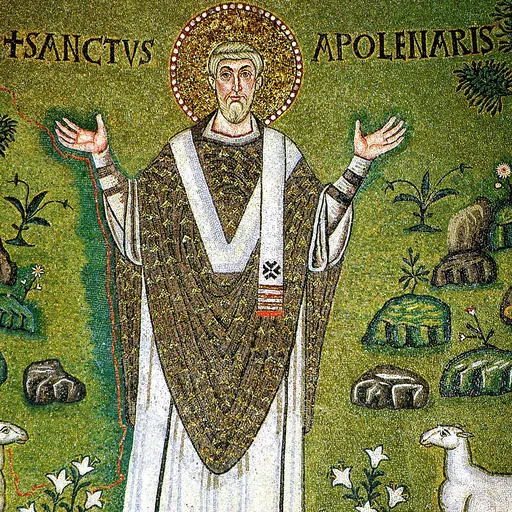
About Apollinaris of Ravenna
Apollinaris of Ravenna was a Roman catholic priest.
Apollinaris of Ravenna (; , Apollinarios, Late Latin: Apolenaris) is a Syrian saint, whom the Roman Martyrology describes as "a bishop who, according to tradition, while spreading among the nations the unsearchable riches of Christ, led his flock as a good shepherd and honoured the Church of Classis near Ravenna by a glorious martyrdom."
Biography It is not certain what was his native place, though it was probably Antioch in the Roman province of Syria. It is not certain that he was one of the seventy-two disciples of Christ, as has been suggested, but he was apparently a disciple of Saint Peter, who may have consecrated and commissioned him as the first Bishop of Ravenna during the reign of the Emperor Claudius, the fourth Roman emperor from 41 to 54 A.D. The precise date of his consecration as Bishop cannot be ascertained. He dedicated himself to the work of evangelization in Emilia-Romagna. During his twenty-six year tenure as bishop of Ravenna, he faced nearly constant persecution.
Christian inscriptions dating from the 2nd century have been discovered near Classe, confirming the presence of Christianity in Ravenna at a very early date. According to the list of the bishops of Ravenna compiled by Bishop Marianus (546–556), the 12th Bishop of Ravenna was named Severus; and he is among those who signed at the Council of Sardica in 343. Thus, the epoch of Saint Apollinaris may be estimated as possibly to the last decades of the 2nd century, placing his martyrdom possibly under Emperor Septimius Severus.
The Passio Sancti Apollinaris presents historical difficulties. It was probably written by Archbishop Maurus of Ravenna (642–671), who presumably wanted to demonstrate the early origin of his see and a connection to Saint Peter, in an effort to achieve a degree of autonomy from Rome. (In 666 Emperor Constans II granted the request of Bishop Maurus, allowing Ravenna to consecrate its bishop without approval from Rome, and declared that the Pope had no jurisdiction over the Archbishop of Ravenna, since that city was the seat of the exarch, his immediate representative.)
Traditional narrative The miracles Apollinaris wrought soon attracted official attention, for they and his preaching won many converts to the Faith, while at the same time bringing upon him the fury of the idolaters, who beat him cruelly and drove him from the city. He was found half-dead on the seashore, and kept in concealment by the Christians, but was captured again and compelled to walk on burning coals and a second time expelled. But he remained in the vicinity, and continued his work of evangelization.
He then journeyed to Aemilia. A third time he returned to Ravenna. Again he was captured, beaten and tortured, and flung into a dungeon, loaded with chains, to starve to death; but after four days he was put on board a ship and sent to Greece. There the same course of preachings, miracles, and sufferings continued; and when his very presence caused the oracles to be silent, he was, after a cruel beating, sent back to Italy. The liturgical celebration was removed by the decree of in 1969. 23 July in the current General Roman Calendar is the feast of Saint Bridget of Sweden, since it is also the day she died and she is now better known in the West than Saint Apollinaris, being one of the patron saints of Europe. because of the threat posed by frequent pirate raids along the Adriatic coast. There are also relics of Apollinaris at . Additional relics are housed at the Apollinariskirche, Remagen.
There are churches dedicated to him in Aachen, and Burtscheid in Germany, where his veneration was probably spread by Benedictine monks. The Frankish king Clovis built a church dedicated to him in Dijon, and another dedicated to Saint Apollinaris also existed in Bologna, but was destroyed in 1250. Bořivoj II, Duke of Bohemia, founded a church with a collegiate chapter dedicated to Saint Apollinaris in Sadská (then an important centre of the Czech state) in 1117/1118. On behalf of Charles IV, Holy Roman Emperor, the chapter was later transferred from Sadská to recently founded New Town of Prague in 1362 and another church of St Apollinaris built there. Both of these churches in Bohemia stand to the present time. In 1957, a church venerating St. Apollinaris was founded in Napa, California.
Patronage Apollinaris is the patron saint of Ravenna, and Emilia-Romagna. He is also the patron saint of Düsseldorf, Germany. A noted miracle worker, Saint Apollinaris is considered especially effective against gout, venereal disease and epilepsy.
Iconography Saint Apollinaris is represented with a pastoral staff, palm, and pallium.
Don’t just read it —
keep it.
Full-length biographies made to live with: read them, listen on the way to work, watch them tonight.
- E-book
- Audio
- Video
Instant download · yours to keep · every purchase keeps this site free
Important facts
Related people
Same field, nearest in time

Frequently asked questions
Who was Apollinaris of Ravenna?
Syrian bishop and saint
When was Apollinaris of Ravenna born?
Apollinaris of Ravenna was born in Antioch.
When did Apollinaris of Ravenna die?
Apollinaris of Ravenna died in Ravenna.
What was Apollinaris of Ravenna's occupation?
Apollinaris of Ravenna was a catholic priest.
What nationality was Apollinaris of Ravenna?
Apollinaris of Ravenna was Roman.
Sources & further reading
· Wikipedia: Apollinaris of Ravenna
· DBpedia: Apollinaris of Ravenna
Cite this page
APA: Biography.guide. (2026). Apollinaris of Ravenna. https://biography.guide/apollinaris-of-ravenna/
MLA: "Apollinaris of Ravenna." Biography.guide, https://biography.guide/apollinaris-of-ravenna/.
Chicago: "Apollinaris of Ravenna." Biography.guide. https://biography.guide/apollinaris-of-ravenna/.
Data last updated: 2026-09-22 · Spot an error? Report a correction.
Portrait: Wikimedia Commons · author & licence
Page generated 2026-09-27 05:02 UTC