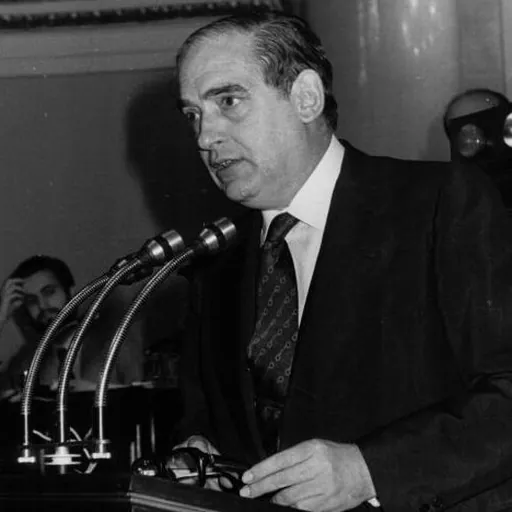
About Antonio Fontán
Lived 1923 – 2010 (aged 86). Antonio Fontán was a Spanish journalist, linguist, politician and writer.
Antonio Fontán Pérez, 1st Marquess of Guadalcanal (15 October 1923 – 14 January 2010) was a Spanish journalist recognized for his work in promoting press freedom in his country. He was also a well-known Catholic and a member of Opus Dei.
Antonio Fontán was the editor of the independent newspaper Madrid from 1967 to 1971. The periodical openly criticized Francisco Franco's authoritarian rule. In 1968, the government began a campaign against the newspaper, in which Fontán was prosecuted 19 times and fined 10 times in the span of four months. In October 1971, the authorities demanded Fontán's resignation, closing down the paper a few weeks later. Fontán's staunch defense of the principles of free expression during those five years as editor earned him and his staff a unique place in the annals of Spanish journalism.
In 1977, Fontán was elected to the Spanish Senate as a member of the Unión de Centro Democrático, in the first democratic general elections after the end of Francoist Spain. During his career, Fontán co-authored Spain's Constitution of 1978, which recognized freedom of expression and freedom of information as fundamental rights. He also served as a minister from 1979 to 1982.
At the time of his death, Fontán was the president and publisher of Nueva Revista de Política, Cultura y Arte, a bimonthly news magazine, which he founded in 1990. The International Press Institute (IPI) has named him one of the "Heroes of Press Freedom."
Early years Fontán was born in Seville, Spain, on October 15, 1923. He attended the University of Seville where he received his doctorate in classical philology in 1948, and was active in clandestine, royalist and liberal circles. In addition, he studied journalism at the Official School of Madrid. Fontán founded the monthly Nuestro Tiempo in 1954. He was the director of a weekly magazine, La Actualidad Española before joining the evening paper, Madrid, in September 1966, shortly after the introduction of a new press law which lifted prior censorship.
Struggle for press freedom in Francoist Spain Fontán was appointed editor-in-chief of Madrid on April 15, 1967. He soon learned that the end of censorship did not necessarily mean true freedom of the press. Madrid quickly became unpopular with the authorities for its coverage of such taboo subjects as student and labor unrest, the growth of regionalism, illegal trade unionism, and opposition party activities. Fontán and his paper were bombarded with sanctions for publishing articles defending democracy and civil liberties, and criticizing Francoist Spain. Between January 1967 and May 1968 alone, proceedings were initiated against the paper on 12 separate occasions. Madrid was shut down for four months on May 30, 1968, inflicting heavy financial losses on the paper. The paper continued to pay the salaries of its staff during this time.
After Madrids reappearance on September 30, 1968, judicial proceedings against the paper continued on a regular basis. Finally, in October 1971, the Minister of Information, Sánchez Bella, demanded the replacement of Fontán with a journalist close to the Falange party and the appointment of a director to represent the Ministry. In the case of refusal, Sánchez Bella warned that the newspaper would be temporarily suspended and an investigation started to consider its permanent closure. However, Madrids publisher and principal owner, Rafael Calvo Serer, refused to agree to these conditions. The paper's editorial staff formed a journalists' association, the first of its kind in Spain, to defend the independence and dignity of the profession and to fight for the retention in office of the present editor.
On November 25, 1971, after the paper published an article critical of General Franco's right-hand man, Admiral Luis Carrero Blanco, the Ministry of Information removed Madrid from the register of press publishers, allegedly because of irregularities in the paper's ownership. The Ministry also told the paper to cease publishing.
Fontán was the president and publisher of Nueva Revista de Política, Cultura y Arte, a bimonthly magazine on current affairs, which he founded in 1990.
He was made Marquess of Guadalcanal (In spanish: Marqués de Guadalcanal), in July 2008, by King Juan Carlos I as an homage to his contributions to political freedom and civil peace in Spain.
Don’t just read it —
keep it.
Full-length biographies made to live with: read them, listen on the way to work, watch them tonight.
- E-book
- Audio
- Video
Instant download · yours to keep · every purchase keeps this site free
Important facts
People in Antonio Fontán's life
Named in this biography and alive at the same time


Related people
Same field, nearest in time


Contemporaries
People whose lives overlapped Antonio Fontán's

Frequently asked questions
Who was Antonio Fontán?
Spanish journalist (1923-2010)
When was Antonio Fontán born?
Antonio Fontán was born on 15 October 1923 in Seville.
When did Antonio Fontán die?
Antonio Fontán died on 14 January 2010 in Madrid.
What was Antonio Fontán's occupation?
Antonio Fontán was a journalist, linguist, politician and writer.
What nationality was Antonio Fontán?
Antonio Fontán was Spanish.
Sources & further reading
Cite this page
APA: Biography.guide. (2026). Antonio Fontán. https://biography.guide/antonio-fontan/
MLA: "Antonio Fontán." Biography.guide, https://biography.guide/antonio-fontan/.
Chicago: "Antonio Fontán." Biography.guide. https://biography.guide/antonio-fontan/.
Data last updated: 2026-09-22 · Spot an error? Report a correction.
Portrait: Wikimedia Commons · author & licence
Page generated 2026-09-27 05:00 UTC