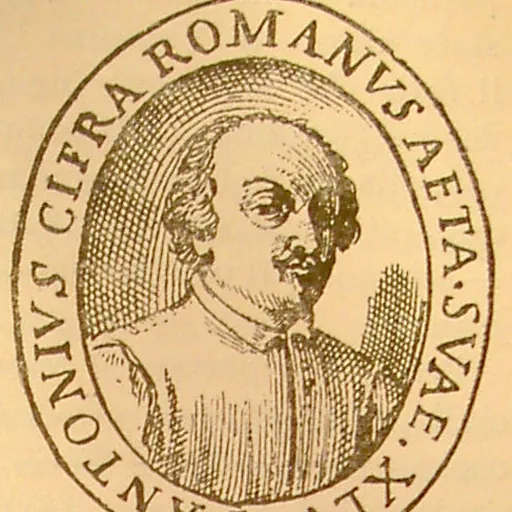
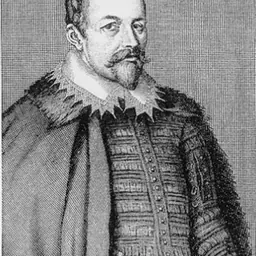
About Antonio Cifra
Lived 1584 – 1629 (aged 44–45). Antonio Cifra was a composer.
Antonio Cifra (1584? – 2 October 1629 in Loreto) was an Italian composer of the Roman School of the Renaissance and early Baroque eras. He was one of the significant transitional figures between the Renaissance and Baroque styles, and produced music in both idioms.
Life and works Son of Costanzo and Claudia, Antonio Cifra was born perhaps in Bassiano (near Terracina). He studied with Giovanni Bernardino Nanino from 27 June 1594 at San Luigi dei Francesi in Rome and then, from 18 January 1597, he was boy soprano of the Cappella Giulia at St Peter. From 1605 to 1607 he was maestro at the Roman Seminary, and from 1608 to 1609 he held the same position at the German College in Rome. In 1609 he was hired as maestro di cappella at Santa Casa in Loreto, where he remained the rest of his life. Cultural connections between Loreto and Rome were close (since Loreto was a pilgrimage destination), and he maintained contact with the composers in Rome during this period. Near the end of his life he took part in several large musical events in Rome, including a large Vespers at St. Peter's for which he batteva (beat time) for one of the choirs.
Cifra was a prolific composer, with 45 separate publications to his credit: they included psalms, motets, litanies, Scherzi sacri, masses, polychoral motets, and sacred songs, as well as secular music including madrigals in both the Renaissance a cappella and Baroque concertato forms.
Stylistically, Cifra's music varies between masses in the Palestrina style, with much use of homophony (as desired by the Counter-Reformation Council of Trent, which had required that polyphonic elaboration be minimized so as to allow for clear expression of the text), and more progressive works in the Venetian style. He also used the technique of monody, as pioneered in northern Italy, for some of his solo madrigals. Some of his concertato madrigals are like small cantatas, and can be seen as foreshadowing this development, which began around the time he died.
Cifra was also one of the very few composers to be influenced by the extreme chromaticism of Carlo Gesualdo. While Cifra did not adopt the technique for many works, or for long, he did publish one book of madrigals which appear to be deliberate copies of Gesualdo's style (the Madrigali concertati libro quinto, 1621). For these madrigals he used 18 of Gesualdo's own texts.
Don’t just read it —
keep it.
Full-length biographies made to live with: read them, listen on the way to work, watch them tonight.
- E-book
- Audio
- Video
Instant download · yours to keep · every purchase keeps this site free
Important facts
People in Antonio Cifra's life
Named in this biography and alive at the same time


Related people
Same field, nearest in time



Contemporaries
People whose lives overlapped Antonio Cifra's



Frequently asked questions
Who was Antonio Cifra?
Italian composer
When was Antonio Cifra born?
Antonio Cifra was born in 1584 in Province of Latina.
When did Antonio Cifra die?
Antonio Cifra died on 2 October 1629 in Loreto.
What was Antonio Cifra's occupation?
Antonio Cifra was a composer.
Sources & further reading
Cite this page
APA: Biography.guide. (2026). Antonio Cifra. https://biography.guide/antonio-cifra/
MLA: "Antonio Cifra." Biography.guide, https://biography.guide/antonio-cifra/.
Chicago: "Antonio Cifra." Biography.guide. https://biography.guide/antonio-cifra/.
Data last updated: 2026-09-22 · Spot an error? Report a correction.
Portrait: Wikimedia Commons · author & licence
Page generated 2026-09-27 05:01 UTC