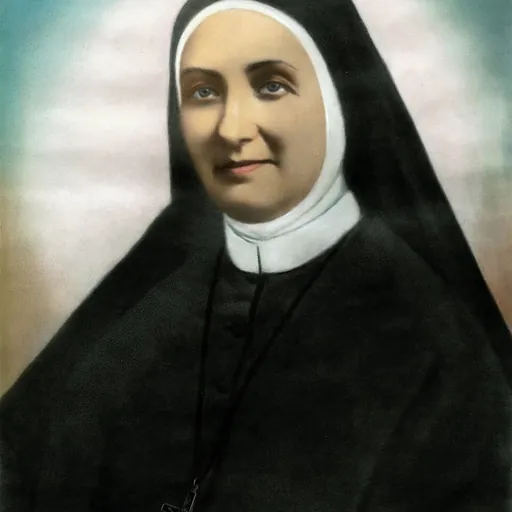
Antonia María de Oviedo y Schönthal
Co-founder of the Oblate Sisters of the Most Holy Redeemer
About Antonia María de Oviedo y Schönthal
Lived 1822 – 1898 (aged 75). Antonia María de Oviedo y Schönthal was a Spanish religious sister.
Antonia Maria de Oviedo Schöntal (16 March 1822 – 28 February 1898) was a Swiss-Spanish religious sister in the Roman Catholic Church and the co-founder of the Oblate Sisters of the Most Holy Redeemer, a congregation that she established with the Benedictine Bishop José María Serra. She assumed the religious name Antonia María of Mercy and worked alongside poor and disadvantaged women.
She was declared venerable on 7 July 1962 after Pope John XXIII approved the fact that she lived a life of heroic virtue. A miracle attributed to her intercession requires papal approval after having received approval from the Congregation for the Causes of Saints in 2005.
Life Antonia Maria de Oviedo Schöntal was born on 16 March 1822 in Lausanne to the Spanish Antonio de Oviedo and the Swiss Susanna Schöntal.
Poems Felicitations and Acrostics (Felicitaciones y Acrósticos, Friburg, 1836-1851) Couplets (Coplas, Lausanne, 1844) Spiritual: To the cross (A la cruz, Madrid, 1850), Amen (Ciempozuelos, 1896) Human values: The refuge of happiness (El refugio de la felicidad, Madrid, 1852) Her name (Su nombre, Rome, 1861)
Dialogues and comedies For a prize distribution (Para una distribución de premios, Friburg, 1845) Goodbye (Adiós, Madrid, 1849) The party or The magic mirror (La fiesta o El espejo mágico, Madrid, 1850)
Historical and travel writings Recollections of London (Recuerdos de Londres, London, 1853) An excursion to Toledo (Una excursión a Toledo, Aranjuez, 1853) The Emperor's bench (El banco del Emperador, Aranjuez, 1853) Switzerland at the edge of the lake (Suiza al borde del lago, Switzerland, 1853) A visit to Rueil (Una visita a Rueil, La Malmaison, 1855) Memories of Switzerland (Recuerdos de Suiza, Switzerland, 1857–58) Memories and paintings (Recuerdos y cuadros, La Malmaison, 1857)
Marian themes A Dream (Un sueño, Friburg, 1847) The Immaculate Conception (La Inmaculada Concepción, La Malmaison, 1854) New month of Mary (Nuevo mes de María, La Malmaison, 1855) The Assumption (La Asunción, La Malmaison, 1857) The wonders of the nineteenth century (Las maravillas del siglo XIX, Madrid, 1885)
Eucharistic themes Month of the Blessed Sacrament (Mes del Santísimo Sacramento, La Malmaison, 1855) Feast of Corpus in Rueil (Fiesta del Corpus en Rueil, La Malmaison, 1855)
Ecclesial-missionary themes The feast of the Kings in the Propaganda School (La fiesta de los Reyes en el Colegio de Propaganda, Rome, 1858) Vidimus stellam (Rome, 1861) Christmas Party in Rome (Fiesta de Navidad en Roma, Rome, 1860) Miscellaneous writings on Rome (Escritos diversos sobre Roma, Rome, 1861) The Missionary (El Misionero, Rome, 1862) The field of Aníbal and the General Council of 1869 (El campo de Aníbal y el Concilio general de 1869, Ciempozuelos, 1869) Letter to the Pope (Carta al papa, Madrid, 1868 and 1871)
Novels The Rose of Magdalena (El Rosal de Magdalena, La Malmaison, 1858) Aurelius (Aurelio Rome, 1859)
Autobiographies History of a conscience (Historia de una conciencia-Bagnères de Bigorre, 1854) ==== A Memory of Bliss (Un recuerdo de dicha, Parías, 1855) Rule of Life ( Regla de Vida, 1838)
Death In the night of February 28, 1898, Antonia Maria of Mercy at 75 years old passed away.
Her remains rest in the Chapel of the Spirituality House of the Oblate Sisters of the Most Holy Redeemer in Ciempozuelos, Madrid, Spain. After her death her fame spread even further.
Beatification process The process of beatification started in the Archdiocese of Madrid with an informative process that commenced on 23 November 1927 and concluded in 1932. Her writings received the approval of theologians on 2 August 1942 who deemed that the writings she left behind were indeed in line with the magisterium of the Christian faith. The formal introduction of the cause came on 1 February 1948, under Pope Pius XII, in which she was accorded the title of Servant of God. produced by the Colegio Santísimo Redentor, in Ramos Mejia, Argentina.
The Commission received a total of 29 videos from Angola, Italy, Colombia, Brazil, Portugal, Argentina and Spain. The ten best videos can be found in the YouTube channel: Oblate Sisters – Communication.
Film: If all the doors are closed ("Si todas las puertas se cierran”) Synopsis
"If all doors are closed" tells the story of three women, apparently separated in time and space, but who end up coming together in their process of finding themselves. The three will have to listen to an inner call that requires them to face their fears and be the true protagonists of their lives, opening new paths of transformation and liberation.
Don’t just read it —
keep it.
Full-length biographies made to live with: read them, listen on the way to work, watch them tonight.
- E-book
- Audio
- Video
Instant download · yours to keep · every purchase keeps this site free
Important facts
People in Antonia María de Oviedo y Schönthal's life
Named in this biography and alive at the same time

Related people
Same field, nearest in time


Contemporaries
People whose lives overlapped Antonia María de Oviedo y Schönthal's





Frequently asked questions
Who was Antonia María de Oviedo y Schönthal?
co-founder of the Oblate Sisters of the Most Holy Redeemer
When was Antonia María de Oviedo y Schönthal born?
Antonia María de Oviedo y Schönthal was born on 16 March 1822 in Lausanne.
When did Antonia María de Oviedo y Schönthal die?
Antonia María de Oviedo y Schönthal died on 28 February 1898 in Ciempozuelos.
What was Antonia María de Oviedo y Schönthal's occupation?
Antonia María de Oviedo y Schönthal was a religious sister.
What nationality was Antonia María de Oviedo y Schönthal?
Antonia María de Oviedo y Schönthal was Spanish.
Sources & further reading
· Wikipedia: Antonia María de Oviedo y Schönthal
· DBpedia: Antonia de Oviedo Schöntal
Cite this page
APA: Biography.guide. (2026). Antonia María de Oviedo y Schönthal. https://biography.guide/antonia-maria-de-oviedo-y-schonthal/
MLA: "Antonia María de Oviedo y Schönthal." Biography.guide, https://biography.guide/antonia-maria-de-oviedo-y-schonthal/.
Chicago: "Antonia María de Oviedo y Schönthal." Biography.guide. https://biography.guide/antonia-maria-de-oviedo-y-schonthal/.
Data last updated: 2026-09-21 · Spot an error? Report a correction.
Portrait: Wikimedia Commons · author & licence
Page generated 2026-09-27 04:59 UTC