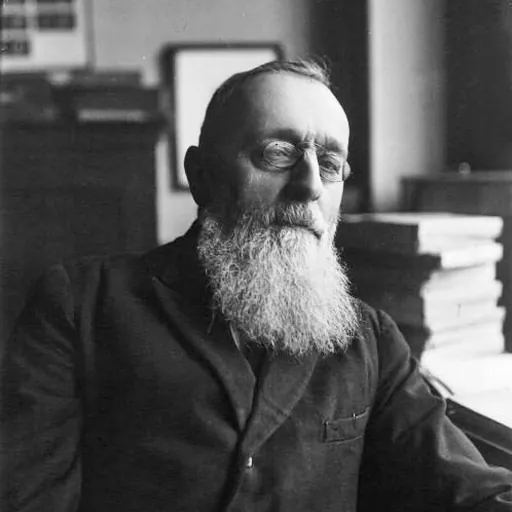
Antoine Lacroix
French mineralogist and geologist
About Antoine Lacroix
Lived 1863 – 1948 (aged 85). Antoine Lacroix was a French geologist, mineralogist, university teacher, volcanologist, petrographer and earth scientist.
Antoine François Alfred Lacroix
Education Alfred Lacroix completed a D. s Sc. in Paris in 1889, as student of Ferdinand André Fouqué. Fouqué only agreed to the graduation if Lacroix would marry his daughter.
Career In 1893, Alfred Lacroix was appointed professor of mineralogy at the Jardin des Plantes, Paris, and in 1896 director of the mineralogical laboratory in the École des Hautes Études.
He paid especial attention to minerals connected with volcanic phenomena and igneous rocks, to the effects of metamorphism, and to mineral veins, in various parts of the world, notably in the Pyrenees. In his numerous contributions to scientific journals he dealt with the mineralogy and petrology of Madagascar, and published an elaborate and exhaustive volume on the eruptions in Martinique, La Montagne Pelée et ses éruptions (Paris 1904).
His will includes a final wish that testifies to his great modesty: “I recall that I want to be buried without ceremony of any kind, in the presence of my family only. This does not mean that I am indifferent to my colleagues, pupils and friends, but I attach little value to external events. I only ask them to devote a small place to me in their memories, which can be done without leaving one's work and normal life.” Alfred Lacroix was buried on 18 March 1948 in the family vault, which has no nominal inscription, at the cimetière du Montparnasse (3rd division, concession 871 P 1827).
Contributions Alfred Lacroix's work was extensive and covered various scientific areas, including mineralogy, geology, petrology, vulcanology, and the history of sciences. He redefined and enriched the concept of mineral species and emphasized the importance of integrating various methods of observation in understanding minerals' occurrence, associations, genesis, and transformations in nature.
He conducted detailed studies on the role of minerals in the composition of rocks, bridging the gap between mineralogy and petrography. Lacroix's research in contact metamorphism, particularly in the Pyrénées, contributed to our understanding of this geological process. His work also supported the theory that mineralizers and volatile emanations from eruptive magmas played a crucial role in metamorphism.
Alfred Lacroix extensively studied volcanic eruptions and the materials ejected by volcanoes worldwide. His investigations on Mount Pelée shed light on the formation of domes and "nuées ardentes" (pyroclastic flows). He played a significant role in the classification of eruptive rocks, which helped determine their relationships and conditions of formation.
Lacroix's expertise extended to the formation of pegmatites, and he notably studied Madagascar pegmatites, distinguishing between potassium and sodium-lithium pegmatites. He also made significant contributions to the understanding of laterite formation, explaining the concentration of iron and aluminum hydroxides during the alteration of silicate rocks in tropical climates.
His interest in terrestrial rocks led him to the study of meteorites, where he applied the same principles to classify stony meteorites rationally. Additionally, he curated extensive mineralogy and petrography collections at the Museum of Natural History in Paris.
Travel and exploration Alfred Lacroix was an adventurous traveler who conducted geological and mineralogical research in various regions worldwide. His journeys took him to Scotland, England, Ireland, Scandinavia, North America (Canada and the USA), Germany, Greece, Asia Minor, Japan, Malaya, and Java. He was a pioneer in colonial mineralogy, exploring regions like Martinique, Guadeloupe, Guinea, Madagascar, and Indochina. His observations during these travels greatly enriched scientific knowledge.
One of his notable discoveries was the identification and study of uranium minerals in Madagascar. as is the Lacroix Glacier in the Taylor Valley of Antarctica.
Society Antoine Lacroix was one of the founder members in 1930 of the Society of Friends of André-Marie Ampère which was created to develop the first science museum in France, the Ampère Museum close to Lyon.
Don’t just read it —
keep it.
Full-length biographies made to live with: read them, listen on the way to work, watch them tonight.
- E-book
- Audio
- Video
Instant download · yours to keep · every purchase keeps this site free
Important facts
People in Antoine Lacroix's life
Named in this biography and alive at the same time

Related people
Same field, nearest in time





Contemporaries
People whose lives overlapped Antoine Lacroix's




Frequently asked questions
Who was Antoine Lacroix?
French mineralogist and geologist (1863–1948)
When was Antoine Lacroix born?
Antoine Lacroix was born on 4 February 1863 in Mâcon.
When did Antoine Lacroix die?
Antoine Lacroix died on 16 March 1948 in Paris, 14th arrondissement of Paris.
What was Antoine Lacroix's occupation?
Antoine Lacroix was a geologist, mineralogist, university teacher, volcanologist, petrographer and earth scientist.
What nationality was Antoine Lacroix?
Antoine Lacroix was French.
Sources & further reading
Cite this page
APA: Biography.guide. (2026). Antoine Lacroix. https://biography.guide/antoine-lacroix/
MLA: "Antoine Lacroix." Biography.guide, https://biography.guide/antoine-lacroix/.
Chicago: "Antoine Lacroix." Biography.guide. https://biography.guide/antoine-lacroix/.
Data last updated: 2026-09-20 · Spot an error? Report a correction.
Portrait: Wikimedia Commons · author & licence
Page generated 2026-09-27 04:58 UTC