Anthony the Wanderer
Russian wanderer (c. 1834 – c. 1911)
About Anthony the Wanderer
Lived 1834 – 1911 (aged 76–77). Anthony the Wanderer was a Russian russian wandering and wanderer.
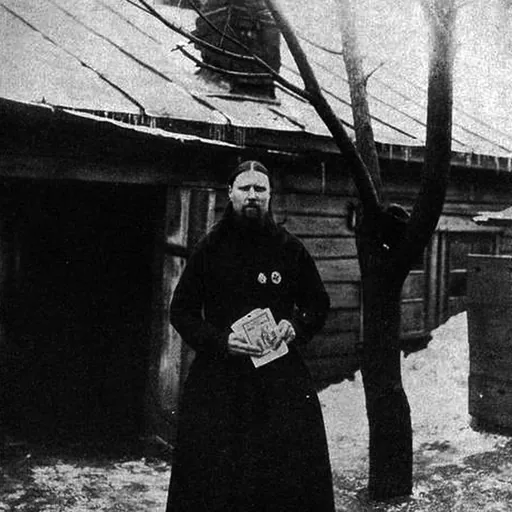
Anthony the Wanderer (; real name Anthony (Anton) Isaevich Petrov; — after 1911) was a Russian wanderer, widely known in Russia during the reigns of Emperors Alexander II, Alexander III and Nicholas II. Some contemporaries, and on the basis of their testimonies, later Soviet and Russian historians attributed to him the influence on the last Russian emperor.
Anthony the Wanderer collected funds for the construction of village churches and schools. However, there were confirmed several cases of entrusted to him money thefts, and fraud in building materials and payment for work; these thefts took place over a long period of time. To humble his body, Anthony wore two poods penance chains and a heavy cane. Regardless of the weather or the season, he walked barefoot. Anthony was known as a righteous man, but his contemporaries were also aware of cases of drunkenness involving minors.
Anthony the Wanderer was closely acquainted with a number of prominent government officials, deputies and some representatives of the higher clergy. Candidate of historical sciences Andrei Tereshchuk found close similarities in the personality, appearance, outlook and biography of the Anthony the Wanderer and Grigory Rasputin.
Biography
Childhood and youth Anthony Isaevich Petrov was born around 1834 in the village of Kolesnikovo, Yalutorovsky uyezd, Tobolsk province. It is known that he had one brother — Rodion Isaevich Petrov. The doctor of history, the expert in the religion history and relations between state and religion Sergey Firsov gave contradictory information about Petrov's social origin. On the one hand, he called him a merchant. Already in his youth he devoted himself to God, to give up his fortune, to leave his family and to wander in holy places. Sergei Firsov and Andrey Tereshchuk noted that his conversion did not happen in his youth, but in his mature years, and the reason for it was the healing of a serious illness. Anthony vowed that if he recovered, he would dedicate his life to God. He gave up his former life and set out on a journey, giving his clothes and boots to the first beggar he met and taking on two pounds of weight. According to her data, also based on archival materials, Anthony was born not in 1834, but in 1850 in the family of a peasant from the village of Kolesnikovo Isaiah Petrov. The family was poor, sometimes starving. In addition to farming in the household was a carriage trade. Anthony was engaged in it in his youth. According to the memories of the villagers, he was cheerful, liked to go out, so he tried to free himself from the control of his father. Contemporaries claimed that the young man was always drunk on trips outside the village. Anthony began to steal. He established close communication "with settlers and gypsies". Finally, the thief was caught stealing. The judge sentenced the young man to 20 lashes. By the decision of the community, Anthony was exiled to the Siberian taiga, but he suddenly disappeared. A few years later the parish received a request "whether the village community has any objections to the transfer of the peasant Anton Isaevich Petrov to the citizens of Biysk". The villagers did not report about the past of a fellow villager and let him go "in peace".
Wanderering After a while, Anthony returned to the village. In the spring of 1895 he was already "a good-looking and quiet wanderer Anthony". He arrived in a "200-ruble carriage" drawn by a trio of horses he owned. The girl sitting next to him was introduced as the nun Sister Anna. It was believed that when alms were given to him, he distributed them immediately. Eventually, Anthony settled in Moscow as a widely known wanderer and philanthropist. Visitors lined up at his house, eager to receive advice from the wanderer or material help. In March 1894, a copper bell weighing 550 poods was cast for the donations of 11,000 roubles collected by Anthony for St. Andrew's Cathedral in Kronstadt. His charity was recognized by a diploma of the Holy Governing Synod, signed by Metropolitan Palladius (Raev) of St. Petersburg and Ladoga. On the contrary, the anonymous author of an article in the magazine Strannik for 1894 argues that Anthony did not address people with any kind of teaching or preaching. People saw in his actions deeds, holiness, sought to receive from him a prophecy, a favor, and the wanderer himself was perceived as a "man of God". thumb
Last years of life
Vladimir Korolenko wrote that from 1894 the fame of the wanderer began to decline rapidly, and by the beginning of the 20th century Anthony had lost his popularity among the general public. However, the ideals and image of the wanderer continued to be important to ordinary people. One of the Kronstadt newspapers wrote: "Instead of the absent wanderer Anthony, we have a new one, with a whole train of sanctimonious godmothers and worshippers. He walks barefoot, in a green silk robe..." In the cemetery of the village of Kolesnikovo there is a red brick grave of the wayfarer. On the grave there is a gray stone without an inscription. Everyone in the city is talking and writing in the newspapers about Anthony the Wanderer who came to St. Petersburg barefoot and in chains. This has given him an aura of holiness. People come to him by the thousands, bringing all kinds of offerings, large and small. Such ugly phenomena from the point of view of true Orthodoxy and morality are now being repeated more and more often and are simply a sign of the times. No police or censorship measures are taken against such ugly manifestations of all kinds of prudes and philanderers and the writing about them. We can expect that they will soon be elevated to the rank of "synodal wanderers", as there are now synodal missionaries. It is an amazing time. We are still treading the ground or turning back, and we want to assure ourselves and others that we are working and moving forward.An extremely negative opinion on Anthony was given by the chief procurator of the Holy Synod, Konstantin Pobedonostsev, in a letter to the head of the main press department of the Ministry of Internal Affairs, Evgeny Feoktistov, dated March 21, 1894. For Pobedonostsev, the wanderer is a "clever scoundrel". He notes that the police act "in concert with him," although, in the opinion of the chief prosecutor, Anton deserves "expulsion" (from the capital). Pobedonostsev suggests that the wanderer paid a number of publications to stir up excitement around him. Among such newspapers he called in Moscow Russky listok, which in each issue prints stories about his "prayers, benefits, healings, etc." According to Pobedonostsev, these articles are written by a certain Jew Strusberg under the pseudonym [A.] Pavlov. In the capital "Petersburg leaflet", from the point of view of the chief prosecutor, prints information about the wanderer even more "shamelessly".
Pobedonostsev told his addressee that he had seen two manuscripts submitted for approval for printing: one — Anthony the Wanderer by Sokolovich, and the other — Anthony the Wanderer, Tomsk citizen Anton Petrov. He walks barefoot and carries weights, which is a collection of articles about the wanderer from the Petersburgsky List. The Procurator was afraid that the censors would allow these publications to be printed. Pobedonostsev asked Feoktistov to take all necessary measures "not to pass and send to the spiritual censorship".
In the first edition of the book of the Russian socio-political figure, deputy of the State Duma of the Russian Empire of the first convocation from Kaluga Governorate and one of the leaders of the Constitutional Democratic Party Viktor Obninsky The Last Autocrat: Materials for the Nicholas II characterization, published in 1912 in Berlin, there was a large reproduction of the photo, under which there was a signature: "Anthony the Wanderer, a favorite of the Black Hundreds. During the first Duma he was summoned to the Tsar to give wise advice". On April 14, 1894, Sankt-Petersburgskie Vedomosti openly accused the wanderer of "hypocrisy and religious charlatanism. The newspaper Novoe Vremya also criticized the wanderer.
In Soviet times, Anthony was commonly referred to as one of the "numerous domestic and imported miracle workers, seers, fortune tellers, and clichés", which included the occultist Papius, the praying mantis Daria Osipova, the wanderer Vasily Barefoot, the soothsayer Grippa, the fools as Pasha Sarovskaya and Mitya Kozelsky. It was believed that they "performed the function of the most trusted persons and advisors of Nicholas II and Alexandra Feodorovna" in the period after the expulsion of the Frenchman Philip and before the appearance at the court of Grigory Rasputin. Doctor of Philosophy Alexander Grigorenko, citing the testimony of Sergei Trufanov, claimed that the tsar had a rule: "First he listens to the 'elders' and 'blessed', and then to the ministers".
For the first time in modern Russia, the attention of historical studies to the figure of the wanderer was drawn by Doctor of History Sergei Firsov in the process of publishing the diary of Apollinarius Lvov. Andrei Tereshchuk found surprising similarities in the personality, appearance, outlook, and biography of the traveler Anthony and Grigory Rasputin.
The Russian writer and publicist Mikhail Shevlyakov described his encounter with Anthony in 1895 during his own pilgrimage to the Holy Trinity-Saint Sergius Lavra. He saw him on the street surrounded by two or three hundred admirers. Talking to one of them, he learned that the wanderer was ascribed the ability to "see with the spirit," the "gift of clairvoyance," the capacity for "revelation," and "righteousness." Shevlyakov was surprised that his admirers considered him a fool. He himself admitted that he saw no signs of foolishness in Anthony. Another gift of the wanderer was the ability to cure constipation. Anthony's admirers told the writer that every day in his apartment he reads Akathistas and conducts a service. Shevlyakov noticed that the wanderer is very talkative, and his speech is characterized by persuasiveness. From the writer's point of view, the "prophetic gift" of the wayfarer is connected with the fact that he tries to dispel the doubts of his interlocutor with moralizing, and the interlocutor unconsciously distorts the facts under the influence of the mystical mood formed in the process of communication with Anthony. According to the writer, the wanderer is especially popular among merchants and bourgeois.
Davydov describes the appearance of the wanderer: "his face is a baked apple, his beard is scrubbed, his hair is unkempt and bushy, his cassock is patchy, his boots are begging for porridge". Anthony believes he has true happiness because he has renounced worldly vanity and wealth. He explains his passion for wanderlust — he was once a novice in Kiev, but could not settle in: "If you stay in one place, your feet yearn. If you are not on the move, you can never drown your passions".
Don’t just read it —
keep it.
Full-length biographies made to live with: read them, listen on the way to work, watch them tonight.
- E-book
- Audio
- Video
Instant download · yours to keep · every purchase keeps this site free
Important facts
People in Anthony the Wanderer's life
Named in this biography and alive at the same time

Contemporaries
People whose lives overlapped Anthony the Wanderer's





Frequently asked questions
Who was Anthony the Wanderer?
Russian wanderer (c. 1834 – c. 1911)
When was Anthony the Wanderer born?
Anthony the Wanderer was born in 1834 in Yalutorovsky Uyezd.
When did Anthony the Wanderer die?
Anthony the Wanderer died in 1911.
What was Anthony the Wanderer's occupation?
Anthony the Wanderer was a russian wandering and wanderer.
What nationality was Anthony the Wanderer?
Anthony the Wanderer was Russian.
Sources & further reading
· Wikipedia: Anthony the Wanderer
· DBpedia: Anthony the Wanderer
Cite this page
APA: Biography.guide. (2026). Anthony the Wanderer. https://biography.guide/anthony-the-wanderer/
MLA: "Anthony the Wanderer." Biography.guide, https://biography.guide/anthony-the-wanderer/.
Chicago: "Anthony the Wanderer." Biography.guide. https://biography.guide/anthony-the-wanderer/.
Data last updated: 2026-09-20 · Spot an error? Report a correction.
Page generated 2026-09-27 05:10 UTC