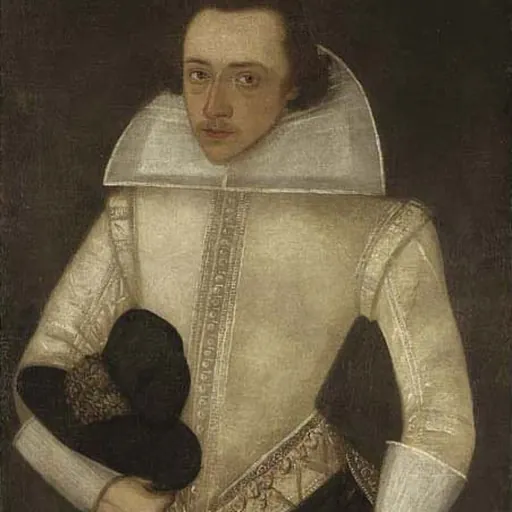
Anthony Babington
English nobleman convicted of plotting the assassination of Elizabeth I of England
About Anthony Babington
Lived 1561 – 1586 (aged 24). Anthony Babington was an English politician.
Anthony Babington (24 October 156120 September 1586) was an English gentleman convicted of plotting the assassination of Elizabeth I of England and conspiring with the imprisoned Mary, Queen of Scots, for which he was hanged, drawn and quartered. The "Babington Plot" and Mary's involvement in it were the basis of the treason charges against her which led to her execution. He was a member of the Babington family.
Biography Born into a gentry family to Sir Henry Babington and Mary Darcy, granddaughter of Thomas Darcy, 1st Baron Darcy de Darcy, at Dethick Manor in Dethick, Derbyshire, England, he was their third child. His father died in 1571 when Anthony was nine years old, and his mother married Henry Foljambe. Anthony was under the guardianship of his mother, her second husband, Henry Foljambe, and Philip Draycot of Paynsley Hall, Cresswell, Staffordshire, his future father-in-law. While publicly Protestant, the family remained Catholic.
Babington was employed as a page boy in the Earl of Shrewsbury's household. The Earl was at this time the gaoler of Mary, Queen of Scots and it is likely that it was during this time that Babington became a supporter of Mary's cause to ascend the throne of England. In 1579, he was married to Margery Draycot. He was never knighted, judging by the fact that he is not listed in The Knights of England.
In about 1580, while travelling on the continent, he had met the arch-conspirator Thomas Morgan, who persuaded him to courier letters to Mary while she was still being held by his former master, the Earl of Shrewsbury. He also assisted the movement of priests in the Catholic Midlands, but by 1586, with Mary removed to the harsher regime of Tutbury and the consequent closing down of communications with her, Babington's role as a courier came to an end. Twice in early 1586 he received letters from France, destined for Mary, but in each case he declined to 'deal further in those affairs'. Around this time he was reportedly considering leaving England permanently and was trying to secure a passport along with his Welsh friend, Thomas Salisbury. He obtained an introduction to Robert Poley, a man with good political contacts, with a view to securing a 'licence' to go to France. Poley, unknown to Babington, was an agent for Francis Walsingham, the Secretary of State, and was under orders to infiltrate known Catholic circles. He probably intentionally failed to obtain a passport for Babington, and instead persuaded him that he, Poley, was a Catholic sympathiser and could be trusted. It was Babington's misplaced trust of, and possibly even love for, Poley that was a large contributory factor in his eventual downfall.
During Elizabeth's reign her court was particularly concerned about the prospect of Mary Stuart coming to the throne. It was a time of great religious tension. The St. Bartholomew's Day Massacre served to increase the realisation of the outcome a return to Roman Catholicism might present. The Queen's security forces, led by Sir Francis Walsingham with its ruthless and cunning spies like Poley were more than effective at their job. During one of Walsingham's investigations, a suspected subversive named Gilbert Gifford was arrested and interrogated. To avoid punishment, Gifford agreed to act as a double agent. He made contact with the French Embassy in London and arranged the smuggling of letters from Mary Stuart to her followers. This was to be achieved through the use of beer barrels. Gifford ensured that Walsingham was given access to these communications, which revealed Mary's requests to the French and Spanish that they intervene on her behalf.
On 6 July 1586, Babington wrote to Mary Stuart, telling her that he and a group of friends were planning to assassinate Elizabeth, whom she (the Queen of Scots) would succeed. Babington's (and Mary Stuart's) defenders claim that in the sixteenth century it was held that the killing of "tyrants" was morally acceptable. However, she left the matter of the assassination to Babington's conscience.
In the meantime, Babington's growing involvement with the plot was being reported to Walsingham, by Poley, who was by this time much in Babington's confidence, despite having been caught by him copying some of Mary's letters.
Death Babington (aged 24) and his thirteen conspirators were convicted of high treason and sentenced to be hanged, drawn and quartered.
His offer to Elizabeth of £1,000 for his pardon was rejected, and the execution of the first seven (including Babington, John Ballard, and Chidiock Tichborne) took place on the 20th. The condemned men, kept in the Tower of London, were marched from their cells, strapped to sledges and pulled by horses through the streets of London. On reaching a specially erected scaffold in St. Giles' Field, near Holborn, they were hanged, drawn and quartered. After this, the executioner distributed the parts of their bodies to prominent locations around the city to warn all of the consequences of disloyalty to the monarch. Geoffrey Streatfeild played Babington in the HBO miniseries, Elizabeth I, which starred Helen Mirren. Eddie Redmayne played Babington in the 2007 film Elizabeth: The Golden Age. Nicholas Agnew played Babington in the 2016 BBC documentary Bloody Queens: Elizabeth and Mary.
Ancestry
Styles Sir Anthony Babington (?–1586) Anthony Babington (1586)
Don’t just read it —
keep it.
Full-length biographies made to live with: read them, listen on the way to work, watch them tonight.
- E-book
- Audio
- Video
Instant download · yours to keep · every purchase keeps this site free
Important facts
People in Anthony Babington's life
Named in this biography and alive at the same time




Related people
Same field, nearest in time

Contemporaries
People whose lives overlapped Anthony Babington's


Frequently asked questions
Who was Anthony Babington?
English nobleman convicted of plotting the assassination of Elizabeth I of England (1561-1586)
When was Anthony Babington born?
Anthony Babington was born on 24 October 1561 in Dethick.
When did Anthony Babington die?
Anthony Babington died on 20 September 1586 in London.
What was Anthony Babington's occupation?
Anthony Babington was a politician.
What nationality was Anthony Babington?
Anthony Babington was English.
Sources & further reading
· Wikipedia: Anthony Babington
Cite this page
APA: Biography.guide. (2026). Anthony Babington. https://biography.guide/anthony-babington-politician-1561/
MLA: "Anthony Babington." Biography.guide, https://biography.guide/anthony-babington-politician-1561/.
Chicago: "Anthony Babington." Biography.guide. https://biography.guide/anthony-babington-politician-1561/.
Data last updated: 2026-09-22 · Spot an error? Report a correction.
Portrait: Wikimedia Commons · author & licence
Page generated 2026-09-27 05:03 UTC