
About Anthonie de Solempne
Anthonie de Solempne was a British printer.
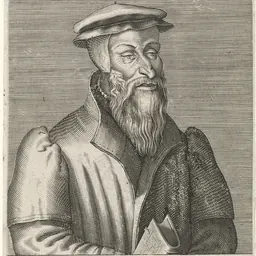
Anthonie de Solempne was a 16th-century Dutch refugee (also known as an Elizabethan Strangers) to the city of Norwich, England who was the first operator of a printing press in the city from around 1567 until at least 1572. Originally a spice merchant in Antwerp, his connection with typographer Albert Christiaensz allowed him to set up a printing press in the city with his own financial backing. He was employed by the Norwich Corporation in 1570 to print bye-laws and obtained citizenship the same year. One of the most wealthy members of the refugee community in the city, he later moved to the White Dove in the city in 1572, possibly switching occupations to sell liquor.
Life in Antwerp In Antwerp in the province of Brabant, Solempne worked as a spice merchant or broker. A 15 March 1566 entry in the Antwerps Poortersboek lists him as a son of one Steven from Mechelen. Solempne was, however, listed as one of only two printers, It was a work of Spanish Protestant minister and 1567 refugee from Antwerp to London Antonio del Corro, translated from Latin with its original title being De opera Dei (On the work of God). This was the first French version of this work. There is a sole surviving copy, which contains four of Solempne's blackletter typefaces and two of ornaments from his edition of the psalms.
Corro later stated that Solempne's ability to quote a lower price of one crown motivated him to come to Norwich to have it printed, though it was also more difficult to legally print works such as this in London. Reading the printing, Corro found that Solempne was not conversant with French and so asked the minister of the Norwich Walloon church, De la Forest, to correct the broadsheet's French. However, the minister reviled the work and covered the margins of the broadsheet with 25 "censures", stating that the broadsheet was an attack on orthodox christology and predestination. The work was still produced, but with no name of printer or place of publication, and later caused a large controversy between Corro and the elders of his adopted Italian Protestant congregation in London. Edmund Grindal, Bishop of London, noted that the publication had not been submitted for approval, and Corro was later suspended from preaching.
Other works Certayne Versis writtene by Thomas Brooks, an execution broadside in English, dates to 1570 and contains lines purporting to have been written by a leader of a minor conspiracy who was hanged in Norwich in August that year, featuring a unique woodcut initial 'I'. The broadside conformed with the Injunction of 1559 and had been licensed by the local ecclesiastical authorities.
Another production from Solempne's press in 1570 was Eenen Calendier, a perpetual calendar and almanac in Dutch, which also contained material aimed toward the Norwich refugee community. This work is in octavo and contains all of Solempne's black letter and roman types together with an uncial not found in other works.
A broadsheet exists in English with a handwritten version of Solempne's imprint dating from 1572, titled A Prayer to be Sayd in the End of the Mornyng Prayer Daily (through the Dioeces of Norwich) during the Tyme of this Sharp Wether, of Frost and Snow. It was printed using three of Solempne's black letter typefaces in the parish of St Andrew, being allowed by the licensing authority.
Typefaces Solempne's largest textura was Vostre’s 2-line Great Primer Textura, with his French Great Primer Textura being another. His Lettersnijder's Pica Textura features as a main text type in his work and went through several variations, gaining damage over time. Others include his Parisian Textura on Bourgeois, and his smallest, Parisian Textura on Brevier. Additional typefaces, which Solempne used to signal changes in textual units as well as section breaks on pages, included a 54mm Brevier roman and an 80mm Pica italic. Many of these typefaces can be identified as Solempne's based on the damage to various letters in the set.
Historiography Mention of Solempne's press is often absent in academia on printing culture in early modern Europe, with some exceptions.
Don’t just read it —
keep it.
Full-length biographies made to live with: read them, listen on the way to work, watch them tonight.
- E-book
- Audio
- Video
Instant download · yours to keep · every purchase keeps this site free
Important facts
Related people
Same field, nearest in time

Frequently asked questions
Who was Anthonie de Solempne?
16th-century Dutch printer who lived in Norwich, England
When was Anthonie de Solempne born?
Anthonie de Solempne was born in Antwerp.
What was Anthonie de Solempne's occupation?
Anthonie de Solempne was a printer.
What nationality was Anthonie de Solempne?
Anthonie de Solempne was British.
Sources & further reading
· Wikipedia: Anthonie de Solempne
· DBpedia: Anthonie de Solempne
Cite this page
APA: Biography.guide. (2026). Anthonie de Solempne. https://biography.guide/anthonie-de-solempne/
MLA: "Anthonie de Solempne." Biography.guide, https://biography.guide/anthonie-de-solempne/.
Chicago: "Anthonie de Solempne." Biography.guide. https://biography.guide/anthonie-de-solempne/.
Data last updated: 2026-09-20 · Spot an error? Report a correction.
Page generated 2026-09-27 05:32 UTC