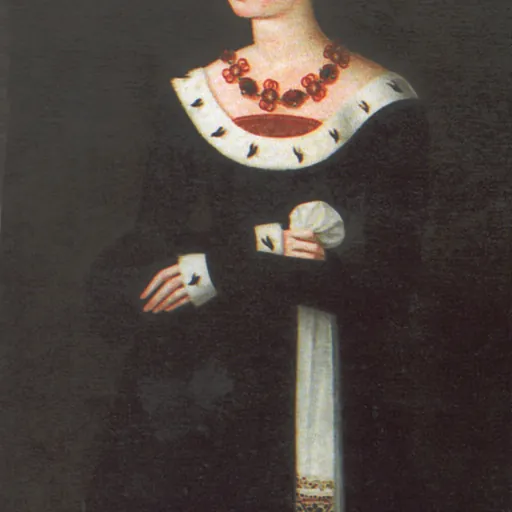
Anne of Nassau-Siegen
German countess regent
About Anne of Nassau-Siegen
Countess Anne of Nassau-Siegen (1440 or 1441 – 5 or 8 April 1514), , official titles: Gräfin zu Nassau, Vianden und Diez, Frau zu Breda, was a countess from the House of Nassau-Siegen, a cadet branch of the Ottonian Line of the House of Nassau, and through marriage successively Duchess of Brunswick-Lüneburg and Countess of Katzenelnbogen. She acted as regent of the Duchy of Brunswick-Lüneburg for her son in the period of 1479–1486.
Biography It is not known where and when Anne was born, some reasons suggest that she was born at the end of 1440 or 1441. She was the eldest daughter of Count John IV of Nassau-Siegen and his wife Lady Mary of Looz-Heinsberg.
Duke Otto II the Victorious of Brunswick-Lüneburg, Anne's first husband. Anonymous portrait, 1595. Royal Collection. Anne married on 28 October 1467 ), who had succeeded his brother Duke Bernard II in 1464. Anne already became a widow in January 1471. Her son Henry succeeded his father. As Henry was still a minor, he was under the custody and regency of his paternal grandfather Duke Frederick II the Pious, who had been in a monastery since 1457. Anne had her dower rebuild between 1471 and 1473.
Anne remarried on 24 January 1474 ). Philip had previously married on 24 February 1422 to Countess Anne of Württemberg . Finally there was a daughter, Anne, who was married to Landgrave Henry III the Rich of Hesse-Marburg.
Burgschwalbach, Anne's dower in Katzenelnbogen. Photo: Johannes Robalotoff, 2004. Anne's second marriage was arranged by Anne's parents with the cooperation of the estates of the realm of the County of Katzenelnbogen. If a son had been born from the marriage between the 72 years old Philip and the 32 years old Anne, the later seizure of the County of Katzenelnbogen by the Landgraviate of Hesse, which had its legal basis in the marriage of Philip's daughter Anne to Henry III of Hesse-Marburg, could have been avoided. This would have been entirely in the interest of the Counts of Nassau. The marriage contract stipulated that Anne should receive an annual income of 1600 guilders in interest and in kind as a dower. Philip assigned Burgschwalbach to his bride as her dower residence, together with the associated lordship and all rights of use; income derived from these lordship rights, for example from court fines and other fees, was not to be deducted from her other income. As a morning gift, Philip obligated himself to allocate her 200 guilders annually, which Anne was allowed to use as she saw fit after his death, for example for the salvation of her soul. In return, Anne was to bring an annual dowry of 400 guilders into the marriage. This dowry consisted of the income from her dower in the Duchy of Brunswick-Lüneburg, the District of Lüchow, which she leased for a sum of 666 guilders annually. For the first time, a firm will on the part of Anne becomes perceptible: as her father-in-law Duke Frederick the Pious and his councillors objected to the lessee she had chosen because they were at feud with him, Anne did not bow to the duke's wishes, but prevailed with regard to the lease agreement. When she left Celle and the Duchy of Brunswick-Lüneburg at the end of 1473, Anne left her five-year-old son in the care of her father-in-law and sister-in-law Margaret as the only female relative. This was customary and even legally binding for the children of a princely widow from her first marriage. After all, Henry was the sole heir to the duchy. What feelings moved Anne in this is unknown, and how the young duke experienced the departure of his mother, is also unknown. After her regency ended in 1486, Anne lived in her town house in Celle, and for a time also in her dower Lüchow Castle, but she also kept in touch with her old homeland and often stayed in Dillenburg or at the spa in Bad Ems. An account from 1487 shows that on 13 July she was in Siegen, together with her brother John, to supervise the progress of the building activities of the Franciscan monastery he had founded there.
Anne died in Celle and was buried there. Duke Henry the Middle (15 September 1468 – Wienhausen, 19 February 1532). He married: in Celle on 27 February 1487 to Princess Margaret of Saxony (Meissen, 4 August 1469 – Weimar, 7 December 1528). around 1528 to Anna von Campe.
The marriage of Anne and Philip remained childless. Great-great-grandparents
Great-grandparents
Grandparents
Parents
Literature
Don’t just read it —
keep it.
Full-length biographies made to live with: read them, listen on the way to work, watch them tonight.
- E-book
- Audio
- Video
Instant download · yours to keep · every purchase keeps this site free
Important facts
Family & relationships
Frequently asked questions
Who was Anne of Nassau-Siegen?
German countess regent
When did Anne of Nassau-Siegen die?
Anne of Nassau-Siegen died in 1514 in Celle.
Sources & further reading
· Wikipedia: Anne of Nassau-Siegen
· DBpedia: Anne of Nassau-Siegen
Cite this page
APA: Biography.guide. (2026). Anne of Nassau-Siegen. https://biography.guide/anne-of-nassau-siegen/
MLA: "Anne of Nassau-Siegen." Biography.guide, https://biography.guide/anne-of-nassau-siegen/.
Chicago: "Anne of Nassau-Siegen." Biography.guide. https://biography.guide/anne-of-nassau-siegen/.
Data last updated: 2026-10-02 · Spot an error? Report a correction.
Portrait: Wikimedia Commons · author & licence
Page generated 2026-10-04 11:17 UTC