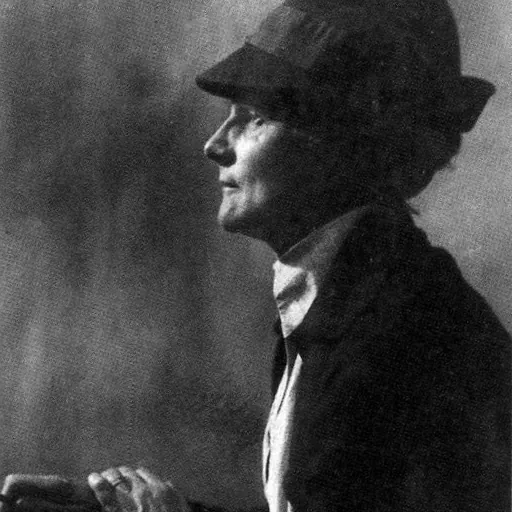
About Anna Feldhusen
Lived 1867 – 1951 (aged 83). Anna Feldhusen was a German painter, exlibrist and painting.
Anna Feldhusen (17 November 1867 – 12 June 1951) was a German painter. She was a prolific producer of still life paintings, of landscape paintings featuring the flat and frequently watery landscapes of north-western Germany and of cityscapes of Bremen, her home city. She was also an able draftswoman with an exceptional talent for producing multi-coloured etchings.
Biography Anna Feldhusen was born and grew up in Bremen at a time when rapid industrial and commercial development, combined with an agricultural depression exacerbated by the increasing availability of inexpensive food imports from overseas (often imported via the port of Bremen) were driving a sustained mass-migration from the countryside to the German cities as people looked for ways to find higher and more predictable incomes. In the case of Bremen, during the second half of the nineteenth century the pressures of intensifying urbanisation triggered a counter-wave of artists, often from prosperous mercantile families, escaping to an art colony in the countryside, the . Johann Philipp Feldhusen, Anna's father, was a Bremen businessman. There were two more sisters. She determined to make her way in life as a professional artist at an early age, moving to Munich in 1892 to obtain the necessary instruction.
Throughout her career, Feldhusen had her own studio. Her Bremen studio was a room in the house at , the home which for a time she shared with her sisters. She was, in addition, a longstanding member of the ("Dachau artists' league"). In 1924 she acquired a business license as an art business. It was a not uncommon device for artists wishing to make a living from their artistic work, but she was, and for many years would remain, the only woman to take this step. She would sign her artworks, for the avoidance of any unnecessary doubt, with the tagline ("Bremen woman painter and graphic artist"). Feldhusen was still selling her own artworks well into her old age.
Many people, especially those from in and around the State of Bremen, became familiar with Feldhusen's work through the Christmas Bazaar organised by the Bremen Cathedral community, at which prints of her etchings could were sold. Several generations were and are made familiar with her images of the city and region through their continuing appearance in Bremen school teaching books. One indication of her prodigious output comes from the accounting records of the arts publishers in Worpswede: These include more than 150 contracts for print runs of her images in excess of 1,000. Between 1903 and 1942 exhibitions of her work took place regularly. These were mostly exhibitions of works offered for sale arranged in the graphics sections of the Bremen "Kunsthalle" art museum or in the artwork displays in the smaller museums and galleries along the Böttgerstraße. Some of her etchings have been taken into the collection of the city's "Gewerbemuseum" (loosely, "Commercial Museum", subsequently renamed as the "Focke Museum"). Her work is also to be found reproduced in the many calendars, magazines and books in which it appeared.
Works
Feldhusen was primarily interested in still life and landscape paintings. Figurative representations are rarely to the fore in her work. When looking for artistic themes, she was drawn to nature. Her many works return again and again to the heather moors around Worpswede and the peaty marshland surrounding Dachau. During her long daily hikes across the countryside she would observe the interplay of light and shadow. What she observed was translated onto canvas with broad expressive brushstrokes.
In terms of technical modalities, the focus of her work is on etching. She became expert in multi-coloured etching and used the possibilities afforded by the technique in various ways. Her principal subjects included a range of Bremen cityscapes: buildings and alleys, veduta panoramas of the city from the Weser, glimpses frequently restricted by the street layouts of the old city, are all precisely drafted reproductions of the realities she witnessed. They were mostly set down as line etchings. Complementary colouring was added to support the mood of the image, either directly as colour etchings or subsequently, applying watercolour paints. The graphical structure of each image always remained the central structure, for which the colouring was never more than supplementary. Often differently coloured prints were produced from a single plate based on the same line-etching.
The many landscapes she produced of the countryside in and around Worpswede display a range of artistic approaches. Some, particularly those from her especially productive period around 1903–04, are characterized by a broader, more economical handling of paint, with less emphasis on perspective and less of the meticulous detail found in her cityscapes.The landscapes tend to use aquatint. Their expressive quality is achieved not so much by invoking a wide range of different colours as through a variability of the shading, achieved through the alternative technology selected.
Although Anna Feldhusen's work fell from critical and public favour for a number of years following her death in 1951, prices achieved at auctions during and since the 1970s indicate a progressive marketplace rehabilitation.
Don’t just read it —
keep it.
Full-length biographies made to live with: read them, listen on the way to work, watch them tonight.
- E-book
- Audio
- Video
Instant download · yours to keep · every purchase keeps this site free
Important facts
Related people
Same field, nearest in time

Contemporaries
People whose lives overlapped Anna Feldhusen's




Frequently asked questions
Who was Anna Feldhusen?
German painter (1867-1951)
When was Anna Feldhusen born?
Anna Feldhusen was born on 17 November 1867 in Bremen.
When did Anna Feldhusen die?
Anna Feldhusen died on 12 June 1951 in Bremen.
What was Anna Feldhusen's occupation?
Anna Feldhusen was a painter, exlibrist and painting.
What nationality was Anna Feldhusen?
Anna Feldhusen was German.
Sources & further reading
Cite this page
APA: Biography.guide. (2026). Anna Feldhusen. https://biography.guide/anna-feldhusen/
MLA: "Anna Feldhusen." Biography.guide, https://biography.guide/anna-feldhusen/.
Chicago: "Anna Feldhusen." Biography.guide. https://biography.guide/anna-feldhusen/.
Data last updated: 2026-09-22 · Spot an error? Report a correction.
Portrait: Wikimedia Commons · author & licence
Page generated 2026-09-27 05:03 UTC