
About Anghel Saligny
Lived 1854 – 1925 (aged 71). Anghel Saligny was a civil engineer, engineer, university teacher and politician.
Anghel Saligny (; 19 April 1854, Șerbănești, Moldavia – 17 June 1925, Bucharest, Romania) was a Romanian engineer, most famous for designing the Fetești-Cernavodă railway bridge over the Danube, the longest bridge in Europe at that time. He also designed the storage facilities in Constanța seaport, one of the earliest examples of reinforced concrete architecture in Europe.
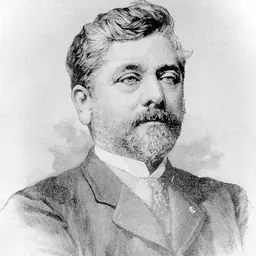
Biography Saligny was born in Șerbănești, Tecuci County (nowadays, Galați County). His father, Alfred Saligny, an educator of French descent, was an immigrant to Moldavia, coming from Prussia. The structure was famous for its era, competing with Gustave Eiffel's engineering works in France—the Garabit viaduct and the Eiffel Tower in Paris.
Brief presentation Studies
the primary classes at the pension in Focşani of his father - Alfred Saligny, pedagogue of French origin from Alsace, settled in Romania; secondary school studies at the future Unirea high school in Focşani (1866-1869); high school studies in Potsdam, Germany (1869); astronomy courses at the Friedrich Wilhelm University in Berlin, having the famous physicist Hermann von Helmholtz as a teacher;
Socio-professional activity after finishing his studies, he worked as an engineer on the construction of the Cottbus-Frankfurt (Oder) railway, in Saxony, and on hydraulic works in northern Prussia, under the direction of Georg Christoph Mehrtens (1874-1875); he returned to Romania at the end of 1875, being appointed ordinary engineer 3rd class in the Service of Bridges and Roads on January 1, 1886, and was immediately sent to Prague for receipts of railway material; upon returning to the country, he was appointed assistant at the second section of the Ploiești-Predeal railway line, fixing his residence in Câmpina and then in Breaza, in May 1876; he designed for the Bucharest City Hall the layout of the alleys next to the Kiseleff Boulevard (1876); he was appointed sub-director of the Bridges and Roads Service on April 8, 1881, and on April 27, 1881, he was promoted to first class ordinary engineer; he was entrusted, in the same year, with the construction works of the railway line Adjud-Târgu Ocna; Gara Mare railway station in Târgu Ocna (architect: A. Saligny), partly destroyed in the World War I he was appointed director for construction of the railway lines Adjud-Târgu Ocna and Bârlad-Vaslui (June 14, 1882); he was entrusted with the construction of the iron bridges that had to replace the wooden bridges that had begun to collapse (March 1883); he was promoted to chief engineer (May 10, 1883); he was commissioned by the General Directorate C.F.R. with the reconstruction of the six large bridges on the Buzău-Mărăşeşti line (February 1884); he was appointed head of the "Bridges and Railways Service" (Oct. 1883), building numerous bridges, including the one in Cosmești, over Siret, the first large bridge designed by him - double road and railway bridge long) - as well as those from Oneşti and Urecheşti; he was confirmed head of the Galati and Brăila Docks (October 3, 1884), a position he held until January 1, 1901, during which he coordinated the construction of docks and warehouses in the ports of Galați and Brăila; they could contain over 25,000 tons of grain - they were x at the base and over high. The walls of the hexagonal cells of the silos were made, also in a world first, from pieces manufactured on the ground, in the form of plates. Prefabrication of floor slabs, stiffening and junction corners, welding of metal bars and assembly mechanization are other global priorities; he was appointed professor at the Department of Bridges within the "School of Bridges and Roads" that would become the "Polytechnic School" of Bucharest, (Nov. 1884 - 1914); he was president of the commissions for the selection of scholarship holders of the "Adamachi" fund for the study of engineering in Romania and of technical specializations abroad; he was promoted to first class chief engineer on June 16, 1886, and worked on the projects for the Filiaşi-Tg Jiu railway; he designed the bridge over the Danube from Cernavodă (1889); he was promoted to inspector general 2nd class on May 9, 1890, and was appointed to the technical commission of the Bucharest City Hall; he built a new standard-gauge Bacău-Piatra Neamț railway line, replacing the old narrow-gauge one (1890-1893); he built the bridge over the Danube from Cernavodă (October 9, 1890 - September 14/26, 1895); he was promoted to the rank of general inspector first class (January 1, 1894); he worked on the consolidation of the bridges over Râmnic and Milcov on the Buzău-Mărăşeşti railway line; he was appointed head of the Railway Bridges (April 1, 1892); he was appointed general director of the Railways (October 7, 1895), a position from which he initiated, in 1895, a law for the reorganization of the Romanian railways and created direct railway routes Bucharest-Berlin and Berlin-Constanța; he was appointed director of the Hydraulic department, of the Docks and Works of the Port of Constanța (13 Aug. 1899); he built the Ramadan port in Giurgiu, favoring the export of oil up the Danube and the import of coal and goods for Bucharest; he was appointed general director of the first Land Improvement Service within the Ministry of Agriculture and Domains, established for the development of land in the flood zone of the Danube and other large rivers in the country (Dec. 21, 1910 – Apr. 1, 1917); he was elected a member of the Board of Censors of the National Bank of Romania (February 17, 1913 – June 17, 1925) and of the "Steaua" oil company; he was director general of Munitions until Romania entered the First World War (Nov. 15, 1915 - Aug. 1916), Minister of Public Works (24 Oct. 1918 – 26 Sept. 1919); he was part of the boards of directors of "Banca de Scont" and "Banca Marmorosch Blank"; he took part in the establishment, in 1913, of the first national maritime navigation society "Romania" and of the Romanian Danube Navigation Society, which started operating on March 1. 1914 (he was its president); he took part in the evacuation of the Romanian treasury in Iași during World War I, then in Moscow; he participated in the organization of the Bucharest Communal Tram Company, of which he was the delegated administrator (1909 – June 17, 1925).
Collaborations Bulletin of the Polytechnic Society, Annals of the Romanian Academy, Adevărul newspaper etc.
Affiliation founding member of the Polytechnic Society of Romania (founded in 1881) and its president between 1894-1897 and 1910–1911; corresponding member (March 31, 1892), full member (April 7, 1897), vice-president (March 26, 1901 – March 23, 1904) and president of the Romanian Academy (April 18, 1907 – May 25, 1910); founding member of the "Gazeta Matematică" Society (founded on Sept. 15, 1895) which established the "Anghel Saligny" fund for the printing of mathematics books, including the Gazeta Matematică magazine.
Awards Grand Cross of the Imperial Austrian Order of Franz Joseph (1896); Grand Cross of the Order of St. Sava - Serbia (19 Oct. 1896); Grand Cross of the Order of the Crown of Romania (May 10, 1897); Commander of the Order of Leopold - Belgium (Nov. 27, 1897); Grand Cross of the Order of Civil Merit - Bulgaria (June 30, 1898); Grand Officer of the Legion of Honour - France (June 22, 1908); Grand Cross of the Order of the Star of Romania (October 27, 1909); Grand Cross of the Order of Saint Anna - Russia (April 10, 1910). As a sign of gratitude, the Polytechnic Society of Romania erected a monument in Cernavodă and another in Bucharest. Also in honour of the great engineer, in 1957 a bronze statue of him was made by the famous sculptor Oscar Han, which was installed in 1965 in front of the main entrance of the Port of Constanța. Also, in front of the new building of the Faculty of Engineering of the "Lower Danube" University in Galați, there is a bust of the engineer, in bronze, installed in 1987.
Notable works
he designed and built the Oneşti and Urecheşti bridges on the Adjud-Târgu Ocna railway line and the double road and railway bridge from Cosmești, over Siret (1882), railway line Tg. Jiu-Filiaşi, the tunnel from Valea Mostiştei, Ramadan port (Giurgiu); he led the construction works of the docks and silos in the ports of Brăila (1888) and Galați (1889), building warehouses with silos where, for the first time in the world, reinforced concrete and prefabricated concrete slabs were used to make the cells; he designed in 1888 and built between 1890 and 1895 the bridge over the Danube at Cernavodă, the longest bridge and with the largest opening - - in 19th century Europe and the third in the world at that time.
Gallery
Don’t just read it —
keep it.
Full-length biographies made to live with: read them, listen on the way to work, watch them tonight.
- E-book
- Audio
- Video
Instant download · yours to keep · every purchase keeps this site free
Important facts
People in Anghel Saligny's life
Named in this biography and alive at the same time



Related people
Same field, nearest in time



Contemporaries
People whose lives overlapped Anghel Saligny's

Frequently asked questions
Who was Anghel Saligny?
Romanian engineer
When was Anghel Saligny born?
Anghel Saligny was born on 19 April 1854 in Liești.
When did Anghel Saligny die?
Anghel Saligny died on 17 June 1925 in Bucharest.
What was Anghel Saligny's occupation?
Anghel Saligny was a civil engineer, engineer, university teacher and politician.
What nationality was Anghel Saligny?
Anghel Saligny's recorded nationality: Principality of Moldavia, Kingdom of Romania.
Sources & further reading
Cite this page
APA: Biography.guide. (2026). Anghel Saligny. https://biography.guide/anghel-saligny/
MLA: "Anghel Saligny." Biography.guide, https://biography.guide/anghel-saligny/.
Chicago: "Anghel Saligny." Biography.guide. https://biography.guide/anghel-saligny/.
Data last updated: 2026-09-20 · Spot an error? Report a correction.
Page generated 2026-09-27 05:21 UTC