
About Angela of Foligno
Lived 1248 – 1309 (aged 60–61). Angela of Foligno was a nun.
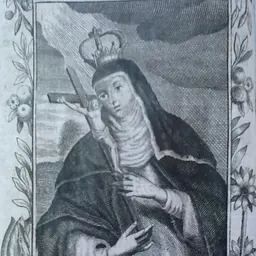
Angela of Foligno (1248 – 4 January 1309) was an Italian Franciscan tertiary who became known as a mystic from her extensive writings about her mystical revelations. Due to the respect those writings engendered in the Catholic Church she became known as Theologorum Magistra ("Teacher of Theologians"), as first used by Maximilian Sandaeus, later cited by Bollandus in the Acta Sanctorum.
Angela was noted not only for her spiritual writings, but also for founding a religious community which refused to become an enclosed order so that it might continue her vision of caring for those in need.
The Catholic Church declared Angela to be a saint in 2013. Her canonization was an “equivalent canonization” (without executing the ordinary judicial process of canonization).
Early life and conversion
Angela's birth date, which is not known with certainty, is often listed as 1248. She was born into a wealthy family at Foligno, in Umbria. Married, perhaps at an early age, she had several children. Angela reports that she loved the world and its pleasures. Around the age of 40, she reportedly had a vision of Francis of Assisi and recognized the emptiness of her life. From that time, she began to lead a life devoted to higher perfection.
Three years later, Angela's mother died, followed, a few months later, by her husband and children.
Angela recorded the history of her conversion in her Book of Visions and Instructions. She dictated, in her Umbrian dialect, an account of her spiritual progress, known as the Memoriale, which was transcribed in Latin by a Franciscan friar indicated only as "Bro A." This work was probably begun in 1292. The Memorial is the first part of two sections of Angela of Foligno's Liber. The second text is known as Instructions and is composed of thirty-six instructional texts, a note about her death, and an epilogue. These texts appear in different orders in different manuscripts, and there is not known to be one correct order.
Brother A. remained with her until 1296 while she completed the higher and more difficult final ten stages, but since it proved impossible for him to understand these fully, he condensed them into seven ‘supplementary stages’ whose description takes up the larger portion of the Memorial. The text was finished by 1298, and submitted to Cardinal James of Colonna and eight Friars Minor, who gave it their approval. It seems that Brother A. revised it shortly after, in 1299–1300.
Between around 1296 and her death in early 1309, the fame of Angela's sanctity gathered around her a number of other tertiaries, both men and women, who strove under her direction to advance in holiness. Later she established at Foligno a community of other women tertiaries, who added to the Rule of the Third Order a commitment to a common life without, however, binding themselves to enclosure, so that they might devote their lives to works of charity.
The final version of the Book appends a series of 36 Instructions to the Memorial.
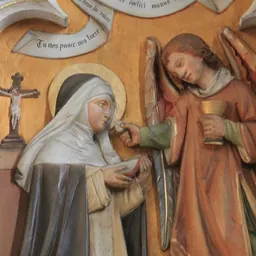
At Christmas 1308, Angela told her companions she would die shortly. A few days later, she had a vision of Christ appearing to her and promising to come personally to take her to heaven. She died in her sleep on 3 January 1309.
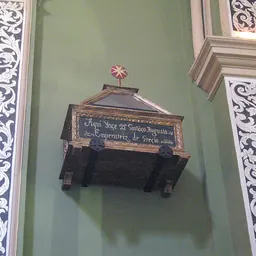
Angela died surrounded by her community of disciples. Her remains repose in the Church of St. Francis at Foligno. Many people attributed miracles to her intercession. Francis also mentions her in his encyclical letter Dilexit nos as one of a number of "holy women" who have "spoken of resting in the heart of the Lord as the source of life and interior peace".
Her feast day is celebrated by the Third Order of Saint Francis, both Secular and Regular, on 4 January (7 January in the United States). Although the community she founded was not recognized as a religious institute until the 20th century, she is honored as a religious.
Don’t just read it —
keep it.
Full-length biographies made to live with: read them, listen on the way to work, watch them tonight.
- E-book
- Audio
- Video
Instant download · yours to keep · every purchase keeps this site free
Important facts
Related people
Same field, nearest in time


Contemporaries
People whose lives overlapped Angela of Foligno's




Frequently asked questions
Who was Angela of Foligno?
Italian saint
When was Angela of Foligno born?
Angela of Foligno was born in 1248 in Foligno.
When did Angela of Foligno die?
Angela of Foligno died on 4 January 1309 in Foligno.
What was Angela of Foligno's occupation?
Angela of Foligno was a nun.
Sources & further reading
· Wikipedia: Angela of Foligno
Cite this page
APA: Biography.guide. (2026). Angela of Foligno. https://biography.guide/angela-of-foligno/
MLA: "Angela of Foligno." Biography.guide, https://biography.guide/angela-of-foligno/.
Chicago: "Angela of Foligno." Biography.guide. https://biography.guide/angela-of-foligno/.
Data last updated: 2026-09-20 · Spot an error? Report a correction.
Page generated 2026-09-27 05:26 UTC