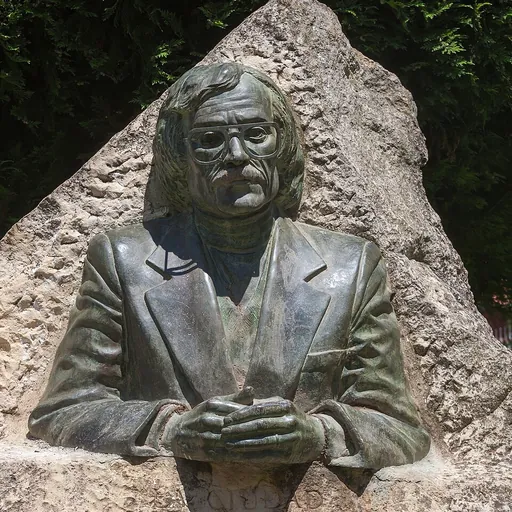
About Ángel Barja
Lived 1938 – 1987 (aged 48). Ángel Barja was a Spanish composer.
Ángel Barja Iglesias (5 October 1938, Terroso, Villardevós, Spain – León, 12 February 1987) was a Spanish composer.
Chronologically, he belongs to the generation that followed the so-called Generation of ’51, represented by composers such as Luis de Pablo, Carmelo Bernaola, Ramón Barce, Xavier Benguerel, Cristóbal Halffter, and Tomás Marco.
According to composer José Luis Turina, Spanish composers born around 1930 emerged around 1951 as a unified group characterized by a high degree of aesthetic cohesion and a groundbreaking approach. However, those born during the following two decades developed a much wider range of currents and trends.
Ángel Barja's career can be situated within this generational context, as his work incorporates influences and compositional procedures ranging from traditional styles to the most innovative avant-garde movements, all within a highly individual and distinctive musical language.
Biography
Early life and education Barja began his musical education in 1950 at the Redemptorist school of El Espino (Burgos), where he studied solfège, piano, and harmony. At the age of fifteen he composed his first choral work, Campanas de Bastabales, a setting of a poem by Rosalía de Castro for four-part choir and bass solo.
In 1956, he entered the Redemptorist novitiate at Nava del Rey (Valladolid), professing his religious vows the following year. He continued his studies at the Redemptorist College in Valladolid with the composer José María Goicoechea and the pianist Pablo San José, and deepened his knowledge of music history, aesthetics and musical performance, from Gregorian chant to the avant-garde movements of the 20th century. During this period, he composed the stage work El rey de los hunos, for choir and several instruments
In 1961 he received a diploma as Master of Gregorian Chant in Madrid.
Between 1965 and 1966 Barja taught at the Redemptorist school of El Escorial, where he also directed school choirs while continuing to compose. His works from this period include Canciones para cello y piano, several piano pieces that would later become part of the collection Álbum de juventud, as well as organ works such as Tema y variación and Meditación.
The Italian years In 1967, Barja moved to Italy to continue his musical education at the Pontifical Institute of Sacred Music in Rome. There he studied with Vieri Tosatti, Eugène Cardine, Higinio Anglés, Ferdinand Haberl and Domenico Bartolucci, among others. Alongside his studies, he was exposed to contemporary musical trends, concerts and avant-garde musicians, particularly through the Gruppo di Improvvisazione Nuova Consonanza. He also came into contact with composers such as Luciano Berio, Goffredo Petrassi, Sylvano Bussotti, Bruno Maderna, Luigi Nono, Mauricio Kagel, Pierre Boulez, and John Cage.
During these years in Italy, he travelled to Milan and Venice and also visited Austria, Switzerland, and Germany. In Vienna, he became particularly influenced by the work of Anton Webern. According to Enrique Franco, Barja took Webern as a model, yet from a perspective of a “free thinking and without aesthetic compromises.”
Among the works from this period are Misa Ara Coeli, Canciones para orquesta de cuerda, Romance de la luna, luna, Tres piezas para orquesta, and Canon para violín y viola; chamber works such as the String Quartet No. 1 in D major, 2 Madrigales para violín y viola, and numerous pieces for piano and organ.
Return to Spain In 1971, the Redemptorist community sent Barja to León (Spain), where he resumed teaching at the Redemptorist School in Astorga. He became director of the Capilla Clásica, a choir founded in 1965, and also taught at the Music Conservatory. Living away from Spain’s major musical centers might have limited his visibility and professional opportunities and contributed to his focus on choral music, a field that offered greater opportunities for performance within his local musical environment than his chamber or orchestral works .
However, his work began to receive recognition beyond the province through his success in numerous composition prizes. In 1972, he won the Second Prize in the International Organ Composition Competition of Ávila for Lamentatio temporis and the National Polyphonic Composition Prize for Madrigal .
During these years, he also composed Canciones Espirituales, a set of sacred songs; Madrigales y canciones, based on texts by poets from the Renaissance and the Spanish Golden Age; several works for piano, such as Suite for Piano, Divertimenti, Cantos de Esperanza, and Cuadernos de lectura a primera vista, a didactic collection; as well as Canticum for choir and chamber orchestra.
In 1975 Barja began a work compilation of folk music of the region, published in the collection Canciones del Reino de León, one of his main contributions to the region's musical heritage.
Some time later, he renounced his religious vows and married in 1978. That year he composed the score for the series La Mancha, tierra de Don Quijote, an orchestral work based on a melody by Eusebio Goicoechea. The Capilla Clásica choir also participated in the recording of the album Maestros de Capilla de la Catedral de León (18th Century), issued as part of the collection Monumentos Históricos de la Música Española
In 1982 he composed Cantos de noche alta, a cycle of fifteen piano pieces as a tribute to the work of Federico Mompou. The following year, at the request of the Mompou Trio, he composed Trio, for violin, cello, and piano. He also completed the String Quartet No. 4: Fluencias, which was premiered at the Santander Festival by the Coull String Quartet.
Final years In 1984, the city of León honoured Barja at a tribute concert featuring the Coull String Quartet, the Coral Salvé de Laredo, and the music critic Enrique Franco. He was also commissioned by the mezzo-soprano Teresa Berganza to compose an opera, but it could not be completed due to time constraints. At the time, Barja was engaged in several major compositions, including Planctum Jeremiae, commissioned by The Scholars. He also composed Pequeña Suite for two recorders and the Suite para un gentil órgano, and began work on a fifth string quartet that remained unfinished.
In 1985, he received a grant to collect traditional songs from the region. Barja initiated the project in collaboration with the folklorist Miguel Manzano, who completed the compilation on his own after Barja's death . Barja also wrote a series of newspaper articles on music criticism and dissemination for the cultural supplement El Filandón of the Diario de León.
In 1986 he won the City of Segorbe Composition Prize for Caro mea. His book Música y poesía para niños was published in January 1987, co-authored with Alfonso García .
After a long illness, Ángel Barja died in February 1987.
A collection of his autograph manuscripts is preserved in the Music Department of the National Library of Spain.
Discography
Limones van por el río - IBS Classical, 2018. Héctor Guerrero, Miguel Bernal, Blanca Gómez. El piano de Ángel Barja - Esther Sánchez, 2007. Música de cámara - Caskabel, León, 2002. Belén Ordóñez Badiola - piano - Caskabel, León, 1994. Cuartetos - Caskabel, León 1993. Maggini Quartet, Coull String Quartet. Coral Salvé de Laredo - La poesía, la tradición - Caskabel, León, 1993. Conductor: José Luis Ocejo. Obras para órgano - Caskabel, León 1992. David Hoyland, José Manuel Azkue. Obras corales - Caskabel, León, 1992. Capilla Clásica de León. Conductor: Fernando García Pérez. La señora luna - RNE. Diputación de León. Madrid, 1991. Coral Valderense Coyantina. Conductor: Luis G. Viñuela. The Scholars - Caskabel, León, 1991. Ángel Barja - Commemorative set. Caskabel, León, 1989. National Recording Award, Ministry of Culture, 1989. Maestros de capilla de la Catedral de León - Ministry of Education and Science, Madrid, 1978. Monumentos Históricos de la Música Española. Capilla Clásica de León. Conductor: Ángel Barja. Camerata de Madrid. Conductor: Luis Remartínez. Vivo sin vivir en mí - Ediciones Paulinas, Madrid, 1981. Tribute to Sta. Teresa de Jesús. Antología Coral Salvé de Laredo - Columbia, Madrid, 1981. National Recording Award, Ministry of Culture, 1983. Coral Salvé de Laredo (Música montañesa I) - Columbia, Madrid ,1978. Conductor: José Luis Ocejo. Coral Salvé de Laredo (Música pejina I) - Columbia, Madrid, 1977. Conductor: José Luis Ocejo. Canciones del Reino de León II - Columbia, Madrid, 1977. Capilla Clásica de León. Conductor: Ángel Barja. Canciones del Reino de León I - Columbia, Madrid, 1975. Capilla Clásica de León. Conductor: Ángel Barja.
Awards and prizes
1972: International Organ Composition Competition of Ávila (Second prize) for Lamentatio temporis 1972: National Polyphonic Composition Prize for Madrigal 1976: International Organ Composition Prize of Ávila for Retablo 1981: International Polyphonic Composition Prize of Tolosa for Cantiones Job 1981: Rosalía de Castro Prize for Choral Music 1982: Cristóbal Halffter Composition Prize for Preludio, canción y fuga 1984: National Composition Prize of the City of Zamora 1984: San Vicente de la Barquera Choral Composition Prize 1985: International Composition Prize of Tolosa for Planctum Jeremiae 1985: International Prize of the Academy of Fine Arts of Granada for Impression for Bach 1986: City of Segorbe Composition Prize for Caro mea
Don’t just read it —
keep it.
Full-length biographies made to live with: read them, listen on the way to work, watch them tonight.
- E-book
- Audio
- Video
Instant download · yours to keep · every purchase keeps this site free
Important facts
People in Ángel Barja's life
Named in this biography and alive at the same time






Related people
Same field, nearest in time

Contemporaries
People whose lives overlapped Ángel Barja's




Frequently asked questions
Who was Ángel Barja?
Spanish composer
When was Ángel Barja born?
Ángel Barja was born on 5 October 1938 in Terroso.
When did Ángel Barja die?
Ángel Barja died on 12 February 1987 in León.
What was Ángel Barja's occupation?
Ángel Barja was a composer.
What nationality was Ángel Barja?
Ángel Barja was Spanish.
Sources & further reading
Cite this page
APA: Biography.guide. (2026). Ángel Barja. https://biography.guide/angel-barja/
MLA: "Ángel Barja." Biography.guide, https://biography.guide/angel-barja/.
Chicago: "Ángel Barja." Biography.guide. https://biography.guide/angel-barja/.
Data last updated: 2026-09-20 · Spot an error? Report a correction.
Portrait: Wikimedia Commons · author & licence
Page generated 2026-09-27 04:58 UTC