
Andrew William Moore
Ph.D. University of Cambridge 1990. Computer Scientist and Dean at Carnegie Mellon University
About Andrew William Moore
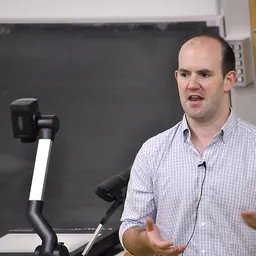
Andrew William Moore was a British and American computer scientist, university teacher, software engineer and academic administrator.
Andrew William Moore is a British-American computer scientist whose research spans machine learning, artificial intelligence, robotics, and large-scale statistical data mining. He is the co-founder and CEO of Lovelace AI, a Pittsburgh-based technology company. Moore previously served as Dean of the Carnegie Mellon School of Computer Science from 2014 to 2018 and held senior roles at Google, including leading Google Cloud AI. In 2023, he was appointed the first adviser for artificial intelligence, robotics, and cloud computing to the United States Central Command.
Early life and education
Early life Moore grew up in Bournemouth, on the south coast of England. During his childhood in Bournemouth, he developed an early interest in computing by writing video games for 6502-based personal computers, including the Tangerine Microtan 65. Following his doctorate, Moore held a postdoctoral position at the Massachusetts Institute of Technology (MIT) in Chris Atkeson's Robot Learning group, where his work included research on robot juggling, manipulation, and the application of non-parametric regression to tasks such as pool playing. In October 2011, while continuing to lead the Pittsburgh office, he was named vice president of engineering for Google Commerce. He left in August 2014 to return to Carnegie Mellon. He began in an advisory capacity before taking on the full-time role in January 2019. In May 2025, the company closed a seed round of $16.2 million led by RRE Ventures.
Government and advisory work
United States Central Command In April 2023, Moore was appointed the first adviser for artificial intelligence, robotics, and cloud computing to the United States Central Command (CENTCOM).
Research Statistical machine learning and big data Moore's research has focused on statistical machine learning and the application of computational statistics to big data, emphasizing efficient algorithms capable of handling massive datasets to uncover patterns and extract meaningful information. His work applies statistical methods and mathematical formulations to large volumes of data from diverse sources, including web searches, astronomy, and medical records, enabling the identification of subtle patterns and the derivation of actionable insights. The lab has pioneered methods for performing large-scale statistical operations efficiently, often achieving improvements over prior state-of-the-art performance by several orders of magnitude. These advances have supported applications in areas such as Bayesian networks, data mining, medical informatics, and social network analysis. To disseminate knowledge in these fields, Moore created extensive online tutorials covering foundational and advanced topics in statistical machine learning and big data. These include probability and density estimation, Bayesian networks (with coverage of inference, structure learning, and naive Bayes classifiers), non-parametric methods such as instance-based learning, and efficient algorithms for tasks like clustering and regression. These resources have been widely accessed and used in education and practice.
Robotics and reinforcement learning Moore's contributions to robotics and reinforcement learning began during his doctoral studies at the University of Cambridge, where he focused on efficient machine learning methods for robot control. In his 1991 PhD thesis, Efficient Memory-based Learning for Robot Control, Moore developed memory-based techniques that allowed robots to learn control policies directly from sensory data and experience, emphasizing fast, instance-based generalization over parametric models. These methods were demonstrated through experiments including simulated robot juggling tasks, where the system learned to maintain stable ball manipulation with relatively few trials. Moore further addressed scalability in complex environments through variable resolution reinforcement learning. His 1994 paper "Variable Resolution Reinforcement Learning" presented the parti-game algorithm, which adaptively partitions state space using kd-trees and incorporates a continuity assumption to minimize unnecessary exploration. The method was validated on robotic tasks, including navigation of a 9-joint snakelike manipulator around obstacles and control of a puck on a non-linear bumpy surface. The lab develops efficient algorithms, intelligent data structures, and learning methods for large-scale statistical operations in machine learning and statistical data mining. The lab has also partnered with industrial research groups, supported predictive maintenance in safety-critical systems, and spun out concepts into successful startups.
Publications Books Wagner, M.M., Moore, A.W., and Aryel, R.M., eds. (2006). The Handbook of Biosurveillance. Academic Press.
Selected articles Moore, A.W. and Atkeson, C.G. (1993). "Prioritized Sweeping: Reinforcement Learning with Less Data and Less Real Time." Machine Learning, 13(1): 103–130. Wong, W.K., Moore, A.W., Cooper, G.F., and Wagner, M.M. (2005). "What's Strange About Recent Events (WSARE): An Algorithm for the Early Detection of Disease Outbreaks." Journal of Machine Learning Research, 6: 1961–1998. Liu, T., Moore, A.W., and Gray, A. (2006). "New Algorithms for Efficient High-Dimensional Nonparametric Classification." Journal of Machine Learning Research, 7: 1135–1158. Moore, A.W. (1991). "An Introductory Tutorial on Kd-trees" (from Ph.D. thesis: Efficient Memory-based Learning for Robot Control). University of Cambridge.
Recognition Moore was elected a Fellow of the Association for the Advancement of Artificial Intelligence in 2005.
Don’t just read it —
keep it.
Full-length biographies made to live with: read them, listen on the way to work, watch them tonight.
- E-book
- Audio
- Video
Instant download · yours to keep · every purchase keeps this site free
Important facts
Related people
Same field, nearest in time





Frequently asked questions
Who was Andrew William Moore?
Ph.D. University of Cambridge 1990. Computer Scientist and Dean at Carnegie Mellon University
What was Andrew William Moore's occupation?
Andrew William Moore was a computer scientist, university teacher, software engineer and academic administrator.
What nationality was Andrew William Moore?
Andrew William Moore was British and American.
Sources & further reading
· Wikipedia: Andrew William Moore
Cite this page
APA: Biography.guide. (2026). Andrew William Moore. https://biography.guide/andrew-william-moore/
MLA: "Andrew William Moore." Biography.guide, https://biography.guide/andrew-william-moore/.
Chicago: "Andrew William Moore." Biography.guide. https://biography.guide/andrew-william-moore/.
Data last updated: 2026-09-20 · Spot an error? Report a correction.
Page generated 2026-09-27 05:06 UTC