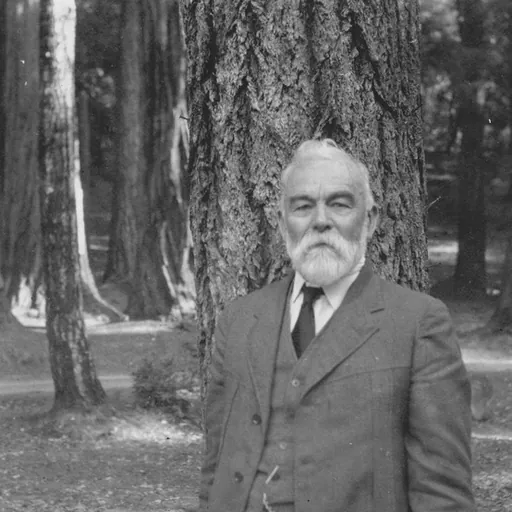
About Andrew P. Hill
Lived 1853 – 1922 (aged 69). Andrew P. Hill was an American photographer and painter.
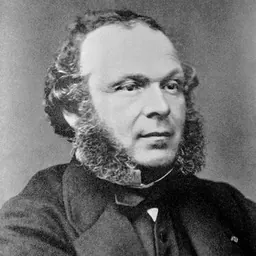
Andrew Putnam Hill (August 9, 1853–September 3, 1922) was a Californian painter and photographer best known for successfully leading an effort from 1899 to 1902 to save a forest of large redwoods in Big Basin, California, as a public park, the first in what became the California State Park System.
Life and career Hill was the only child of Elijah and Jane Hill, both of whom were descended from early American settlers. Born on August 9, 1853, in Porter County, Indiana, he came to California with his uncle when he was fourteen; his father had come West shortly before Andrew's birth but died of exhaustion and exposure after surviving an Indian attack. Although a Protestant, he studied for two years at the Catholic Santa Clara College, (now Santa Clara University) in Santa Clara: one year at high-school level and one at college freshman level. When Franklin left a year later, he partnered with his mother-in-law, Laura Broughton Watkins, as the Hill and Watkins Photographers Studio. For three years they were joined by watercolor artist Sydney J. Yard. In the earthquake of 1906, Hill's studio and the works there were destroyed, as was his painting The Murphy Party, which hung in the historical room of the California Pioneers Association in San Francisco and depicted the first settlers crossing Sunset Pass. At the turn of the century only 25% of the old growth Redwood forests remained. Hill vowed to save the redwoods for posterity. In his memoirs, he wrote of this decision: I was a little angry, and somewhat disgusted, with my reception at the Santa Cruz Big Trees. It made me think. There were still fifteen minutes until the train time. Just as the gate closed, the thought flashed through my mind that these trees, because of their size and antiquity, were among the natural wonders of the world, and should be saved for posterity. I said to myself, "I will start a campaign immediately to make a public park of the place." I argued that as I had been furnishing illustrations for a number of writers, whom I knew quite well, that there was a latent force, which, when awakened to a noble cause, would immediately respond, and perhaps arouse the press of the whole country. Thus was born my idea of saving the redwoods.
His attention shifted to Big Basin when it was suggested that the redwoods there were taller and more important. On May 18, 1900, while camping there, he and others founded the Sempervirens Club, which decided that Big Basin should become a public park. Many prominent locals supported the effort, including Santa Clara College's president, Robert E. Kenna, S.J., Stanford University's president, David Starr Jordan, the mayor of San Francisco, James D. Phelan (Kenna's nephew), and Carrie Stevens Walter, who later served as secretary of the club. and after securing a monetary guarantee from Phelan, a bill that allocated $250,000 to purchase the Big Basin land passed. These were enormous sums of money at the time. Supporters secured a second $250,000 from private benefactors and, with the state, created California's first state park, California Redwood Park, now Big Basin Redwoods State Park and now encompassing over of protected temperate rainforest lands. Father Kenna was appointed one of the first park commissioners. The park opened to camping in 1904. Hill spent summers there and photographed the trees until his death.
Death Hill died on September 3, 1922, in Pacific Grove, California, at age 69. His ashes were scattered at Big Basin Redwoods State Park "at the foot of the redwood monarch which will have the honor of forming his monument."
Legacy
Hill was unable to achieve financial success, leaving his family less than $900 at his death, among the last 3% of old growth Redwood forests remaining today. As stated in Eugene T. Sawyer's history of Santa Clara County, "Mr. Hill had a public duty to perform, and he went at it with a singleness of purpose which has made men conquerors of fate since the beginning of time." The California State Parks named the Hill Award for Inspiration after him.
The Victorian Preservation Association of Santa Clara Valley bought his San Jose house in 1995, moved it to History Park at Kelley Park, and has fully restored it. Andrew P. Hill High School in San Jose is named after him.
Don’t just read it —
keep it.
Full-length biographies made to live with: read them, listen on the way to work, watch them tonight.
- E-book
- Audio
- Video
Instant download · yours to keep · every purchase keeps this site free
Important facts
People in Andrew P. Hill's life
Named in this biography and alive at the same time


Related people
Same field, nearest in time



Contemporaries
People whose lives overlapped Andrew P. Hill's

Frequently asked questions
Who was Andrew P. Hill?
American artist, photographer and conservationist (1853–1922)
When was Andrew P. Hill born?
Andrew P. Hill was born on 9 August 1853 in Valparaiso.
When did Andrew P. Hill die?
Andrew P. Hill died on 3 September 1922 in Pacific Grove.
What was Andrew P. Hill's occupation?
Andrew P. Hill was a photographer and painter.
What nationality was Andrew P. Hill?
Andrew P. Hill was American.
Sources & further reading
Cite this page
APA: Biography.guide. (2026). Andrew P. Hill. https://biography.guide/andrew-p-hill/
MLA: "Andrew P. Hill." Biography.guide, https://biography.guide/andrew-p-hill/.
Chicago: "Andrew P. Hill." Biography.guide. https://biography.guide/andrew-p-hill/.
Data last updated: 2026-09-23 · Spot an error? Report a correction.
Portrait: Wikimedia Commons · author & licence
Page generated 2026-09-27 05:05 UTC