
Andrew Gillison
Scottish-born Australian minister
About Andrew Gillison
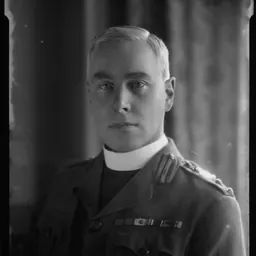
Lived 1868 – 1915 (aged 46–47). Andrew Gillison was a military chaplain and presbyterian minister.
Captain Andrew Gillison (7 June 1868 – 22 August 1915) was an Australian minister who served as a Presbyterian chaplain in the Australian Army. He was born and educated in Scotland and practised there as a minister. Gillison also served in the Volunteer Force's Queen's Edinburgh Rifles. He emigrated to Australia in 1903 to take up a post at St Paul's Presbyterian Church, Spring Hill, and, from 1909, at St George's Church in St Kilda East, Victoria.
Gillison was appointed a chaplain to the Australian military in 1906. After the outbreak of the First World War he was appointed a chaplain-captain to the 14th Battalion. He was posted with them to the Dardanelles campaign and landed at Anzac Cove within the first few days of the operation. During the campaign Gillison assisted with wounded soldiers, buried the dead and carried out religious services. Despite his non-combatant status he took up arms to snipe at Turkish soldiers. Gillison was killed on the second day of the Battle of Hill 60 while trying to retrieve a wounded soldier from no man's land.
Early life Gillison was born on 7 June 1868 at Baldernock, Stirlingshire, Scotland. His father was John Gillison, a minister in the Free Church of Scotland, and his mother was Jane Broatch. Gillison was involved in arranging a truce on 24 May to allow burial of a large number of dead lying in no man's land. Gillison subsequently received a mention in despatches from General Ian Hamilton, commander of the Mediterranean Expeditionary Force, on 11 December 1915.
Gillison later served directly with his battalion. In spite of his non-combatant status Gillison made use of his target-shooting experience in counter-sniping against the Turkish forces. The 4th Brigade was held in reserve for the Battle of Chunuk Bair and on the day before the attack (6 August) Gillison held a service in which the massed men sang the hymn "Lead, Kindly Light". In the event, the main attacking forces of 1st Brigade were successful and the 4th Brigade was not called upon to reinforce them.
Death On 21 August the British Empire forces launched the Battle of Hill 60, one of the last major offensives in Gallipoli and an attempt to unite the Anzac Cove front with that at Suvla Bay. British, Australian, New Zealand and Indian troops were involved. After the failure of the first day's attack many wounded were left lying in no man's land, at risk of burning to death from fires caused by exploding shells. Gillison, his battalion's medical officer Captain Henry Loughran and a former Methodist minister, Corporal Robert Pittendirgh were active that night in bringing in the casualties.
The following day Gillison was in the front line trench, waiting to read a burial service when he heard the cries of a wounded man left on the field. Loughran warned that rescue was impossible as the route to the man was covered by Turkish rifle and machine gun positions but Gillison, Pittendirgh and Private Arthur Wild decided to attempt a rescue. Pittendirgh successfully returned to the Australian trench but Gillison collapsed short of it and was brought in by others, Wild escaped unharmed. He spoke with three fellow chaplains before his death, which happened around 2:00pm. The 14th Battalion's 1929 official history notes that with his death "the 14th suffered the greatest loss it had yet incurred in the death of any one man". Gillison's diary is in the collection of the Australian War Memorial (AWM) and covers a period from 1 November 1914 until his death. The AWM also holds his purse, containing three Turkish 20 piastre coins, and his next-of-kin's Memorial Plaque. Gillison's grave lies in the Embarkation Pier Cemetery, cared for by the Commonwealth War Graves Commission, and his grave marker includes the personal inscription "Their glory shall not be blotted out". Gillison was survived by his wife, three sons and a daughter. One son was Douglas Napier Gillison, who wrote the official history of the Royal Australian Air Force for 1939–42.
Don’t just read it —
keep it.
Full-length biographies made to live with: read them, listen on the way to work, watch them tonight.
- E-book
- Audio
- Video
Instant download · yours to keep · every purchase keeps this site free
Important facts
People in Andrew Gillison's life
Named in this biography and alive at the same time




Related people
Same field, nearest in time




Contemporaries
People whose lives overlapped Andrew Gillison's




Frequently asked questions
Who was Andrew Gillison?
Scottish-born Australian minister (1868–1915)
When was Andrew Gillison born?
Andrew Gillison was born on 7 June 1868.
When did Andrew Gillison die?
Andrew Gillison died in 1915.
What was Andrew Gillison's occupation?
Andrew Gillison was a military chaplain and presbyterian minister.
Sources & further reading
Cite this page
APA: Biography.guide. (2026). Andrew Gillison. https://biography.guide/andrew-gillison/
MLA: "Andrew Gillison." Biography.guide, https://biography.guide/andrew-gillison/.
Chicago: "Andrew Gillison." Biography.guide. https://biography.guide/andrew-gillison/.
Data last updated: 2026-09-20 · Spot an error? Report a correction.
Page generated 2026-09-27 04:57 UTC