
About Andrei Grechko
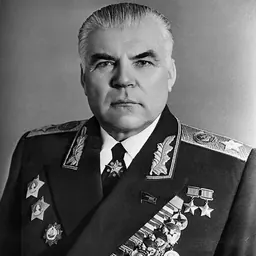
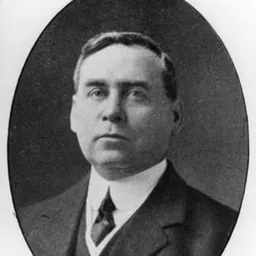
Lived 1903 – 1976 (aged 72). Andrei Grechko was a Russian military officer, politician and soldier.
Andrei Antonovich Grechko (; ; – 26 April 1976) was a Soviet military commander and Marshal of the Soviet Union during the Cold War. He served as the Soviet minister of defence from 1967 to 1976.
Born to a Ukrainian peasant family near Rostov-on-Don, Grechko served in the Red Army cavalry during the Russian Civil War. After graduating from the Frunze Military Academy, he took part in the Soviet invasion of Poland in 1939. Grechko was a fresh graduate of the Voroshilov Military Academy when Axis forces invaded the Soviet Union. He held a succession of cavalry and army commands afterwards and saw action in the Caucasus, Ukraine and Central Europe.
After the war, Grechko commanded the Kiev Military District. In 1953, he was appointed commander-in-chief of Soviet Forces in East Germany, and led the suppression of the East German uprising. In 1955, he was named a Marshal of the Soviet Union. In 1957, he became commander-in-chief of the Soviet Ground Forces, and three years later he also became the commander of the Warsaw Pact forces. In 1967, Grechko was appointed Minister of Defence, and oversaw the subsequent Warsaw Pact invasion of Czechoslovakia and violent border clashes with China. He helped modernize the Soviet Army and was responsible for continuing the Soviet hegemony over Eastern Europe. An ideological hardliner, he was a defender of the first strike nuclear strategy, and only reluctantly supported Leonid Brezhnev's détente with the United States and the Strategic Arms Limitation Talks (SALT). Grechko died in 1976 at the age of 72.
Early life Grechko was the thirteenth child born to a family of Ukrainian peasants on 17 October 1903, at a small town near Rostov-on-Don.
Early military career
He joined the Red Army in 1919, where he was a part of the 1st Cavalry Army. During the war, he fought in the Caucasian Front and Southern Front, where he fought in battles against the White Army troops of Generals Anton Denikin and Pyotr Wrangel, and detachments of Ataman Nestor Makhno, and the elimination of political and criminal banditry.
From 5 January 1943, Grechko was commander of the 56th Army in the Transcaucasian Front, during which he took part in the North Caucasian Strategic Offensive Operation. After fierce battles in January, his unit broke through the heavily fortified enemy defenses and reached the approaches to Krasnodar. From February to March, as part of the North Caucasian Front, he participated in the Krasnodar Offensive, and then in a number of local and mostly unsuccessful offensive operations of the front troops. In September 1943, the troops of the 56th Army, in cooperation with the 9th and the 18th Armies, liberated the Taman Peninsula from the direction of Novorossiysk, during the Novorossiysk-Taman Strategic Offensive Operation.
Grechko served as the deputy commander of the Voronezh Front from 16 October 1943 and on 20 October, he was appointed as deputy commander of the 1st Ukrainian Front. During this time, he fought in the Battle of the Dnieper and Second Battle of Kiev.
Then, on 14 December 1943, he was made the Commanding General of 1st Guards Army, a position he held until the end of the war. The First Guards Army was a part of the 4th Ukrainian Front, which was led by Col.-Gen. Ivan Yefimovich Petrov. Grechko led the 1st Guards in a number of offensive operations, predominantly in Czechoslovakia, Hungary and into Austria.
On 11 March 1955, Grechko and five other high-ranking colleagues, all of whom gained recognition during the Great Patriotic War as either army or front commanders – Moskalenko, Chuikov, Bagramyan, Biryuzov and Yeremenko - were promoted to the rank of Marshal of the Soviet Union. From 1957 to 1960, Grechko was the Commander-in-Chief of the Ground Forces. By decree of the Presidium of the Supreme Soviet of the USSR of 1 February 1958, "for the courage and heroism shown in the fight against the Nazi invaders", Grechko was awarded the title of Hero of the Soviet Union with the Order of Lenin and the Gold Star medal.
From 1960 to 1967, he was the Commander-in-Chief of the Warsaw Pact Forces.
Minister of Defense On 12 April 1967, Grechko was made the Minister of Defense, taking over shortly after Marshal Rodion Malinovsky died. Grechko served in this capacity until his death in 1976. During the 1970s, Grechko served as the chairman of the editorial commission that produced the official Soviet history of the Second World War.
In January 1968, following the outbreak of the Prague Spring in Czechoslovakia, Grechko was the major planner and supporter of the Warsaw Pact invasion of the country, which stopped Alexander Dubček's Prague Spring liberalisation reforms and strengthened the authoritarian wing of the Communist Party of Czechoslovakia (KSČ). In March 1969, Chinese and Soviet troops fought in violent border clashes near Damansky Island and Tielieketi. In response to the clashes, Grechko strongly persuaded General Secretary of the Communist Party Leonid Brezhnev to carry out a surgical nuclear strike against China, especially targeting the Lop Nur Nuclear Test Site in the Chinese autonomous region of Xinjiang. Due to the resistance of the party factions headed by Mikhail Suslov and Soviet Premier Alexei Kosygin, who went to Beijing to meet with the Chinese leaders to reduce tensions between the two countries, a nuclear war was avoided.
In December 1971, during the Indo-Pakistani War of 1971, Grechko helped to provide military support to India during the war. During the Arab-Israeli conflict, Grechko oversaw the providing of Soviet military support to Arab countries against Israel. In the final days of the Yom Kippur War in 1973, Grechko authorized the Soviet advisers operating the Scud missile brigade stationed in Egypt to fulfill Egyptian request to launch a barrage of missiles at Israel Defense Forces targets at the Israeli bridgehead on the western bank of the Suez Canal on October 22, just moments before the ceasefire. Seven Israeli soldiers were killed in the attack.
By decree of the Presidium of the Supreme Soviet of the USSR of October 16, 1973, "for services to the Motherland in the construction and strengthening of the Armed Forces of the USSR and in connection with the 70th anniversary of his birth", Grechko was awarded the title of the Hero of the Soviet Union for the second time. He was also responsible for maintaining Soviet military might and hegemony over Eastern Europe. An ideological and strategic hardliner, and a reluctant supporter of the Strategic Arms Limitation Talks (SALT), his most notable idea was his assumption that a Third World War would always go nuclear at some point, and as such he planned that if World War III did begin, to launch all-out nuclear strikes against the NATO nations the moment that the war began. For Grechko, nuclear weapons would be weapons of first resort in a world war, not weapons of last resort. His views had caused opposition within the military and the political leadership, who wanted the Soviet Union to have a second strike capacity in order to prevent a war with the United States from going nuclear immediately as he preferred.
Personal life and death Grechko was married to Claudia Vladimirovna Grechko (1907–1990), with whom he had a daughter Tatyana Andreevna (1927–2002). Tatyana was married to Soviet and Russian diplomat Yuriy Kirichenko (1936–2017), the son of First Secretary of the Communist Party of Ukraine Aleksey Kirichenko. According to the memoirs of his contemporaries, Grechko was an enthusiastic fan of the sports club CSKA Moscow. Due to his efforts, the club received not only a new stadium, but also an arena, a base in Arkhangelsk and a host of other sports facilities.
Grechko died on 26 April 1976, at the age of 72. According to The New York Times, Grechko's medical report, which was published by the Soviet press agency TASS stated that he had suffered for a long time from atherosclerosis and coronary insufficiency. He was honoured with a state funeral and cremated on 30 April. The urn containing his ashes is buried by the Kremlin Wall Necropolis.
Honours and awards
Foreign
Other honors
Bronze busts honoring Grechko were installed in his hometown at the Kuibyshevo in Rostov Oblast of Russia and Alley of Heroes Monument in Slovakia. Following his death in 1976, the Order of Lenin and Ushakov Naval Academy was renamed to Order of Lenin and Ushakov Marshal of the Soviet Union A.A. Grechko Naval Academy in honor of him. In 1990, the academy's name was changed to honor Admiral of the Fleet of the Soviet Union Nikolai Kuznetsov. An ore-bulk-oil carrier and oil tanker of the Novorossiysk Shipping Company were named in honor of him. Memorial plaques honoring Grechko were installed on the former headquarters of the Kiev Military District and former building of the Military Academy of the General Staff of the Armed Forces of Russia in Moscow.
Selected works Great Feat of the Soviet People (1970) Battle for the Caucasus (1971) Through the Carpathians (1972) Liberation of Kiev (1973) Liberation Mission of the Soviet Armed Forces in the Second World War (1975) Years of War 1941—1943 (1976) The Armed Forces of the Soviet Union (1977) Source:
Don’t just read it —
keep it.
Full-length biographies made to live with: read them, listen on the way to work, watch them tonight.
- E-book
- Audio
- Video
Instant download · yours to keep · every purchase keeps this site free
Important facts
People in Andrei Grechko's life
Named in this biography and alive at the same time



Related people
Same field, nearest in time


Contemporaries
People whose lives overlapped Andrei Grechko's
Frequently asked questions
Who was Andrei Grechko?
Soviet marshal
When was Andrei Grechko born?
Andrei Grechko was born on 4 October 1903 in Kuybyshevo, Rostov-on-Don.
When did Andrei Grechko die?
Andrei Grechko died on 26 April 1976 in Moscow.
What was Andrei Grechko's occupation?
Andrei Grechko was a military officer, politician and soldier.
What nationality was Andrei Grechko?
Andrei Grechko was Russian.
Sources & further reading
Cite this page
APA: Biography.guide. (2026). Andrei Grechko. https://biography.guide/andrei-grechko/
MLA: "Andrei Grechko." Biography.guide, https://biography.guide/andrei-grechko/.
Chicago: "Andrei Grechko." Biography.guide. https://biography.guide/andrei-grechko/.
Data last updated: 2026-09-26 · Spot an error? Report a correction.
Page generated 2026-09-27 05:15 UTC