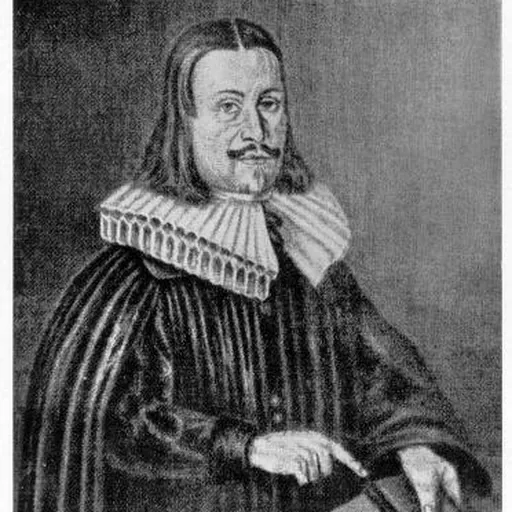
Andreas Libavius
German physician and writer (ca 1560-1616)
About Andreas Libavius
Lived 1555 – 1616 (aged 60–61). Andreas Libavius was a German chemist, university teacher and physician.
Andreas Libavius (known as Andrew Libavius in English; , Halle – 25 July 1616, Coburg) was a German writer.
He was a Renaissance man who spent time as a professor at the University of Jena, teaching history and poetry. After which he became a physician at the Gymnasium in Rothenburg and later founded the Gymnasium at Coburg. Libavius was most known for practicing alchemy and writing a book called Alchemia, one of the first chemistry textbooks ever written.
Life Libavius was born in Halle, Germany, as Andreas Libau, the son of Johann Libau. His father, only a linen worker, could not give Libavius an education because in this time period only the wealthy were able to get a higher education. Showing great intelligence as a child Libavius overcame his personal status and attended the University of Wittenberg at the age of eighteen in 1578. Alchemists also tried to find an elixir of life that would allow them to cure all disease.
In 1597 Libavius published Alchemia, a textbook that summarized all the discoveries alchemists had made at this point. Alchemia was organized into four parts: what to have in a laboratory, descriptions of procedures, chemical analysis, and transmutation. Publishing such a book was blasphemous, as many alchemists wanted to keep their findings to themselves to prevent their findings from being misused. Libavius thought that knowledge should be shared if it could be used to help better mankind.
His studies in alchemy led to many new discoveries in chemistry. He discovered methods to prepare a number of chemicals like hydrochloric acid, ammonium sulfate and tin chloride. Despite this, he did not entirely reject all Paracelsian methods. In The Rosicrucian Enlightenment, Frances Yates states:
Andrea Libavius was one of those chymists who was influenced up to a point by the new teachings of Paracelsus in that he accepted the use of the new chemical remedies in medicine advocated by Paracelsus, whilst adhering theoretically to the traditional Aristotelian and Galenist teachings and rejecting Paracelsist mysticism. Aristotle and Galen appear, honourably placed, on the title-page of Libavius's main work, the Alchymia, published at Frankfurt in 1596 ... Libavius criticized the Rosicrucian Fama and Confessio in several works. Basing himself on the texts of the two manifestos, Libavius raises serious objections to them on scientific, political, and religious grounds. Libavius is strongly against theories of macro-microcosmic harmony, against Magia and Cabala, against Hermes Trismegistus (from whose supposed writings he makes many quotations), against Agrippa and Trithemius—in short he is against the Renaissance tradition.
He accepted the Paracelsian principle of using occult properties to explain phenomena with no apparent cause but rejected the conclusion that a thing possessing these properties must have an astral connection to the divine.
He was also critical of alchemists who claimed to have produced a panacea, or cure-all, not because he didn't believe that a panacea was possible, but because these alchemists invariably refused to disclose their formulas. He believed that anyone who managed to create a panacea was duty bound to teach the process to as many other people as possible, so that it could benefit mankind.
Works Plate XVIII: Chymie, Volume III of Denis Diderot's Recueil de planches, sur les sciences, les arts libéraux, et les arts méchaniques, avec leur explication. Diderot's allegorical image of chemistry has at its base the text "PARADIGMA OPERIS PHILOSOPHICI, E. Libavio," in homage to Andreas Libavius.
Within a span of 25 years (1591–1616) Libavius wrote more than 40 works in the field of logic, theology, physics, medicine, chemistry, pharmacy and poetry. He was actively involved in polemics, especially in the fields of chemistry and alchemy, and as such many of his writings were controversial at the time.
Libavius was an orthodox Lutheran, and in his theological treatises, which he wrote under the pseudonym of Basilius de Varna, he criticized Catholicism, specifically the Jesuit order, and later on in his life, Calvinism. This can also be seen in some of his non-theological works, particularly in some of the works produced during his involvement with the conflict between the Paracelsists, anti-Paracelsists, Galenists, and Hermetics.
In 1597, he wrote the first systematic chemistry textbook, Alchymia, where he described the possibility of transmutation. In this book he also showed that cuprous salt lotions are detectable with ammonia, which causes them to change color to dark blue. In 1615 he wrote Syntagmatis alchamiae arcanorum where he detailed the production of tin chloride, something that he developed in 1605. He was not the first person to invent this process, however, as the Franciscan friar Ulmannus had discovered it earlier and wrote about in the book Buch der heiligen Dreifaltigkeit in 1415.
He also contributed works to the study of medicine. Between 1599 and 1601 he wrote Singularia, a four volume collection of lectures on natural science, which included a collection of descriptions and discussions about medical phenomena. In 1610 he published one of the first German medical texts, Tractatus Medicus Physicus und Historia des fürtrefflichen Casimirianischen SawerBrunnen/ unter Libenstein/ nicht fern von Schmalkalden gelegen.
Other works Quaestionum physicarum – 1591 Dialectica – 1593 Neoparacelsica – 1594 Tractatus duo physici – 1594 Exercitiorum logicorum liber – 1595 Dialogus logicus – 1595 Antigramania – 1595 Gegenbericht von der Panacea Amwaldina, auff Georg vom Waldt davon aussgegangenen Bericht – 1595 Singularium pars prima … pars secunda – 1595 Tetraemerum – 1596 Commentationum metallicorum libri – 1597 Variarum controversarium libri duo – 1601 Analysis dialéctica colloquii Ratisbonensis – 1602 Poemata epica, lyrica, et elegica – 1602 Alchymistische Practic – 1603 (Digitalisat) Gretserus triumphatus – 1604 Praxis alchymiae – 1604 Alchymia triumphans – 1607 Pharmacopea – 1607 Syntagma selectorum – 1611 Syntagma arcanorum – 1613 Syntagmatis arcanorum chymicorum – 1613 Examen philosophiae novae – 1615 Analysis confessionis Fraternitatis de Rosae Cruce – 1615 Wolmeinendes Bedencken / Von der Fama, und Confession der Brüderschaft deß Rosen Creutzes – 1616
Don’t just read it —
keep it.
Full-length biographies made to live with: read them, listen on the way to work, watch them tonight.
- E-book
- Audio
- Video
Instant download · yours to keep · every purchase keeps this site free
Important facts
Related people
Same field, nearest in time
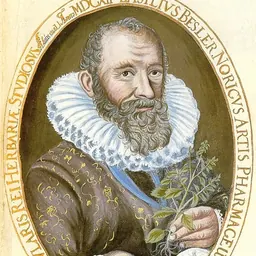


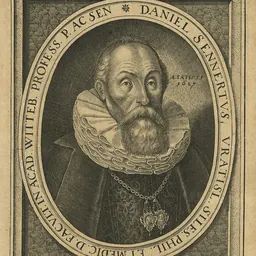
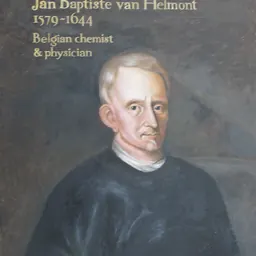
Contemporaries
People whose lives overlapped Andreas Libavius's



Frequently asked questions
Who was Andreas Libavius?
German physician and writer (ca 1560-1616)
When was Andreas Libavius born?
Andreas Libavius was born in 1555 in Halle (Saale).
When did Andreas Libavius die?
Andreas Libavius died on 25 July 1616 in Coburg.
What was Andreas Libavius's occupation?
Andreas Libavius was a chemist, university teacher and physician.
What nationality was Andreas Libavius?
Andreas Libavius was German.
Sources & further reading
Cite this page
APA: Biography.guide. (2026). Andreas Libavius. https://biography.guide/andreas-libavius/
MLA: "Andreas Libavius." Biography.guide, https://biography.guide/andreas-libavius/.
Chicago: "Andreas Libavius." Biography.guide. https://biography.guide/andreas-libavius/.
Data last updated: 2026-09-20 · Spot an error? Report a correction.
Portrait: Wikimedia Commons · author & licence
Page generated 2026-09-27 05:11 UTC