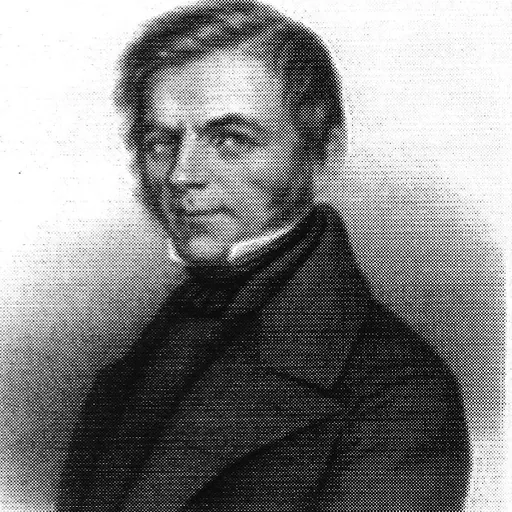
About Andreas Johan Sjögren
Lived 1794 – 1855 (aged 60). Andreas Johan Sjögren was a Russian and Finnish linguist, anthropologist, explorer, traveler, philologist and ethnologist.
Anders Johan Sjögren (8 May 1794 – 18 January 1855) was a Finnish linguist, ethnographer, historian and explorer. He was the first to systematically apply scientific methodology and fieldwork to the study of Finno-Ugric languages, combining linguistic analysis with ethnographic observation and historical research. On his expeditions across Russia, the Baltic region, and the Caucasus, he documented languages, collected folklore, and studied the social and cultural life of various peoples. His interdisciplinary approach became a model for later research on Finno-Ugric languages and cultures. Sjögren is also regarded the creator of the Ossetian Cyrillic alphabet, which is still used today with some modifications.
Early life and education Anders Johan was born in the village of Sitikkala in Iitti, Finland, into a Finnish-speaking family of craftsmen. His father, Michael Johansson , was a shoemaker, and his mother, Karin Aronsdotter Hogen, was the daughter of a blacksmith. At the time of his birth, Finland was part of the Kingdom of Sweden, with Iitti located close to the Russian border. In 1809, Finland was ceded to the Russian Empire.
Both of his parents were literate, and his mother taught him to read. His intellectual abilities were noticed by local clergymen, who arranged for him to receive instruction in Swedish (the language of education in Finland at the time), and provided financial support for him to attend school in Loviisa (1803–1809) and the gymnasium in Porvoo (1809–1813). After completing gymnasium, he moved to Turku (Åbo) to study at the Imperial Academy of Turku, graduating in 1819 as Doctor of Philosophy. He finance his studies through tutoring and loans. Sjögren shared these views. He made his first field trip to collect Finnish folklore in 1814. Following the example of the Danish linguist Rasmus Rask, who visited Turku in 1818, Sjögren was guided towards an approach advocating learning the living language directly from native speakers through fieldwork. he established connections within the St. Petersburg Academy of Sciences. His publication Ueber die finnische Sprache und ihre Literatur (1821), funded by Rumyantsev, significantly raised his profile. Sjögren was a bibliophile, and in 1823, he succeeded Hipping as Rumyantsev's librarian. In 1823, after some initial setbacks, he finally secured imperial approval and funding for his long-planned expedition. With Hipping's help, he had gained the support of the Finnish State Secretary Robert Henrik Rehbinder, and the funding came from the Finnish state treasury. Sjögren made a preparatory trip around Lake Ladoga in the summer of 1823. This trip taught him the importance of studying the local archives, and he practiced making observations in the field.
Northern Russia and Finnish Lapland (1824–1829) Sjögren traveled in Northern Russia and Finland for five years, from 1824 to 1829. The scientific motivation for the journey, as stated by Sjögren, drew on Porthan's historical research on Finland and on the Primary Chronicle, which tells the early history of Russia, listing various Finno-Ugric peoples. The initial plan was to examine a variety of Finno-Ugric peoples, extending from Finland to the Volga region and as far as western Siberia. He started his journey with a two-month stay in Novgorod where he studied old manuscripts. He then continued to study the Baltic Finnic peoples in Olonets and White Karelia, northeastern Finland, and the Sámi in Lapland and the Kola Peninsula. From Kola, he traveled east to Perm near the Ural Mountains. He intended to continue to western Siberia, but was persuaded by the academicians to return to St. Petersburg. On the return journey, he took a southern route through Kazan and Vologda. He created a grammar and dictionary of the Liv language, which were published after his death by Ferdinand Wiedemann, as well as the first "Ossetian Grammar" (Grammatik der ossetischen Sprache).
He was elected to the Russian Academy of Sciences and through the Academy provided sponsorship and research funding to Matthias Castrén, another ethnologist and philologist in the study of Uralic languages.
Legacy
Sjögren's diaries, the Ephemerider, span from 1806 to 1855 and comprise more than 8,000 handwritten pages. Written primarily in Swedish but also containing passages in German, Latin, French, and Russian, they contain information on his scientific work, personal reflections, social life, and the intellectual currents of his time. The diaries were published in 2020 on the initiative of Michael Branch and were also edited by and Marja Leinonen.
Don’t just read it —
keep it.
Full-length biographies made to live with: read them, listen on the way to work, watch them tonight.
- E-book
- Audio
- Video
Instant download · yours to keep · every purchase keeps this site free
Important facts
People in Andreas Johan Sjögren's life
Named in this biography and alive at the same time

Related people
Same field, nearest in time

Contemporaries
People whose lives overlapped Andreas Johan Sjögren's





Frequently asked questions
Who was Andreas Johan Sjögren?
Finnish linguist (1794-1855)
When was Andreas Johan Sjögren born?
Andreas Johan Sjögren was born on 15 April 1794 in Sitikkala.
When did Andreas Johan Sjögren die?
Andreas Johan Sjögren died on 6 January 1855 in Saint Petersburg.
What was Andreas Johan Sjögren's occupation?
Andreas Johan Sjögren was a linguist, anthropologist, explorer, traveler, philologist and ethnologist.
What nationality was Andreas Johan Sjögren?
Andreas Johan Sjögren was Russian and Finnish.
Sources & further reading
· Wikipedia: Andreas Johan Sjögren
· DBpedia: Anders Johan Sjögren
Cite this page
APA: Biography.guide. (2026). Andreas Johan Sjögren. https://biography.guide/andreas-johan-sjogren/
MLA: "Andreas Johan Sjögren." Biography.guide, https://biography.guide/andreas-johan-sjogren/.
Chicago: "Andreas Johan Sjögren." Biography.guide. https://biography.guide/andreas-johan-sjogren/.
Data last updated: 2026-09-23 · Spot an error? Report a correction.
Portrait: Wikimedia Commons · author & licence
Page generated 2026-09-27 05:06 UTC