
About Andreas de Vega
Lived 1498 – 1560 (aged 61–62). Andreas de Vega was a Spanish catholic theologian.
Andreas de Vega (died c. 1560) was a Spanish theologian and Franciscan Observantine.
Life
Vega was born at Segovia in Old Castile, Spain. He studied at the University of Salamanca, and was a professor there when he became an Observantine of the Franciscan Order. He continued his work as a teacher in the monastery of the Observantines where Alphonso de Castro also taught. He died at Salamanca.
Vega was a moderate Scotist who at the same time held to St. Bonaventure. The Emperor Charles V sent Vega as theologian together with other scholars to the Council of Trent. At Trent he came into connection with Cardinal Petrus Pacheco, Bishop of Jaen (consequently called "Giennensis"), who was a patron of the Franciscan Order. Vega was conspicuous in the preliminary discussions of the canon of the Scriptures and on the Vulgate, which were treated in the Decree promulgated in the fourth session of the council, 8 April 1546. He also took a prominent part in the preliminary discussions on the dogma of justification, and drew attention to himself at the same time by his debates with Dominicus de Soto, the Dominican who defended the dogmas of Thomism. The Decree was promulgated in the sixth session on 13 January 1547.
Works
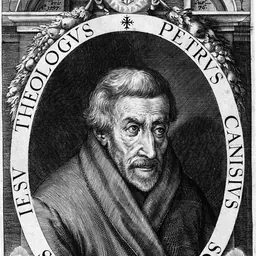
Previous to the council Vega had written to defend the Catholic doctrine of justification against the Protestants, "De justificatione, gratia fide, operibus et meritis quaestiones quindecim" (Venice, 1546). The dedication to Cardinal Pacheco is dated Trent, 1 January 1546. After the promulgation of the Decree he wrote in its defence at Trent and Venice, "Tridentini decreti de justificatione exposition et defensio lib. XV distincta" (Venice, 1548). In the last two books he attacks John Calvin's "Acta synodi tridentinae cum antidoto" (Geneva, 1547). This was Vega's major work. Peter Canisius had it reprinted at Cologne (1572) in one volume with Vega's previous work, "De justificatione". Reprints were issued at Cologne (1585) and at Aschaffenburg (1621).
A posthumous work by Vega was also published, his "Commentaria in Psalmos" (Alaclà de Henares, 1599).
Don’t just read it —
keep it.
Full-length biographies made to live with: read them, listen on the way to work, watch them tonight.
- E-book
- Audio
- Video
Instant download · yours to keep · every purchase keeps this site free
Important facts
People in Andreas de Vega's life
Named in this biography and alive at the same time

Related people
Same field, nearest in time





Contemporaries
People whose lives overlapped Andreas de Vega's






Frequently asked questions
Who was Andreas de Vega?
Spanish theologian
When was Andreas de Vega born?
Andreas de Vega was born in 1498 in Segovia.
When did Andreas de Vega die?
Andreas de Vega died in 1560 in Salamanca.
What was Andreas de Vega's occupation?
Andreas de Vega was a catholic theologian.
What nationality was Andreas de Vega?
Andreas de Vega was Spanish.
Sources & further reading
Cite this page
APA: Biography.guide. (2026). Andreas de Vega. https://biography.guide/andreas-de-vega/
MLA: "Andreas de Vega." Biography.guide, https://biography.guide/andreas-de-vega/.
Chicago: "Andreas de Vega." Biography.guide. https://biography.guide/andreas-de-vega/.
Data last updated: 2026-09-20 · Spot an error? Report a correction.
Page generated 2026-09-27 05:07 UTC