
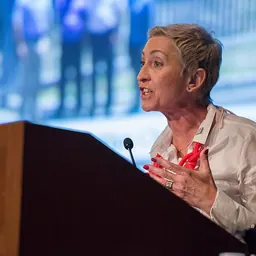
Andrea Crisanti
Italian microbiologist, politic, academic and science divulgator (born 1954)
About Andrea Crisanti
Born 1954. Andrea Crisanti is an Italian physician, parasitologist, microbiologist and university teacher.
Andrea Crisanti (born 14 September 1954) is an Italian full professor of microbiology at the University of Padua and politician. He previously was professor of Molecular Parasitology at Imperial College London. He is best known for the development of genetically manipulated mosquitoes with the objective to interfere with either their reproductive rate or the capability to transmit diseases such as malaria.
Biography
Crisanti earned his Master of Medicine and Surgery degree in Italy at Sapienza University of Rome. Crisanti served as a Postdoctoral Fellow at the Center for Molecular Biology (ZMBH) at the University of Heidelberg. In 1994, Crisanti became a lecturer at Imperial College, before being appointed Professor in 2000. He is also the director of the Centre of Functional Genomics at the University of Perugia. In 2018, Crisanti and colleagues demonstrated that CRISPR/Cas9 can be programmed to attack a conserved region of the sex determination gene, doublesex, which impairs female mosquito development and could spread effectively to 100% of a population in a few generations. This study represents the first time that researchers have been able to block the reproductive capacity of a complex organism in the laboratory using designer molecular approaches.
In 2011, Crisanti was appointed editor-in-chief of medical journal Annals of Tropical Medicine and Parasitology, which in 2012 under Crisanti's leadership became Pathogens and Global Health, reflecting the journal's newly formed broader focus. Crisanti is a chairman of the scientific panel of the EU Marie Curie Programme, I-Move, and has advised on issues concerning the safety of genetically modified insects for the Consilium Pontificium of the Vatican City and the European Food Safety Authority.
COVID-19 In March 2020 during the COVID-19 pandemic in Italy, Crisanti conducted analysis of citizens in Vò and found that most of the infected people were asymptomatic carriers; without symptoms but capable of spreading the COVID-19 virus. Crisanti's research, which was published in Nature, was strongly supported by a BMJ editorial which appeared on 1 July. Crisanti is highly critical of the World Health Organization. His throat swab test methodology was complete on 25 January (the date is an error) and amongst the first in the world. Crisanti demanded and obtained the co-operation of the President of Veneto, Luca Zaia, in the teeth of opposition by the WHO, which had co-opted the administration of Giuseppe Conte. In neighbouring Lombardy the death toll exceeded 16,800 while in Veneto it was minimal. In the opinion of Crisanti,
Personal life Andrea Crisanti is married to Nicoletta and has a son, Giulio; he considers himself Roman Catholic.
Don’t just read it —
keep it.
Full-length biographies made to live with: read them, listen on the way to work, watch them tonight.
- E-book
- Audio
- Video
Instant download · yours to keep · every purchase keeps this site free
Important facts
People in Andrea Crisanti's life
Named in this biography and alive at the same time




Related people
Same field, nearest in time



Contemporaries
People whose lives overlapped Andrea Crisanti's

Frequently asked questions
Who is Andrea Crisanti?
Italian microbiologist, politic, academic and science divulgator (born 1954)
When was Andrea Crisanti born?
Andrea Crisanti was born on 14 September 1954 in Rome.
What is Andrea Crisanti's occupation?
Andrea Crisanti is a physician, parasitologist, microbiologist and university teacher.
What nationality is Andrea Crisanti?
Andrea Crisanti is Italian.
Sources & further reading
· DBpedia: Andrea Crisanti (scientist)
Cite this page
APA: Biography.guide. (2026). Andrea Crisanti. https://biography.guide/andrea-crisanti/
MLA: "Andrea Crisanti." Biography.guide, https://biography.guide/andrea-crisanti/.
Chicago: "Andrea Crisanti." Biography.guide. https://biography.guide/andrea-crisanti/.
Data last updated: 2026-09-20 · Spot an error? Report a correction.
Page generated 2026-09-27 05:28 UTC