
About André Wink
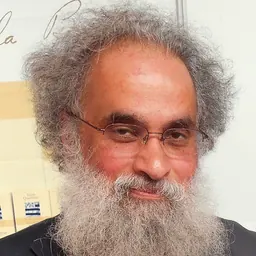
Born 1953. André Wink is a teacher, writer and historian.
André Wink is an emeritus professor of history at University of Wisconsin, Madison. He is known for his studies on India and the Indian Ocean area, particularly over the medieval and early modern age (700 to 1800 CE). He is the author of a series of books published by Brill Academic, Oxford University Press, and Cambridge University Press on al-Hind – a term used in Arab history to refer to the Islamized regions in the Indian subcontinent and nearby regions.
Wink was born in 1953, in Hollandia, Netherlands New Guinea (present day Jayapura, Indonesia). He studied at Leiden University, and in 1984, he received a Ph.D. in Indian history under the guidance of Indologist J.C. Heesterman. Until 1990, he researched and published from the Netherlands. He became a professor at the University of Wisconsin in 1989, from where he has contributed ever since to the field of history of India, Indonesia and countries near the Indian Ocean. He became a senior fellow in 2009.
Works
Land and Sovereignty: Agrarian Society and Politics under the Eighteenth-Century Maratha Svarajya In 1986, Wink published a socioeconomic history of the Marathas in eighteenth century. Reviews were largely favorable and his revisionist approach was admired.
Al-Hind: The Making of the Indo-Islamic World
Volume 1 Indologist Catherine Asher calls it a "ground-breaking volume" that is based on recent scholarship as well as the "contemporary Arab, Persian, Sanskrit and Indian vernacular texts". Wink examines the "political, economic and social" impact on the Indian subcontinent between seventh and eleventh centuries from the conquests and expansion of Islam. Lawrence questions Wink's glossing over India's past political history to make his economic and trade theory related point that there was "no cohesive entity labelled India before Arabs coined the word al-Hind". His discussion of the economic impact of early Islamic expansion into India relies primarily on a region consisting of the Gurjara-Pratiharas, the Rashtrakutas, the Cola-mandalam and the Asian archipelago, with only two – Kashmir and Bengal – covered from the rest of India. Some of his conclusions on Tibet and China are scarcely discussed in the book. The major blunder of Wink's volume 1, states Lawrence, is to "reduce the entire process of Islamization to an expanding commercial network, with the result that Islam becomes merely the idiom for unifying the economy of the Indian Ocean at the beginning of the second millennium AD." Wink sketched Sind as an "economically and culturally marginal" territory dominated by rebellions, a view supported more to colonial historians than primary sources. The chapter on non-Arab India provided "welcome glimmers of insight" and did "break some new ground" by challenging R.S. Sharma's thesis of feudalism. However, states MacLean, Wink's work exhibited signs of "hasty research and composition" affecting his larger conjectures and portrayed a reductive, unsubtle and "ahistorical caricature" of a complex Indo-Islamic past. The book is based on a "highly impressive range of secondary literature" as well early literature published in the Middle East. Its central theme is how the formation of the Caliphate and Islamic expansion interconnected with the "development of the India trade". Wink goes beyond the typical rhetoric of Islamic holy war and Arab politics, vigorously challenging the "notions purveyed by R.S. Sharma" that unconvincingly parallel early India into the mold of medieval Europe. Denis Sinor states that he fails to detect any other central themes other than the primary importance of trade and admires Wink's "erudition and wide reading". However, the book was loaded with "far too many data on far too many subjects", and "often overtly verbose and superfluous", striving to fit a vast range of facts into a framework too small to hold them. K.S. Shrimali reiterates like criticisms and found the work to be neo-colonialist.
Ranabir Chakravarti, a historian of ancient India, expressed surprise that Wink's discussion on Rashtrakutas were solely based on Arabic chronicles and that he did not cite any epigraphic records. Viswa Mohan Jha, in his review, deemed it to be an "impossible caricature" replete with references that did not support the text.
Volume 2 In the review of volume 2, states Peter Jackson, Wink's "geographical scope is vast", just like in volume 1. It embraces not "merely India and Ceylon but south-east Asia". This is the period in Wink's analysis where a fusion happened between two different cultures, one "of maritime trade and pastoral nomadism" prevalent in the Islamic controlled parts of West and Central Asia, and the settled and "static agricultural world" of India. The Delhi Sultanate became the crucible for the processes of this fusion. In volume 2 of his series, states Jackson, Wink publishes a dedicated study on the conquest of India by Islamic armies, the military differences between the invading and defending armies, the processes and history of conquest, raids, religious advisors and of early Delhi Sultanate through 1290 CE.
Richard Eaton states, "like its predecessor, this volume is wide-ranging, extensively researched and highly schematic". He mentions Wink's central thesis on the establishment of the Delhi Sultanate as a part of larger geo-cultural movement, that the attacks and wars during this period had a major role in essentially ending Buddhism within India, and its shift to Tibet, Sri Lanka and southeast Asia. Wink's work, states Eaton, also argues how the Delhi Sultanate's iqta system revitalized north Indian economy and helped India become "the hub of world trade". Eaton questions the thesis on iqta and its impact on Indian economy, adding that Wink provides a wealth of information on the topic. According to Eaton, the numismatic evidence shows that the Indian economy was already highly monetized before the Turkic conquests. There are other difficulties in the book, states Eaton, such as how the quotations and his sources are presented. Eaton criticizes Wink's "juxtaposing works composed hundreds of years apart from each other without contextualizing them". Setting aside such difficulties, Eaton states that Volume 2 provides important and provocative new interpretations, one that correctly sees "Indo-Islamic world as a world-historical process".
Volume 3 Peter Jackson found all the three volumes to be magisterial works and based on impressive secondary literature.
Richard Eaton's review of the 3rd volume of Al-Hind states that it is a "survey of the 14th and 15th century Indian Ocean region through the lens of geography". It presents the Indo-Islamic developments over this period as a "fusion" of the nomadic central Asian culture with settled agrarian north Indian culture, thus creating post-nomadic empires of Ghurids and Khaljis. Eaton calls this an elegant scheme, if somewhat awkward. It covers the Habshi slaves and mercenaries from East Africa brought into India for military campaigns in Bengal, Gujarat and the Deccan, how capitals and major cities such as Delhi and Devagiri were settled in the fringes of semi-arid zones as well as in the non-arid lower Gangetic valley. Eaton questions Wink's theory and understanding of religion and religious conversion in Malaysia, Kashmir, eastern Bengal, and the Indonesian archipelago. After reviewing the book, states Eaton, "one feels the need to identify more precisely the mechanisms by which Muslim societies emerged from the fusion of these two geo-cultural worlds". Wink's suggestion that "threats, humiliation, destruction of temples" or "fusion" of nomadic-settled cultures, states Eaton, does not explain this. The Volume 3 may be judged by critics as 'sweeping geography-driven" scheme that does not give human agency the credit it deserves, states Eaton, yet it is innovative and provocative secondary work that is a "welcome relief from standard dynastic narratives" commonly published.
In his review, Sanjay Subrahmanyam begins by stating that Wink's three volume project was a monumental task and skeptics had feared about how any scholar could hope to dominate this vast field covering a thousand-year span, given the uneven state of historiography and myriad sources. He then observes that the first two volumes have their admirers but they did not entirely allay the fears. However, he thinks that some of Wink's approaches have limitations. Namely, Wink's overuse of dichotomies that downplay the flexibility of some categories like "mobile" and "settled".
Don’t just read it —
keep it.
Full-length biographies made to live with: read them, listen on the way to work, watch them tonight.
- E-book
- Audio
- Video
Instant download · yours to keep · every purchase keeps this site free
Important facts
People in André Wink's life
Named in this biography and alive at the same time


Related people
Same field, nearest in time






Contemporaries
People whose lives overlapped André Wink's


Frequently asked questions
Who is André Wink?
Dutch historian (born 1953)
When was André Wink born?
André Wink was born in 1953.
What is André Wink's occupation?
André Wink is a teacher, writer and historian.
Sources & further reading
Cite this page
APA: Biography.guide. (2026). André Wink. https://biography.guide/andre-wink/
MLA: "André Wink." Biography.guide, https://biography.guide/andre-wink/.
Chicago: "André Wink." Biography.guide. https://biography.guide/andre-wink/.
Data last updated: 2026-09-20 · Spot an error? Report a correction.
Page generated 2026-09-27 05:14 UTC