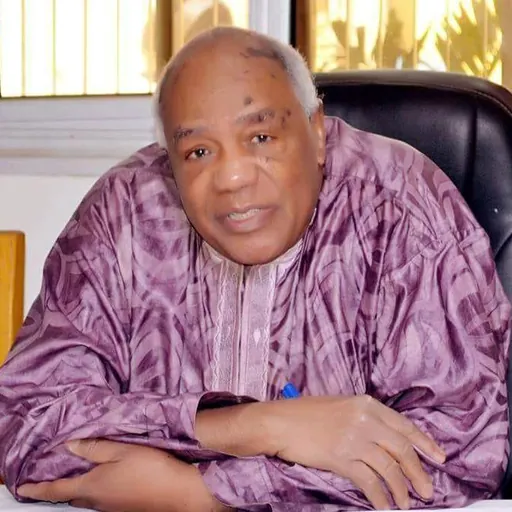
About André Salifou
Lived 1942 – 2022 (aged 79–80). André Salifou was a Nigerien historian of Modern Age, university teacher, writer, politician, diplomat and minister.
André Salifou (1942 – 14 May 2022) was a Nigerian politician, diplomat, and professor. He was president of the High Council of the Republic during the 1991–93 transitional period, briefly served as Minister of Foreign Affairs in 1996, and was an unsuccessful presidential candidate in 1999.
Biography Salifou was born in Zinder. From 1972 to 1979, he worked for the Agency of Cultural and Technical Cooperation (Agence de Coopération Culturelle et Technique), UNESCO, and the Common African and Mauritian Organization. For his doctorate d'état, he wrote the thesis Colonisation et sociétés indigènes au Niger de la fin du XIXe siècle à la début de la Seconde Guerre mondiale (Colonization and indigenous societies of Niger from the end of the 19th century to the beginning of the Second World War).
Political career Role in the National Conference and High Council of the Republic At the end of the 1980s, the military regime of Brigadier General Ali Saibou came under increasing domestic pressure and civil resistance. At the end of 1990, the regime acquiesced to demands for a return to civilian rule and a national conference was convened in July 1991 to prepare the way for the adoption of a new constitution and the holding of free and fair elections. Professor Salifou was chosen as a neutral figure to be president of the Presidium of the National Conference, which was held from July 29, 1991, to November 3, 1991
Opposition politician In the February 1993 parliamentary election, Salifou was a candidate for his party, the Union of Democratic and Progressive Patriots (UPDP-Chamoua), in the Zinder constituency, and was elected to the National Assembly. Like Prime Minister Ahmadou Cheiffou, he was prohibited by the National Conference from standing as a candidate in the presidential election held later in the same month due to his role as president of the High Council of the Republic. Following the election, the UPDP, which was led by Salifou, formed part of the opposition along with the National Movement for the Development of Society (MNSD). Salifou participated in an opposition protest on April 16, 1994, and was arrested along with 90 others, including MNSD leader Tandja Mamadou. He left this position in December 1996, when he was moved to the post of Minister of State in charge of relations with the Assemblies; he remained in the latter position until December 1997. In the election, he placed sixth with 2.08% of the vote.
After the 1999 election, Salifou acted in a diplomatic role for international organizations. He was special envoy of La Francophonie to the Comoros; on March 15, 2001, the Comoran opposition alleged that Salifou, together with the French ambassador, had been secretly working against the presence of the Organization of African Unity in the Comoros. Later, on April 30, 2002, Salifou was named special envoy of OAU Secretary-General Amara Essy to Madagascar.
Salifou was appointed by President Tandja as his special representative to La Francophonie, and he was included in the Nigerien delegation to La Francophonie's ninth summit, held in Beirut in October 2002. He also headed an African Union mission to the Central African Republic in November 2002, meeting with Central African President Ange-Félix Patassé on November 19 to discuss "the conditions for the restoration of peace in the CAR". On February 13, 2003, he was designated as the special representative of Essy, who was by this time the interim chairman of the commission of the African Union, to Côte d'Ivoire.
After Mahamadou Issoufou took office as president, he appointed Salifou as special adviser to the president, with the rank of minister, on 20 April 2011. Salifou held that post concurrently with his role as the president's personal representative to La Francophonie.
Don’t just read it —
keep it.
Full-length biographies made to live with: read them, listen on the way to work, watch them tonight.
- E-book
- Audio
- Video
Instant download · yours to keep · every purchase keeps this site free
Important facts
People in André Salifou's life
Named in this biography and alive at the same time

Related people
Same field, nearest in time



Contemporaries
People whose lives overlapped André Salifou's

Frequently asked questions
Who was André Salifou?
Nigerien Politician
When was André Salifou born?
André Salifou was born in 1942 in Zinder.
When did André Salifou die?
André Salifou died on 14 May 2022.
What was André Salifou's occupation?
André Salifou was a historian of Modern Age, university teacher, writer, politician, diplomat and minister.
What nationality was André Salifou?
André Salifou was Nigerien.
Sources & further reading
Cite this page
APA: Biography.guide. (2026). André Salifou. https://biography.guide/andre-salifou/
MLA: "André Salifou." Biography.guide, https://biography.guide/andre-salifou/.
Chicago: "André Salifou." Biography.guide. https://biography.guide/andre-salifou/.
Data last updated: 2026-09-22 · Spot an error? Report a correction.
Portrait: Wikimedia Commons · author & licence
Page generated 2026-09-27 05:04 UTC