
About André Evard
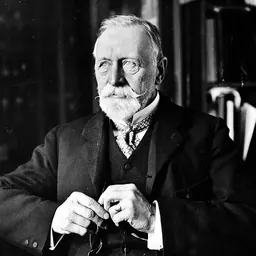
Lived 1876 – 1972 (aged 96). André Evard was a Swiss painter and artist.
Jean André Evard (1 June 1876 – 20 July 1972) was a Swiss painter and drafter. His special significance lies in the field of constructive art. He is counted among the first artists who did not work figuratively. In the course of his life he produced hundreds of oil paintings, a large number of drawings as well as approximately 2000 to 3000 watercolor and gouache paintings.
Biography André Evard was born on 1 June 1876 in Renan (Bernese Jura) as the son of Jean-Félix Evard (1849–1879) and Marie Sagne (1852–1921). After the early death of his father, he and his mother moved to La Chaux-de-Fonds, where Marie Evard ran a pastry shop. Initially working as a pastry chef, André received an inheritance which enabled him to study art. He studied at the École d'Art in La Chaux-de-Fonds from 1905 to 1909 and attended courses in decorative art with Charles L'Eplattenier, a former student of Ferdinand Hodler. Through L'Eplattenier, La Chaux-de-Fonds became a centre of Art Nouveau in Switzerland. He was particularly interested in the nature of the Jura and encouraged his pupils to "[...] study the nature of the Jura – from the fir trees to the tectonics of the limestone cliffs – analyse their regularities and translate them into abstract ornaments" (in German: }
Here André Evard distinguished himself above all in the goldsmith and enamel art with the finest works, which is why the art critic Jean-Marie Nussbaum labeled him a jeweller of painting. At that time Evard was artistically still strongly influenced by Art Nouveau. Among his friends at university were Le Corbusier, Conrad Meili and Léon Perrin, with whom he decorated and painted private villas. With Le Corbusier, for example, he furnished the interiors of the Villa Fallet in La Chaux-de-Fonds.
Around 1900 Evard got in touch with Paul Pettavel, a priest in La Chaux-de-Fonds who published a free Sunday newspaper, "La Feuille du dimanche", in which he propagated social reformist and pacifist ideas. The weekly also focused on the fight against alcoholism. La Chaux-de-Fonds was then a centre of international pacifism. Evard became a member of the Christian Youth Association of the pastor and administered the publication of the weekly newspaper for almost 30 years. Through his activities at Pettavel he got to know the painter , whose daughter he married in 1928.
Around the year 1907 Evard shifted his artistic interest almost completely to painting and drawing and in the same year undertook a longer study trip to Italy, where he studied the old Masters. Above all, small-format portraits and atmospheric landscapes were the main characteristics of the works of the following years. His first collages were made in 1908, but they met with strong rejection. The participation in various exhibitions, such as 1909 in Munich or 1914 in Neuchâtel, did not lead to any success either. The result was a deep creative crisis and a complete reorientation. Thus from 1913 he undertook the first non-objective, cubist and constructive attempts, which were ultimately to place him in the front rank not only of the Swiss avant-garde. More and more he devoted himself to the principle of the series (an example of this is the painting series Roses), because he was fascinated by the variations of a basic motif and its color variations.
From 1912 until the end of World War I, André Evard used the name "Louvrier" as a pseudonym.
In addition, he came into contact with African sculpture for the first time, which increased his interest in non-European art. Since then he has attached particular importance to black – for him the aristocrat of colors. Some of his abstract, cubist and constructive works created during these Parisian years were exhibited at the Salon des Indépendants and the Salon d'Automne. Although André Evard was now at the center of the avant-garde, he responded to requests from the art trade by rejecting them and almost never gave his works to galleries or collectors. He sought recognition almost exclusively in the context of official institutions.
Back in La Chaux de Fonds, he married Milca Reguin, the daughter of the painter Louis Reguin in 1928. The following year was a huge one: Due to the Wall Street crash of 1929 he lost his entire fortune. Until the end of his life he now lived in modest circumstances. It was no longer possible to travel to Paris. His sphere of influence was thus limited to his homeland, which he had never left since. Moreover, his avant-garde works were not in demand among conservative audiences. At first he resignedly stopped his production, but from 1932 he changed his style in order to increase the chances of a sale. In addition to other Concrete works, a multitude of traditionally figurative, almost deserted landscapes and still lifes were created, characterized by strong colors: "La Chaux-de-Fonds lies at around 1,000 metres above sea level and is therefore one of the highest cities in Europe. From this altitude, Evard was particularly fascinated by the spectacle of light during sunrises and sunsets. The steep valley flanks (Côtes du Doubs) are densely wooded and partly crossed by rocky outcrops" (in German: }
Artistic work After completing his studies, Evard initially painted in the French tradition of the late 19th and early 20th centuries. Influences of Salon paintings, Impressionism and symbolism were mixed with influences Vincent van Gogh, but also with those of Far Eastern art, whereby the various artist's styles seemed to merge into a very individual style. In his color compositions, Evard knew how to subject completely opposite colors to absolute harmony. Extreme freedom of feeling, great variety of moods, subtle color modulations and chromatic vivacity characterise his works, as Evard wants to give color its 'spirit'. Analysis of a painting: André Evard
Exhibitions (selection) 1936: Zeitprobleme in der Schweizer Malerei und Plastik (Temporal problems in Swiss painting and sculpture), Kunsthaus Zürich, Zürich, Switzerland 1981: 1936 – eine Konfrontation (1936 – A Confrontation), Kunsthaus Aarau, Switzerland 1981: Konstruktive Kunst in der Schweiz 1915-1945 (Constructive Art in Switzerland 1915-1945), Olten, Switzerland 2005: André Evard. De l´Art nouveau a l´abstraction (André Evard. From Art Nouveau to abstraction), Musée des beaux-arts, La Chaux-de-Fonds, Switzerland 2009: Hommage an André Evard, Kunsthalle Messmer, Riegel am Kaiserstuhl, Germany 2012: Le Corbusier & André Evard. Vom Jugendstil zur Moderne (Le Corbusier & André Evard. From Art Nouveau to Modernism), Kunsthalle Messmer, Riegel am Kaiserstuhl, Germany 2016 André Evard: Der Farbe ihren Geist geben. 1876 bis 1972 (André Evard: Giving color its spirit. 1876 to 1972), Galerie Michael Schultz, Berlin, Germany 2018 André Evard: Farben der Natur (André Evard: Colors of nature), Galerie Messmer, Riegel am Kaiserstuhl, Germany 2019 10 Jahre Kunsthalle Messmer: Ein Leben für die Kunst (10 Years Kunsthalle Messmer: A Life for Art), Kunsthalle Messmer, Riegel am Kaiserstuhl, Germany
Don’t just read it —
keep it.
Full-length biographies made to live with: read them, listen on the way to work, watch them tonight.
- E-book
- Audio
- Video
Instant download · yours to keep · every purchase keeps this site free
Important facts
People in André Evard's life
Named in this biography and alive at the same time



Related people
Same field, nearest in time

Contemporaries
People whose lives overlapped André Evard's
Frequently asked questions
Who was André Evard?
Swiss painter (1876-1972)
When was André Evard born?
André Evard was born on 1 June 1876 in Renan.
When did André Evard die?
André Evard died on 23 July 1972 in Le Locle.
What was André Evard's occupation?
André Evard was a painter and artist.
What nationality was André Evard?
André Evard was Swiss.
Sources & further reading
Cite this page
APA: Biography.guide. (2026). André Evard. https://biography.guide/andre-evard/
MLA: "André Evard." Biography.guide, https://biography.guide/andre-evard/.
Chicago: "André Evard." Biography.guide. https://biography.guide/andre-evard/.
Data last updated: 2026-09-20 · Spot an error? Report a correction.
Page generated 2026-09-27 05:07 UTC