
About András Róna-Tas
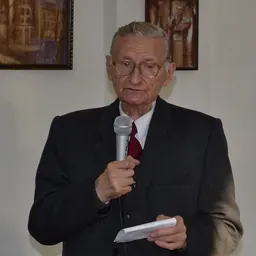
Born 1931. András Róna-Tas is a Hungarian linguist, historian, lecturer, orientalist and ethnologist.
András Róna-Tas (born 30 December 1931) is a Hungarian historian and linguist.
Biography He was born in 1931 in Budapest. Róna-Tas studied under such preeminent professors as Gyula Ortutay and Lajos Ligeti, and received a degree in folklore and eastern linguistics (Tibetan, Mongol, and Turkic.)
From 1956, he worked at the Faculty of Humanities of the Eötvös Loránd University. In 1957–1958, Róna-Tas conducted anthropological fieldwork in Mongolia, studying the culture, language, and folklore of the nomadic tribes in that country. During the mid-1960s, Róna-Tas focused his fieldwork on the Chuvash people of the middle Volga River basin. In 1964, Róna-Tas defended his candidates (CSc) degree, and finally in 1971, he earned a doctorate from the Hungarian Academy of Sciences (DSc) with his thesis "The Theory of Linguistic Affinity and the Linguistic Relations between the Chuvash and Mongol Languages", published as Linguistic Affinity in 1978.
From 1968 to 2002, Róna-Tas was professor of Altaic Studies and Early Hungarian History at József Attila University in Szeged, where he is now a distinguished professor emeritus. He has published over 450 papers, monographs and reviews. His magnum opus, A honfoglaló magyar nép, was published in 1996 and an extended translated version, Hungarians and Europe in the Early Middle Ages, appeared in 1999.
In addition to his work on the early Magyars, Róna-Tas has published numerous works on other Eurasian societies such as the Tibetans, Kipchaks, Khazars, Oghuz Turks and Alans. He was awarded the prestigious Humboldt Prize in 1996.
In 2005–2006, Róna-Tas was a Fellow at the Swedish Collegium for Advanced Study in Uppsala, Sweden.
Selected bibliography "Turkic-Alanian-Hungarian contacts." (2005) (Journal article in Acta Orientalia Academiae Scientiarum Hungaricae) "Khitan word for 'marmot'." (2004) (Journal article in Acta Orientalia Academiae Scientiarum Hungaricae) "New publications on Uyghur texts translated from Chinese." (2003) (Journal article in Acta Orientalia Academiae Scientiarum Hungaricae) "Old Turkic Loan Words in Hungarian: Overview and Samples." (2002) (Journal article in Acta Orientalia Academiae Scientiarum Hungaricae) "Where was Khuvrat's Bulgharia?" (2000) (Journal Article in Acta Orientalia Academiae Scientiarum Hungaricae) "Chuvash and historical morphology." (1999) (Journal Article in Acta Orientalia Academiae Scientiarum Hungaricae) The Migration and Landtaking of the Magyars (Journal article in The Hungarian Quarterly)
Don’t just read it —
keep it.
Full-length biographies made to live with: read them, listen on the way to work, watch them tonight.
- E-book
- Audio
- Video
Instant download · yours to keep · every purchase keeps this site free
Important facts
People in András Róna-Tas's life
Named in this biography and alive at the same time


Related people
Same field, nearest in time




Contemporaries
People whose lives overlapped András Róna-Tas's


Frequently asked questions
Who is András Róna-Tas?
Hungarian historian
When was András Róna-Tas born?
András Róna-Tas was born on 30 December 1931 in Budapest.
What is András Róna-Tas's occupation?
András Róna-Tas is a linguist, historian, lecturer, orientalist and ethnologist.
What nationality is András Róna-Tas?
András Róna-Tas is Hungarian.
Sources & further reading
Cite this page
APA: Biography.guide. (2026). András Róna-Tas. https://biography.guide/andras-rona-tas/
MLA: "András Róna-Tas." Biography.guide, https://biography.guide/andras-rona-tas/.
Chicago: "András Róna-Tas." Biography.guide. https://biography.guide/andras-rona-tas/.
Data last updated: 2026-09-27 · Spot an error? Report a correction.
Page generated 2026-09-27 05:17 UTC