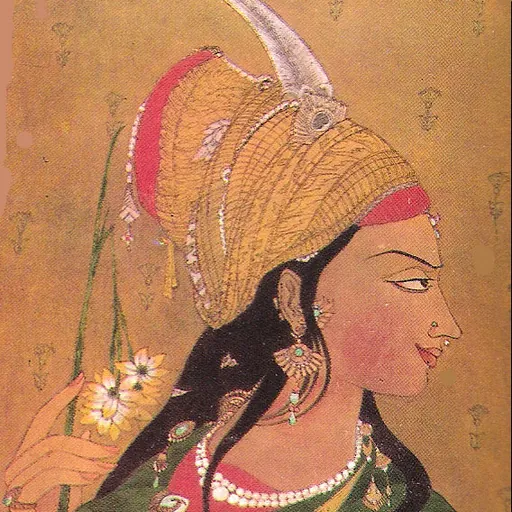
Anarkali
Mughal courtesan
About Anarkali
Anarkali is a legendary young woman said to be loved by the 16th-century Mughal Prince Salim, who later became Emperor Jahangir. According to some accounts, Anarkali was the nickname of the courtesan (tawaif) Mehr-un-Nisa, though scholars hold varying opinions.
According to speculative and fictional accounts, Anarkali had an illicit relationship with Salim, the son of Mughal Emperor Akbar, who had her executed by immurement. The character often appears in movies, books and historical fiction, most notably depicted in the 1960 Bollywood film Mughal-e-Azam in which she is portrayed by Madhubala.
Historicity and development The possible Tomb of Anarkali, in the Pakistani city of Lahore.
Anarkali was first mentioned in the journal of the English tourist and trader William Finch, who visited the Mughal Empire on 24 August 1608.
Western traveller accounts The richly carved white marble cenotaph at the Tomb of Anarkali bears inscription: Could I behold the face of my beloved once more, I would thank God until the day of resurrection. The earliest known Western accounts of the alleged relationship between Salim and Anarkali were written by the English travellers William Finch and Edward Terry. Finch arrived in Lahore in February 1611, approximately eleven years after Anarkali's supposed death, while traveling on behalf of the East India Company. His account, written in the early seventeenth century, provides the following description:
... is a faire monument for Don Sha his mother, one of the Akbar his wives, with whom it is said Sha Selim had to do ( her name was Immaeque Kelle, or Pomgranate kernell); upon notice of which the King [Akbar] caused her to be inclosed quicke within a wall in his moholl, where she died, and the King [Jahangir], in token of his love commands a sumptuous tomb to be built of stone in the midst of four square garden richly walled, with a gate and divers roomes over it. The convexity of the tomb he hath willed to be wrought in workes of gold with a large faire jounter with roomes over—head... (sic) ~ William Finch.
Anarkali had a relationship with Prince Salim. Upon notice of the relationship, Akbar ordered her to be enclosed within a wall of his palace, where she died. Subsequently, Jahangir, as a token of his love, ordered a stone tomb to be built in the centre of a walled, four-square garden surrounded by a gate. As per the description given by Finch, Jahangir ordered the dome of the tomb to be wrought in works of gold.
Edward Terry, who visited a few years after William Finch, wrote that Akbar had threatened to disinherit Jahangir for his relationship with Anarkali, the emperor's most-beloved wife, but on his death-bed he repealed the threat.
The legends According to Lisa Balabanlilar, the majority of legends present Anarkali as a part of Akbar's harem, as a spouse, a concubine or a servant.
Scholarly claims and discourse Inscription The gravestone in the tomb for Anarkali bears the inscription: Could I behold the face of my beloved once more, I would thank God until the day of resurrection. ~ Majnun Salim Akbar
According to Andrew Topsfield, in his book Paintings from Mughal India, (p. 171 n. 18) Robert Skelton has identified these verses as being from the 13th-century poet Saʿdī. According to Muhammed Baqir, the author of "Lahore Past and Present", Anarkali was originally just the name of the garden in which the tomb of Sahib-i-Jamal, one of the wife of Jahangir, was situated. The tomb later came to be named as that of Anarkali. The translator of Akbar Nama, H. Beveridge, said Akbar objected to the marriage because the Prince was already married "to Zain Khan's niece" (the daughter of paternal uncle of Zain Khan, and hence Zain Khan's cousin). Akbar objected to the marriage of near relations.
Sharf-un-Nissa
According to Haroon Khalid, a chronicler named Noor Ahmad Chishti in his Tehqiqat–i–Chishti first published in 1849 notes Anarkali or Sharf-un-Nissa as Emperor Akbar's favorite concubine. According to Tehqiqat–i–Chishti, Anarkali died while Akbar was on his Deccan campaign. Khalid says that while Chishti's book does not speak about a love affair with Salim, it was around the same time that Salim rebelled against his father. Khalid says one possibility might also be that Akbar had the mausoleum built after his return from the Deccan campaign.
Eraly supports his hypothesis by quoting an incident recorded by Abul Fazl, Akbar's court historian, according to whom, Salim was assaulted one evening by the guards of Akbar's royal harem. A madman wandered into Akbar's harem because of the carelessness of the guards. According to Abul Fazl, Salim caught the man but was himself mistaken for the intruder. According to Masudul Hasan and also Lisa Balabanlilar, a popular legend exists that Jahangir saw Nur Jahan in childhood and was attracted to her but Akbar had not given him permission to marry her; when Jahangir ascended the throne he got her husband killed and married her. Art historian Ram Nath gives credence to this theory saying for unknown reasons Nur Jahan's first marriage to Sher Afghan took place in 1599 when she was almost 22, quite late for a woman of that time. Nath says it is quite possible that Jahangir might have seen her, and shown interest but his father Akbar denied permission taking political considerations into account. Nath says that while modern biographers like Beniprasad do not put faith in this legend, there are contemporary mentions of the legend. Nath points out that De Laet mentioned that a contemporary traveler Pelsaert said that Jahangir loved Nur Jahan even before her marriage to Sher Afghan but Akbar intervened otherwise.
According to other accounts, after Akbar's death, Salim (Jahangir) recalled Anarkali and they married. She was given a new name, Nur Jahan.
Nur Jahan died in 1645, 18 years after Jahangir's death and she was buried in her tomb near the tomb of Jahangir at Shahdara, Lahore.
Opinion of historian Ram Nath
Art historian R. Nath said Jahangir had no wife on record bearing the name or title Anarkali, to whom the emperor could have built a tomb and dedicated a couplet with a suffix Majnun. He writes: [it is] absolutely improbable that the grand Mughal emperor would address his married wife as yar, designate himself as majnun and aspire to see her face once again. Had he not seen her enough? Obviously she was not his married wife but only his beloved, to whom he would take the liberty to be romantic and a little poetic too, and it appears to be a case of an unsuccessful romance of a disappointed lover... The prince could not save her, though it is on record that he was so unhappy with his father in this year 1599 that he defied his orders and revolted. It may be recalled that Mehrunissa (later Nurjahan Begum) was also married to Sher Afgan the same year and the young Prince was so dejected and disturbed on the failure of his two romances and annihilation of his tender feelings of love that he went as far as to defy Akbar.
Personalities and timeline Personality Who is whoRespective Time lineAnarkali The lover in the legend of Emperor Jahangir - Anarkali; Alternatively just the name of a historic pomegranate garden in Lahore.Majnun Salim AkbarEmperor Jahangir himself31 August 1569– 28 October 1627 Reign: 3 November 1605 – 28 October 1627AkbarMughal Emperor and father of JahangirOctober 1542– 27 October 1605) Married to Salim on 18 June 1596Daughter of Khawaja HasanWife of Salim i.e. JahangirNur Jahan (born Mehr-un-Nissa, The twentieth (and last) wife of the Mughal emperor Jahangir married him in 1611. She was the favourite wife of Jahangir.31 May 1577 – 18 December 1645
Fictional portrayals
Anarkali has been the subject of a number of Indian, Bangladeshi and Pakistani books, plays and films. The earliest, most-celebrated historical play about her, Anarkali, was written by Imtiaz Ali Taj in Urdu and performed in 1922. The play was made into a film Loves of a Mughal Prince, which was released in India in 1928 and stars Taj as Akbar. Another Indian silent film about the tawaif, Anarkali, was released in 1928 by R.S. Choudhury, who remade it in Hindi with the same title in 1935. Bina Rai portrayed Anarkali in Anarkali, a 1953 Indian film. In 1955, Akkineni Nageswara Rao and Anjali Devi starred in Anarkali. Kunchacko directed Anarkali, an Indian Tamil-language film, in 1966. Schofield says in this case film producer seemingly twists the plot finding it difficult to reconcile an idealized national hero of modern times had been legendarily cruel enough to entomb a woman alive.
In Pakistan, Anarkali was released in 1958 with Noor Jehan in the titular role, based on the Imtiaz Ali Taj play/script as adapted by Qamar Ajnalvi for Anwar Kamal Pasha's direction. Iman Ali portrayed Anarkali in Shoaib Mansoor's short music video series on the theme Ishq in 2003. A daily soap titled "Dastan-e-Mohabbat...Salim Anarkali" in which Prince Salim is played by Shaheer Sheikh and his beloved Anarkali by Sonarika Bhadoria, was aired on Colors TV.
In 2022 TAJ, a webseries, started. Following the first season 'Anarkali' played a prominent role in the first half of the series.
Don’t just read it —
keep it.
Full-length biographies made to live with: read them, listen on the way to work, watch them tonight.
- E-book
- Audio
- Video
Instant download · yours to keep · every purchase keeps this site free
Frequently asked questions
Who was Anarkali?
mughal courtesan
Sources & further reading
Cite this page
APA: Biography.guide. (2026). Anarkali. https://biography.guide/anarkali/
MLA: "Anarkali." Biography.guide, https://biography.guide/anarkali/.
Chicago: "Anarkali." Biography.guide. https://biography.guide/anarkali/.
Data last updated: 2026-09-22 · Spot an error? Report a correction.
Portrait: Wikimedia Commons · author & licence
Page generated 2026-09-27 05:03 UTC