
About Anandi Gopal Joshi
Lived 1865 – 1887 (aged 21). Anandi Gopal Joshi was an Indian physician.
Anandibai Gopalrao Joshi (Marathi: ; 31 March 1865 – 26 February 1887) was the first certified Indian female doctor of western medicine while Kadambini Ganguly was the first Indian female doctor who actually practiced.
Anandibai travelled to New York from Kolkata (Calcutta) by ship, chaperoned by two female English missionary acquaintances of the Thorborns. She was also referred to as Anandibai Joshi and Anandi Gopal Joshi (where Gopal came from Gopalrao, her husband's first name).
Early life Anandi Baii Joshi's birth name was Yamuna and she was born in Kalyan, on 31 March 1865, the fifth of nine children. She was raised in a Marathi Chitpavan Brahmin family Keeping with the traditions of the time and under the pressure from her mother, she was married at the age of nine to Gopalrao Joshi, who was a widower and twenty years older than her. After marriage, Yamuna's husband renamed her 'Anandi'. Gopalrao Joshi worked as a postal clerk in Kalyan. Later, he was transferred to Alibag, and then, finally, to Kolhapur. He was a progressive thinker, and, unusually for that time, supported education for women. During the nineteenth century, most girls in India were expected to marry young and focus on responsibilities at home instead of education. Support for women's education was uncommon at the time. Historians have noted that Gopalrao Joshi encouraging Anandibai to study was unusual for the time and played a major role in her decision to pursue medicine later in life. Anandibai was also a cousin of Pandita Ramabai (1858–1922), an Indian social reformer, educator, and advocate for women's rights.
At the age of fourteen, Anandibai gave birth to a boy, but the child lived only for a total of ten days due to lack of medical care. This proved to be a turning point in Anandi's life and inspired her to become a physician. After Gopalrao tried to enroll her in missionary schools but failed, they moved to Calcutta. There she was able to learn how to read and speak Sanskrit and English.
Academic life
Her husband encouraged her to study medicine despite societal opposition. In 1880, he wrote a letter to Royal Wilder, a well-known American missionary, expressing his wife's interest in studying medicine and inquiring about opportunities in the United States Wilder published the correspondence in his Princeton's Missionary Review. Theodicia Carpenter, a resident of Roselle, New Jersey, happened to read it while waiting to see her dentist. Impressed by both Anandibai's desire to study medicine, and Gopalrao's support for his wife, she wrote to Anandibai. Carpenter and Anandibai developed a close friendship and came to refer to each other as "aunt" and "niece." Later, Carpenter would host Anandibai in Rochelle during Joshi's stay in the U.S. She discussed the persecution she and her husband had endured. She stressed the need for female doctors in India. She argued that Hindu women, constrained by cultural norms, would feel more comfortable receiving medical care from female doctors rather than male physicians. It was very uncommon for husbands to beat their wives for cooking instead of reading. As Gopalrao's obsession with Joshi's education grew, he sent her with Mrs Carpenter, a Philadelphian missionary, to America to study medicine. Before her voyage, she addressed a public hall in 1883. She addressed the lack of women doctors and said "I volunteer myself as one."
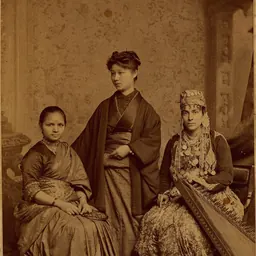
In the United States Anandibai Joshee graduated from Woman's Medical College of Pennsylvania (WMCP) in 1886. Seen here with Kei Okami (center) and Sabat Islambooly (right). All three completed their medical studies and each of them was among the first women from their respective countries to obtain a degree in Western medicine. Anandibai travelled to New York from Kolkata (Calcutta) by ship, chaperoned by two female English missionary acquaintances of the Thorborns. In New York, Theodicia Carpenter, her American host, received her in June 1883. Anandibai wrote to the Woman's Medical College of Pennsylvania in Philadelphia, which was the second women's medical program in the world. She asked to be admitted to the school, indicating that she wanted to earn a medical degree because her "poor suffering country women...would rather die...than accept [medical aid] at the hands of a male physician”. Rachel Bodley, the dean of the college, enrolled her.
Anandibai began her medical training at age 19, making her one of the first Indian women to formally train in Western medicine. While studying in the United States, Anandibai faced many challenges adjusting to life abroad. She struggled with the cold climate, different food, and being far away from home. Even while studying Western medicine, she continued following many Hindu traditions. Researchers later described this balance between traditional Indian beliefs and Western education as an important part of her identity. Modern scholars have described Anandibai's journey to America an important moment in the history of women in medicine. At a time when very few Indian women were able to travel abroad for education, her decision to study medicine in the United States inspired many generations of women. The topic of her thesis was "Obstetrics among the Aryan Hindus." The thesis incorporated references from classic Ayurvedic texts and American medical textbooks, showing her effort to bridge Indian and Western medical knowledge.
Return to India On November 16, 1886, Anandibai returned to India and was welcomed with great admiration and celebration for her achievements. Her return was seen as a moment of national pride, especially for advocates of women's education and healthcare reform, Soon after, she was appointed as the physician-in-charge the female ward of the local Albert Edward Hospital.
Modern researchers also recognize Anandibai as one of the early women who helped shape the history of medicine in South Asia. Even though she died at a young age, many scholars believe her accomplishments inspired future generations of women to pursue higher education and careers in healthcare.
Legacy In 1888, American feminist writer Caroline Wells Healey Dall wrote Joshi's biography. Dall was acquainted with Joshi and admired her greatly. However, certain points in the biography, particularly its harsh treatment of Gopalrao Joshi, sparked controversy among Joshi's friends.
Dr. Anjali Kirtane has extensively researched the life of Dr. Anandibai Joshi and has written a Marathi book entitled "डॉ. आनंदीबाई जोशी काळ आणि कर्तृत्व" ("Dr. Anandibai Joshi: her times and accomplishments") which contains rare photographs of Dr. Anandibai Joshi.
The Institute for Research and Documentation in Social Sciences (IRDS), a non-governmental organization from Lucknow, has been awarding the Anandibai Joshi Award for Medicine in honour of her early contributions to the cause of advancing medical science in India.
Modern feminist scholars continue to study Anadibai Joshi's life because of her influence on women's education and healthcare in India. Her story is often connected to more discussions about women's rights, medical education, and social reform during the nineteenth century.
Anandi Gopal, an Indian biographical film on her life in Marathi by Sameer Vidwans released in 2019. It stars Bhagyashree Milind in the titular role, Lalit Prabhakar as her husband - Gopalrao Joshi and Yogesh Soman as her father - Ganpatrao Amriteshwar Joshi. In 2017, a Gujarati-language play titled Dr. Anandibai Joshi, directed by Manoj Shah, premiered at the National Centre for the Performing Arts.
Recent scholarship highlights Joshi as an early feminist thinker who challenged the oppression of women and advocated for their education and healthcare. Historian Meera Kosambi describes her writings as evidence of an emerging, though fragmented, feminist consciousness in a time when women's voices were often marginalized.
Don’t just read it —
keep it.
Full-length biographies made to live with: read them, listen on the way to work, watch them tonight.
- E-book
- Audio
- Video
Instant download · yours to keep · every purchase keeps this site free
Important facts
more
Anandi Gopalrao JoshiPeople in Anandi Gopal Joshi's life
Named in this biography and alive at the same time

Related people
Same field, nearest in time



Contemporaries
People whose lives overlapped Anandi Gopal Joshi's


Frequently asked questions
Who was Anandi Gopal Joshi?
One of the first Indian woman doctor (1865-1887)
When was Anandi Gopal Joshi born?
Anandi Gopal Joshi was born on 31 March 1865 in Thane.
When did Anandi Gopal Joshi die?
Anandi Gopal Joshi died on 26 February 1887 in Pune.
What was Anandi Gopal Joshi's occupation?
Anandi Gopal Joshi was a physician.
What nationality was Anandi Gopal Joshi?
Anandi Gopal Joshi was Indian.
Sources & further reading
· Wikipedia: Anandi Gopal Joshi
Cite this page
APA: Biography.guide. (2026). Anandi Gopal Joshi. https://biography.guide/anandi-gopal-joshi/
MLA: "Anandi Gopal Joshi." Biography.guide, https://biography.guide/anandi-gopal-joshi/.
Chicago: "Anandi Gopal Joshi." Biography.guide. https://biography.guide/anandi-gopal-joshi/.
Data last updated: 2026-09-20 · Spot an error? Report a correction.
Page generated 2026-09-27 05:19 UTC