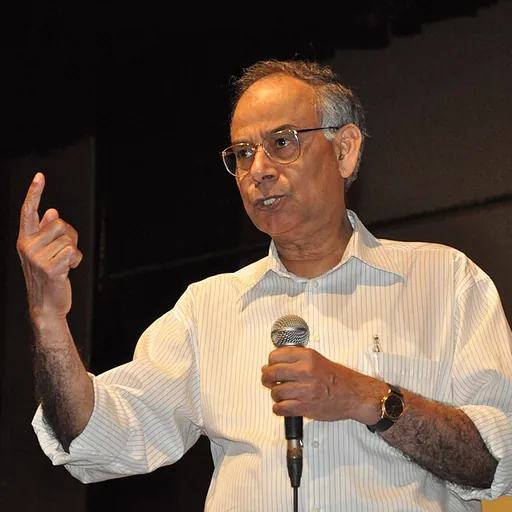
About Ananda Mohan Chakrabarty
Lived 1938 – 2020 (aged 82). Ananda Mohan Chakrabarty was an Indian and American microbiologist, known for Genetic engineering.
Ananda Mohan Chakrabarty (4 April 1938 – 10 July 2020) was an Indian American microbiologist, scientist, and researcher, most notable for his work in directed evolution and his role in developing a genetically engineered organism using plasmid transfer while working at GE, the patent for which led to landmark Supreme Court case, Diamond v. Chakrabarty.
Early life Ananda (generally called "Al" by scientific colleagues) Chakrabarty was born in Sainthia on 4 April 1938. He attended Sainthia High School, Ramakrishna Mission Vidyamandira and St. Xavier's College, Calcutta—in that order—during the course of his undergraduate education. Prof. Chakrabarty received his PhD. from the University of Calcutta in Kolkata, West Bengal in 1965.
Scientific work Prof. Chakrabarty genetically engineered a new species of Pseudomonas bacteria ("the oil-eating bacteria") in 1971 while working for the Research & Development Center at General Electric Company in Schenectady, New York.
At the time, four known species of oil-metabolizing bacteria were known to exist, but when introduced into an oil spill, they competed with each other, limiting the amount of crude oil that they degraded. The genes necessary to degrade oil were carried on plasmids, which could be transferred among species. By irradiating the transformed organism with UV light after plasmid transfer, Prof. Chakrabarty discovered a method for genetic cross-linking that fixed all four plasmid genes in place and produced a new, stable, bacterial species (now called Pseudomonas putida) capable of consuming oil one or two orders of magnitude faster than the previous four strains of oil-eating microbes. The new microbe, which Chakrabarty called "multiplasmid hydrocarbon-degrading Pseudomonas," could digest about two-thirds of the hydrocarbons that would be found in a typical oil spill.
The bacteria drew international attention when he applied for a patent—the first U.S. patent for a genetically modified organism. (U.S. utility patents had been granted to living organisms before, including two pure bacterial cultures, patented by Louis Pasteur. Chakrabarty's modified bacterium was granted a patent in the U.K. before the U.S. patent came through.) He was initially denied the patent by the Patent Office because the patent code was thought to preclude patents on living organisms. The United States Court of Customs and Patent Appeals overturned the decision in Chakrabarty's favor, writing:
Sidney A. Diamond, Commissioner of Patents and Trademarks, then appealed to the Supreme Court. The Supreme Court case was argued on 17 March 1980 and decided on 16 June 1980. This patent was granted by the U.S. Supreme Court (Diamond v. Chakrabarty), in a 5–4 decision, when it determined:
Prof. Chakrabarty's research has since paved the way for many patents on genetically modified micro-organisms and other life forms, and catapulted him into the international spotlight.
Last work His lab worked on elucidating the role of bacterial cupredoxins and cytochromes in cancer regression and arresting cell cycle progression. These proteins have been formerly known for their involvement in bacterial electron transport. He isolated a bacterial protein, azurin, with potential antineoplastic properties. He expanded his lab's work to include multiple microbiological species, including Neisseria, Plasmodia, and Acidithiobacillus ferrooxidans. Amrita Therapeutics Ltd. received initial funding in late 2008 from Gujarat Venture Finance Limited, and later received a grant for a two-year research program in 2010 from the Indian Department of Biotechnology under the Biotechnology Industry Promotion Program (BIPP).
Academic career Chakrabarty was a Distinguished University Professor in the Department of Microbiology and Immunology in the University of Illinois at Chicago College of Medicine. Ananda Chakrabarty has been an advisor to judges, governments, and the UN.
Don’t just read it —
keep it.
Full-length biographies made to live with: read them, listen on the way to work, watch them tonight.
- E-book
- Audio
- Video
Instant download · yours to keep · every purchase keeps this site free
Important facts
Related people
Same field, nearest in time




Contemporaries
People whose lives overlapped Ananda Mohan Chakrabarty's



Frequently asked questions
Who was Ananda Mohan Chakrabarty?
Indian-American microbiologist (1938-2020)
When was Ananda Mohan Chakrabarty born?
Ananda Mohan Chakrabarty was born on 4 April 1938 in Sainthia.
When did Ananda Mohan Chakrabarty die?
Ananda Mohan Chakrabarty died on 10 July 2020 in Illinois.
What was Ananda Mohan Chakrabarty's occupation?
Ananda Mohan Chakrabarty was a microbiologist.
What was Ananda Mohan Chakrabarty known for?
Ananda Mohan Chakrabarty was known for Genetic engineering.
What nationality was Ananda Mohan Chakrabarty?
Ananda Mohan Chakrabarty was Indian and American.
Sources & further reading
· Wikipedia: Ananda Mohan Chakrabarty
· DBpedia: Ananda Mohan Chakrabarty
Cite this page
APA: Biography.guide. (2026). Ananda Mohan Chakrabarty. https://biography.guide/ananda-mohan-chakrabarty/
MLA: "Ananda Mohan Chakrabarty." Biography.guide, https://biography.guide/ananda-mohan-chakrabarty/.
Chicago: "Ananda Mohan Chakrabarty." Biography.guide. https://biography.guide/ananda-mohan-chakrabarty/.
Data last updated: 2026-09-21 · Spot an error? Report a correction.
Portrait: Wikimedia Commons · author & licence
Page generated 2026-09-27 04:59 UTC