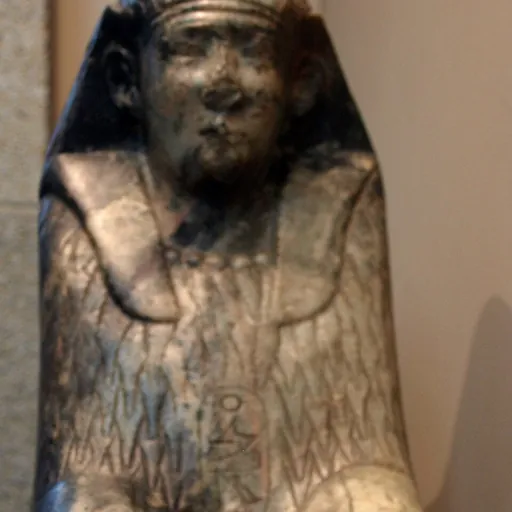
About Amenemhat IV
Lived 1900 BC – 1790 BC. Amenemhat IV was an Egyptian politician.
Family
Amenemhat IV's mother was a woman named Hetepti. Hetepti's only known attestation is an inscription on the wall of the temple of Renenutet at Medinet Madi, where she is given the title of "King's Mother", but not the titles of "King's Wife", "King's Daughter", or "King's Sister". In addition to Amenemhat IV, Hetepti appears to have had a daughter, Merestekhi, attested with the title of "King's Sister" after the accession of Amenemhat IV; her son Ankhew was overseer of the fields in the reign of his uncle Amenemhat IV.
The relationship of Amenemhat IV to Amenemhat III is debated. Amenemhat IV was the son of Amenemhat III according to Manetho, but as he isn't called a "King's Son" in any known reference to him, some historians believe that he was a grandson.
Africanus' epitome of Manetho indicates that Amenemhat IV (Ammenemēs) was succeeded by his sister Sobekneferu (Skemiophris), who indeed ruled in her own right upon the death of Amenemhat IV and is attested as a daughter of Amenemhat III. Sobekneferu is not known to have borne the title of "King's Wife" or "King's Sister" among her other titles. Egyptologist Kim Ryholt has alternatively proposed that before marrying Amenemhat III, Hetepti had been previously married to another man and that Amenemhat IV came from this marriage, thus becoming Sobekneferu's stepbrother – which could explain the Manethonian tradition. ), Amenemhat IV may have died without a surviving male heir, which could explain why he was succeeded by Sobekneferu. However, Julien Siesse has argued that such an interpretation of the royal names is not supported by the evidence and that the multiple names all refer to the same individual.
Reign The Turin Canon, a king list redacted during the early Ramesside period, records Amenemhat IV on Column 6, Row 1, and credits him with a reign of 9 years, 3 months and 27 days.
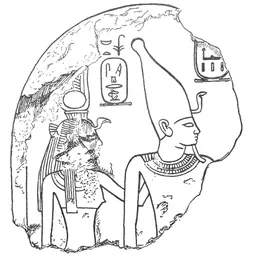
Coregency One of the naos from the funerary temple of Amenemhat III at Hawara, now located in the Egyptian Museum at Cairo. The left figure, flexing his arm across his chest in order to bring a sign "ankh" (life) to the face of his partner, is Amenemhat III. The king on the right is Amenemhat IV. Amenemhat IV first came to power as a junior coregent of his predecessor Amenemhat III, whose reign marks the apex of the Middle Kingdom period. The coregency is well attested by numerous monuments and artefacts where the names of the two kings parallel each other.
Byblos During his reign, important trade relations must have existed with the city of Byblos on the coast of modern-day Lebanon, where an obsidian and gold chest as well as a jar lid bearing Amenemhat IV's name have been found.
Mersa Gawasis Two fragments of a stela depicting Amenemhat IV and dating to his regnal year 7 were found at Berenice on the Red Sea. In 2010, a report on continuing excavations at Wadi Gawasis on the Red Sea coast notes the finding of two wooden chests and an ostracon inscribed with a hieratic text mentioning an expedition to the fabled Land of Punt in Regnal year 8 of Amenemhat IV, under the direction of the royal scribe Djedy.
Nilometer In Nubia, three nilometer records are known from Kumna that are explicitly dated to regnal years 5, 6, and 7, showing that Egyptian presence in the region was maintained during his lifetime. It is "the only intact temple still existing from the Middle Kingdom" according to Zahi Hawass, former Secretary-General of Egypt's Supreme Council of Antiquities (SCA). The foundations of the temple, administrative buildings, granaries, and residences were uncovered by an Egyptian archaeological expedition in early 2006. It is possible that Amenemhat IV built a temple in the northeastern Fayum at Qasr el-Sagha.
Amenemhat IV is responsible for the completion of a shrine at the temple of Hathor in the Sinai and may also have undertaken works in Karnak where a pedestal for a sacred barque inscribed with the names of Amenemhat III and Amenemhat IV was found in 1924.
Royal Court
Sahathor (assistant treasurer) led an expedition to the amethyst mine in the Wadi el-Hudi in Year 2 of Amenemhat IV. Djedy (royal scribe) led an expedition to the Land of Punt in Year 8 of Amenemhat IV. Kemeni (royal butler) known from a cosmetic box. Ptahhotep (expedition leader) known from stela at Berenice.
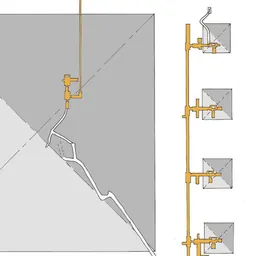
Death Pyramid
Plaquette mentioning Amenemhat IV and his son the prince Ameny. London. British Museum 22879.
Theories Legacy Less than half a decade after Amenemhat IV's death, the Twelfth Dynasty came to an end and was replaced by the much weaker Thirteenth Dynasty. Under the Thirteenth Dynasty, the Asiatic population of the Delta founded an independent kingdom ruled by kings of Canaanite descent, forming the Fourteenth Dynasty that reigned from Avaris. Approximately 80 years after the reign of Amenemhat IV, "the administration [of the Egyptian state] seems to have completely collapsed", marking the start of the Second Intermediate Period.
Dating Various authors provide different estimates for his reign: AE Chronology (1772–1764), v. Beckerath (1807–1798), Shaw (1786–1777), Dodson (1798–1785), Arnold (1799–1787), Malek (1814–1805), Grimal (1797–1790), Franke (1773–1764), Redford (1798–1790).
Don’t just read it —
keep it.
Full-length biographies made to live with: read them, listen on the way to work, watch them tonight.
- E-book
- Audio
- Video
Instant download · yours to keep · every purchase keeps this site free
Important facts
People in Amenemhat IV's life
Named in this biography and alive at the same time

Related people
Same field, nearest in time


Contemporaries
People whose lives overlapped Amenemhat IV's


Frequently asked questions
Who was Amenemhat IV?
Pharaoh of Egypt
When was Amenemhat IV born?
Amenemhat IV was born in 1900 BC.
When did Amenemhat IV die?
Amenemhat IV died in 1790 BC.
What was Amenemhat IV's occupation?
Amenemhat IV was a politician.
What nationality was Amenemhat IV?
Amenemhat IV was Egyptian.
Sources & further reading
Cite this page
APA: Biography.guide. (2026). Amenemhat IV. https://biography.guide/amenemhat-iv/
MLA: "Amenemhat IV." Biography.guide, https://biography.guide/amenemhat-iv/.
Chicago: "Amenemhat IV." Biography.guide. https://biography.guide/amenemhat-iv/.
Data last updated: 2026-09-20 · Spot an error? Report a correction.
Portrait: Wikimedia Commons · author & licence
Page generated 2026-09-27 05:08 UTC