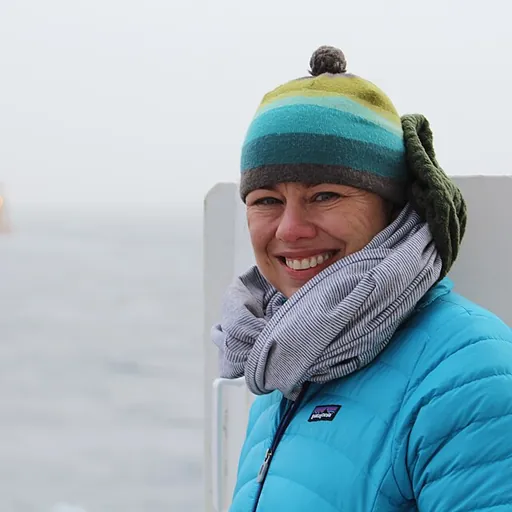
About Amelia E. Shevenell
Amelia E. Shevenell was a scientist and geologist.
Amelia E. Shevenell is an American marine geologist who specializes in high-latitude paleoclimatology and paleoceanography. She is currently a Professor in the College of Marine Science at the University of South Florida. She has made notable contributions to understanding the history of the Antarctic ice sheets and published in high-impact journals and, as a result, was awarded full membership of Sigma Xi. She has a long record of participation in international ocean drilling programs and has served in leadership positions of these organizations. Shevenell served as the elected Geological Oceanography Council Member for The Oceanography Society (2019-2021).
Early life and education Shevenell earned a bachelor's degree in geology and studio art at Hamilton College in New York State. Shevenell worked as a laboratory technician and environmental scientist in Juneau, Alaska, before attending the University of California, Santa Barbara, where she studied Antarctic ice sheet evolution and paleoceanography and earned her Ph.D. in Marine Science (2004). Shevenell was a postdoctoral fellow at the Program on Climate Change at the University of Washington School of Oceanography. From 2007 to 2011, Shevenell was a lecturer in earth sciences and geography at University College London. In 2011, Shevenell joined the faculty of the University of South Florida College of Marine Science, earning tenure in 2017.
Career and impact Amelia Shevenell's research focuses on understanding the evolution of Antarctica's ice sheets over the last 65 million years. Shevenell uses the sedimentological, geochemical, and micropaleontological properties of marine sediments from the deep-sea and Antarctica's continental margins to reconstruct relationships between Antarctica's ice sheets and Earth's oceans, carbon cycle, and climate on million - to decadal timescales. Shevenell's research is relevant to Intergovernmental Panel on Climate Change (IPCC) concerns that ongoing oceanic and atmospheric warming is accelerating polar ice cap melting and global sea level rise. She has participated in eight oceanographic expeditions to the Southern Ocean, several of which are featured in her scientific blogs.
Antarctic ice sheet development during the Cenozoic. Shevenell's research has focused on Antarctic ice sheet development in the Miocene when ice expansion occurred. Her work discovered that Southern Ocean cooling during the Middle Miocene Climate Transition occurred before the expansion of Antarctica's ice sheets at ~14 million years ago. Shevenell has since shown that progressive ice sheet expansion on Antarctica began around 14.8 million years ago, during the Miocene Climatic Optimum, when average global temperatures were warmer than present. Ice growth was paced by changes the eccentricity of Earth's orbit around the Sun. Another study established that glaciers reached the Sabrina Coast of East Antarctica by at least the late Paleocene to early Eocene. This finding was counter to earlier studies that placed the beginning of ice expansion in Antarctica at the start of the Oligocene roughly 34 million years ago.
Carbon cycling in high-latitude oceans. In a study of Holocene marine sediments in the western Pacific Shevenell found evidence for increased upwelling in the North Pacific. The increased upwelling was caused by stronger winds, which in turn released more CO2 into the atmosphere enhancing global warming during the Holocene and the shrinkage of ice sheets. Thus, demonstrating that a possible cause of the warming was a change in ocean circulation. At present, atmospheric connections to the tropical Pacific allow warm ocean waters to move onto Antarctica's continental shelves, melting regional glaciers. Shevenell's research indicates this process has occurred in past warm climate intervals, and will likely continue as Earth's climate continues to warm. Shevenell led the sedimentology group on IODP Expedition 374 to the central Ross Sea, Antarctica. This Expedition was designed to understand the factors influencing ice sheet development over the last 20 million years, including the formation and history of the West Antarctic Ice Sheet.
Shevenell has also served within the leadership of the IODP Scientific Advisory Structure, as a member of the Science Evaluation Panel (2011-2014) and the United States Advisory Committee for Scientific Ocean Drilling (2014-2018). Shevenell has served as a US member of the JOIDES Resolution facility board since 2019.
Honors and recognition In 2006, Shevenell was awarded the Storrs Cole Memorial Research Award of the Geological Society of America for her publications on invertebrate micropaleontology.
Based upon her scientific ocean drilling research, Shevenell was selected as an IODP Distinguished Lecturer for 2014–2015. Lecturers are nominated by the scientific ocean drilling community and selected by the United States Science Support Office for ocean drilling. Distinguished lecturers visit institutions that are not typically involved in ocean drilling and may not have funds to host visiting speakers.
In 2016, Shevenell was recognized by American Geophysical Union (AGU) journal editors as an AGU Outstanding Reviewer for Geophysical Research Letters.
In 2019, Shevenell was elected as a Full Member of Sigma Xi, the scientific research honor society.
Her Nature paper, Gulick and Shevenell et al.
Media coverage The significance of Shevenall's work to the understanding of changes affecting the Antarctic ice sheets have been featured in Discover Magazine, National Geographic, and Reuters.
Her research is featured in an episode of the Forecast Podcast a podcast about climate science and climate scientists with Nature’s editor for climate science, Michael White.
Shevenell also maintains a blog for Antarctic research cruises on ice breaker Laurence Gould LMG12-11 (October, 2012); LMG13-11 (October 2013); icebreaker Nathaniel Palmer NBP14-02 (January–March, 2014), and IODP Expedition 374 (January–March, 2018).
Selected works
Don’t just read it —
keep it.
Full-length biographies made to live with: read them, listen on the way to work, watch them tonight.
- E-book
- Audio
- Video
Instant download · yours to keep · every purchase keeps this site free
Important facts
Related people
Same field, nearest in time


Frequently asked questions
Who was Amelia E. Shevenell?
American marine geologist
What was Amelia E. Shevenell's occupation?
Amelia E. Shevenell was a scientist and geologist.
Sources & further reading
· Wikipedia: Amelia E. Shevenell
· DBpedia: Amelia E. Shevenell
Cite this page
APA: Biography.guide. (2026). Amelia E. Shevenell. https://biography.guide/amelia-e-shevenell/
MLA: "Amelia E. Shevenell." Biography.guide, https://biography.guide/amelia-e-shevenell/.
Chicago: "Amelia E. Shevenell." Biography.guide. https://biography.guide/amelia-e-shevenell/.
Data last updated: 2026-09-21 · Spot an error? Report a correction.
Portrait: Wikimedia Commons · author & licence
Page generated 2026-09-27 05:01 UTC