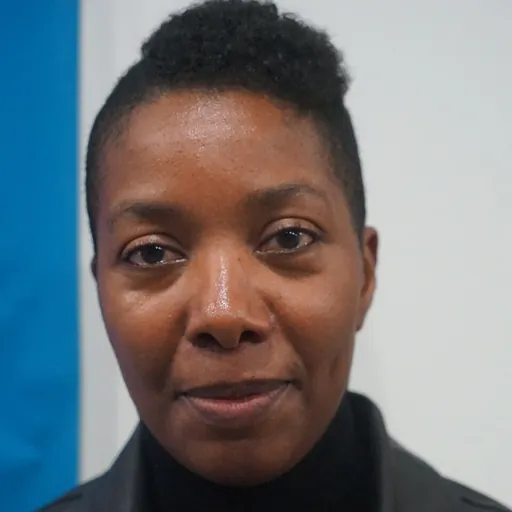
About Amandine Gay
Born 1984. Amandine Gay is a French film director, actor, afrofeminist, screenwriter and feminist.
Amandine Gay (; born October 16, 1984) is a French feminist, filmmaker, researcher and actress. Her first film Ouvrir la Voix is a documentary giving voice to Black women in France that aims to give an other approach of feminist movements.
Biography Amandine Gay is born of a Moroccan mother and an unknown father on October 16, 1984, in France. Her mother and her adoptive father, both white, are respectively a school teacher and a roadmender living in a village near Lyon. She plays basketball at a good level.
My entire education, I did it in white environments, surrounded by racist people. I tried to make efforts but I was only just a black person for them. I've been pissed at a very young age. However, I would say that activism came with a certain political awareness. When in 2005, deputies UMP tried to pass a law, Law on the recognition of the Nation and national contribution in favor of French repatriates (loi sur le rôle positif de la colonisation), I was so shocked I decided to work on « the stakes and approach of the colonial question » as my research subject during my last year as a student in Lyon's political science school.5.
After her studies she starts working as an actress, but after a few months of activity, she realizes that she is always interpreting the same stereotypical roles (drug addict, prostitute, illegal immigrant). Her agent tells her that although he is sending her profile for roles corresponding to her age, she receives answers only when the scenario is specifying that the role is for a Black character.
In five years of work, I obtained only two "normal" roles, a lawyer on a TF1 series and a theater role, in which I played several different characters. After 5 years, I had enough: I ceased my career to become a film maker." She starts to write short programs for television, though she finds it difficult to find funding. Amandine Gay explains that film producers are usually white men in their fifties. They don't recognize their societal experiences in the programs that she develops. She co-writes a fiction, a satire of feminine magazines called Medias Tartes. One of the characters is a Black lesbian wine steward meets the misunderstanding of potential investors, who tell her that such a person does not exist in France, then this character is inspired from her own life. The film received the Out d'or for artistic creation in 2017.
Since 2014, as she did not see herself founding a family "nothing that could make a black child proud", she lives in Montreal then declaring:
And again:
She defines herself as of African descent, Black, born, afro-feminist, pansexual, antiracist, anti heteronormativity, afro-punk, pro-choice (abortion, veil, sex working), body-positive.
Publications Amandine Gay published two major autobiographical essays. Her latest book, Vivre, libre. Exister au cœur de la suprématie blanche (2025), examines the structures of white supremacy and the prospects for emancipation in a society shaped by racial oppression. Gay explores questions of resistance to systemic racism, framing white supremacy as a political regime rather than a purely individual or moral issue. She analyzes everyday experiences—adult supremacy, family, friendship, sexuality, and work—and considers how white supremacy perpetuates itself. Gay, as a keen observer of power relations, identifies "ordinary forms of racial violence" and proposes methods for emancipation through active antiracism.
Drawing on the philosopher Charles W. Mills, Gay discusses "white ignorance", a concept describing cognitive mechanisms among whites that render racial dominance invisible to them. According to Mills, whose theories trace back to Enlightenment thinkers, the origin lies in the seventeenth century "social contract," which in effect excluded large groups—non-Europeans—from full humanity. Mills qualifies the social contract as a racial contract, foundational yet tacit and widely unacknowledged.
Gay's first autobiographical work, Une poupée en chocolat (2021), addresses questions of adoption, loss, and identity. She recalls, "I am a person born under X, possessing nothing from my past: no medical history, no genealogy, no family memory. I must write my story so as not to remain a sum of silences, traumas, and dispossessions. This book is a trace, an archive, a piece of the puzzle I try to complete through political analysis."
Additional publications
Publications
Vivre, libre. Exister au cœur de la suprématie blanche (La Découverte, 2025) Une poupée en chocolat (La Découverte, 2021)
Additional publications
Nouveau départ (2023), a text titled Ceci n’est pas une postface. Preface: Lâche le micro ! 150 ans de luttes des femmes noires pour le droit à l'auto-détermination, in the French translation of bell hooks, Ne suis-je pas une femme ? Femmes noires et féminisme (2015). This preface introduces bell hooks's foundational work on Black feminism to a French audience. Chapter Je n’en ferai pas in Nullipares et alors ? (2025). Contributed a chapter titled Je n’en ferai pas (pp. 147–163) in this collective work discussing childlessness and societal expectations. Contribution to Venir au monde – autonomie, dignité et luttes pour une justice reproductive (2025). Contribution to this collective volume focused on autonomy, dignity, and reproductive justice. Essay Emulation or competition? in Wages for wages against – volume 3 (2024) (pp. 68–77) exploring precarity and selection processes in artistic fields. Essay Les blanc·he·s et les noir·e·s ont bien une place distincte dans la hiérarchie sociale en France, in Écrits féministes. II. de 1970 à nos jours (2023)(pp. 133–139), discussing racial hierarchies in French society. Contribution in La poudre – féminismes et cinéma. Le grand tournant raconté par les voix engagées du cinéma français. Tome 2 (2021) (pp. 47–70), reflecting on feminism and cinema. Essay What’s in a word? in Reach everyone on the planet: Kimberlé Crenshaw and intersectionality (2019) (pp. 63–66) about intersectionality theory. Essay La crise d’une utopie blanche ? in Éloge des mauvaises herbes (2018)(pp. 157–165), analyzing white utopia and social movements. Essay La réappropriation des moyens de production au service d’une esthétique autonome, in Décolonisons les arts ! (2018)(pp. 46–53). Essay Who’s claiming us in Black anthology: adult adoptees claim their space (2016) (pp. 80–87) on adoptees reclaiming agency. Preface to Lettres du Bangwe (2021) Pages 11–15, a collection focused on testimonies and letters.
Film and Documentaries Gay's documentary Ouvrir La Voix (2017) gives space to the testimonies of 24 French-speaking women of African descent. The film, self-produced and self-distributed, offers an intersectional exploration of gender and racial stereotypes lived by Black women in Europe, connecting their experiences to histories of colonialism and discrimination.
Other Projects Since 2018, Amandine Gay has organized the "Month of the Adopted" (Le Mois des Adopté·es), an annual series of events taking place in November across France, Switzerland, Belgium, and Quebec. Inspired by the National Adoption Awareness Month in Anglophone countries, the project offers panels, film screenings, and workshops aimed at reclaiming the narrative for adoptees—now mostly adults.
Gay also regularly lectures on afrofeminism, cultural industries, intersectionality, and adoption.
Don’t just read it —
keep it.
Full-length biographies made to live with: read them, listen on the way to work, watch them tonight.
- E-book
- Audio
- Video
Instant download · yours to keep · every purchase keeps this site free
Important facts
People in Amandine Gay's life
Named in this biography and alive at the same time


Related people
Same field, nearest in time



Contemporaries
People whose lives overlapped Amandine Gay's




Frequently asked questions
Who is Amandine Gay?
French director, actress and afrofeminist
When was Amandine Gay born?
Amandine Gay was born on 16 October 1984 in France.
What is Amandine Gay's occupation?
Amandine Gay is a film director, actor, afrofeminist, screenwriter and feminist.
What nationality is Amandine Gay?
Amandine Gay is French.
Sources & further reading
Cite this page
APA: Biography.guide. (2026). Amandine Gay. https://biography.guide/amandine-gay/
MLA: "Amandine Gay." Biography.guide, https://biography.guide/amandine-gay/.
Chicago: "Amandine Gay." Biography.guide. https://biography.guide/amandine-gay/.
Data last updated: 2026-09-24 · Spot an error? Report a correction.
Portrait: Wikimedia Commons · author & licence
Page generated 2026-09-27 05:08 UTC