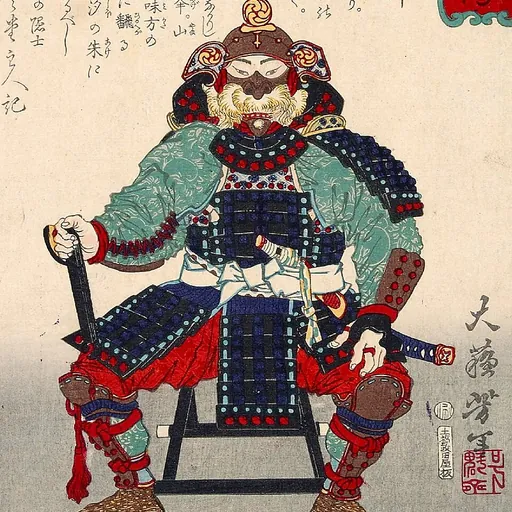
About Amakusa Shirō
Lived 1621 – 1638 (aged 16–17). Amakusa Shirō was a samurai.
, also known as , was a Japanese Christian of the Edo period and leader of the Shimabara Rebellion, an uprising of Japanese Roman Catholics against the Shogunate. His Christian name was Geronimo and he was later known as Francisco.
The uprising led by Shirō was defeated, and he was executed at the age of 17. His head was displayed on a pike near Nagasaki as a warning to Christians. His efforts as the spiritual leader of the uprising, and the inevitable defeat of the Christian rebels at Hara Castle, were reflected in the 1962 movie (shown in English-speaking countries as The Christian Revolt or The Revolutionary), by the Japanese movie director Nagisa Oshima.
Early life Shirō was born in 1621 as the son of Catholic parents, Masuda Jinbei (益田 甚兵衛), a former Konishi clan retainer, and his wife. Legend speculates that Shirō could have been the illegitimate son of Toyotomi Hideyori, but these claims have little credibility.
Portuguese Jesuit missionaries had been active in Japan since the late 16th century. By the age of 15, the charismatic youth was known to his Japanese Catholic followers as "Heaven's messenger". Miraculous powers were attributed to him.
Rebellion Banner of Amakusa Shirō, during the Shimabara Rebellion. Text on the banner is medieval Portuguese reading "". English meaning "Praised be the Most Holy Sacrament".
Shirō was among Japanese Catholics who took over Hara Castle in a rebellion against the Shogunate. They mounted a coordinated defense that held off attackers, but the rebel force had no logistical support, and their resolve was weakened. Shirō was said to display posters in the castle to raise morale and said:
Now, those who accompany me in being besieged in this castle, will be my friends unto the next world.
One of the rebel soldiers, , betrayed Shirō. He got a message to the Shogunate that rebel food supplies were running low. The Shogunate forces made a final assault, taking Hara Castle in the process. The Shogunate forces massacred almost 40,000 rebels. Yamada was the only recorded survivor.
Death Shirō was taken captive and executed after the castle was captured. His head was displayed on a pike in Nagasaki for an extended period of time as a warning to potential Christian rebels.
Don’t just read it —
keep it.
Full-length biographies made to live with: read them, listen on the way to work, watch them tonight.
- E-book
- Audio
- Video
Instant download · yours to keep · every purchase keeps this site free
Important facts
more
Amakusa ShirouRelated people
Same field, nearest in time



Frequently asked questions
Who was Amakusa Shirō?
leader of the Shimabara Rebellion
When was Amakusa Shirō born?
Amakusa Shirō was born in 1621 in Ōyano Island.
When did Amakusa Shirō die?
Amakusa Shirō died on 12 April 1638 in Hara Castle.
What was Amakusa Shirō's occupation?
Amakusa Shirō was a samurai.
What nationality was Amakusa Shirō?
Amakusa Shirō's recorded nationality: Tokugawa shogunate.
Sources & further reading
Cite this page
APA: Biography.guide. (2026). Amakusa Shirō. https://biography.guide/amakusa-shiro/
MLA: "Amakusa Shirō." Biography.guide, https://biography.guide/amakusa-shiro/.
Chicago: "Amakusa Shirō." Biography.guide. https://biography.guide/amakusa-shiro/.
Data last updated: 2026-09-24 · Spot an error? Report a correction.
Portrait: Wikimedia Commons · author & licence
Page generated 2026-09-27 05:08 UTC