
Ali ibn Sahl Rabban al-Tabari
Persian scholar and physician
About Ali ibn Sahl Rabban al-Tabari
Lived 838 – 874 (aged 35–36). Ali ibn Sahl Rabban al-Tabari was an Arab philosopher, physician, psychologist, scientist and scholar.
Ali ibn Sahl Rabban al-Tabari (; c. 838 – c. 870 CE; also given as 810–855 or 808–864 also 783–858 Muslim scholar, physician and psychologist, who produced one of the first Islamic encyclopedia of medicine titled Firdaws al-Hikmah ("Paradise of Wisdom"). Ali ibn Sahl spoke Syriac and Greek, the two sources of the medical tradition of Antiquity which had been lost by medieval Europe, and transcribed in meticulous calligraphy. His most famous student was the physician and alchemist Abu Bakr al-Razi . Al-Tabari wrote the first encyclopedic work on medicine. He lived for over 70 years and interacted with important figures of the time, such as Muslim caliphs, governors, and eminent scholars. Because of his family's religious history, as well as his religious work, al-Tabarī was one of the most controversial scholars. He first discovered that pulmonary tuberculosis is contagious.
Outside the rational sciences, as a convert from Christianity to Islam he was also involved in interreligious polemics, writing two works critical of his former religion, al-Radd ´alā l-Nasārā (The Refutation of the Christians) and Kitāb al-Dīn wa-l-Dawla (The Book of Religion and Empire), both of which having been published by Brill in 2016 in a single book, The Polemical Works of ʿAlī al-Ṭabarī.
Life Ali came from a Persian or Syriac family of Tabaristan Amol (hence al-Tabari – "from Tabaristan"). Hossein Nasr states that he was a convert to Islam from Zoroastrianism, His father Sahl ibn Bishr was a state official, highly educated and well respected member of the Syriac community.
The Abbasid caliph al-Mu'tasim (833–842) took him into the service of the court, which he continued under al-Mutawakkil (847–861). Ali ibn Sahl was fluent in Syriac and Greek, the two sources for the medical tradition of antiquity, and versed in fine calligraphy.
Works Although few of his works are extant, al-Tabarī wrote twelve books. Most of them were about medicine. In addition to medicine, he was known as a scholar of philosophy, mathematics and astronomy. His Firdaws al-Hikmah ("Paradise of Wisdom"), which he wrote in Arabic called also al-Kunnash was a system of medicine in seven parts. He also translated it into Syriac, to give it wider usefulness. The information in Firdaws al-Hikmah has never entered common circulation in the West because it was not edited until the 20th century, when Mohammed Zubair Siddiqui assembled an edition using the five surviving partial manuscripts. There is still no English translation. A German translation by Alfred Siggel of the chapters on Indian medicine was published in 1951. Tuhfat al-Muluk ("The King's Present") a work on the proper use of food, drink, and medicines. Hafzh al-Sihhah ("The Proper Care of Health"), following Greek and Indian authorities. Kitab al-Ruqa ("Book of Magic or Amulets") Kitab fi al-hijamah ("Treatise on Cupping") Kitab fi Tartib al-'Ardhiyah ("Treatise on the Preparation of Food")
Firdaws al-Hikmah
Firdaws al-Hikmah or Paradise of Wisdom is one of the oldest encyclopedias of Islamic medicine, based on Syriac translations of Greek and Indian sources (Hippocrates, Galen, Dioscorides, and others).It is divided into 7 sections and 30 parts, with 360 chapters in total. Part I. general philosophical ideas, the categories, natures, elements, metamorphosis, genesis and decay.subdivided into I2 chapters, treats of general philosophical ideas, mostly following Aristotle. On the Name of the Book and its Composition. The author mentions among his sources Hippocrates, Galen and Aristotle Hunayn ibn Ishaq On Matter Shape, Quantity and Quality On simple and compound Temperaments On the Antagonism of these Temperaments and the Refutation of the Opinion of those who allege that the Air is cold (of temper.). diagram of the four temperaments and their antagonistic action. On the Genesis of Temperaments one from another. On Metamorphosis Plato is quoted. On Genesis and Decay. On Activity and Passivity On the Genesis of Things from the Elements, the Action of the Celestial Sphere and the Luminous Bodies therein. On the Effects of the Action of the Elements on the Air and subterranean Conditions On shooting Stars and the Colors which are generated in the Air. (rainbows) Part II embryology, pregnancy, the functions and morphology of different organs, ages and seasons, psychology, the external and internal senses, the temperaments and emotions, personal idiosyncrasies, nervous affections, tetanus, torpor, palpitation, nightmare, the evil eye, hygiene and dietetics. Book I Book II Book III Book IV Book V Part III. Treats of nutrition and dietetics. 3 chapters Part IV. (The longest, 107 out of 276 folios and 152 chapters. Each chapter is short, often less than one page and seldom more than two. There is little beyond the signs and symptoms of each disease and the treatment recommended there are no references to actual cases, or clinical notes. ) general and special pathology, from the head to the feet, and concludes with an account of the number of muscles, nerves and veins, and dissertations on phlebotomy, the pulse and urinoscopy. Book 1 (9 chapters) on general pathology, the signs and symptoms of internal disorders, and the principles of therapeutics. Book 2 (14 chapters) on diseases and injuries of the head; and diseases of the brain, including epilepsy, various kinds of headache, tinnitus, vertigo, amnesia, and nightmare. Book 3 (12 chapters) on diseases of the eyes and eyelids, the ear and the nose (including epistaxis and catarrh), the face, mouth and teeth. Book 4 (7 chapters) on nervous diseases, including spasm, tetanus, paralysis, facial palsy, etc. Book 5 (7 chapters) on diseases of the throat, chest and vocal organs, including asthma. Book 6 (6 chapters) on diseases of the stomach, including hiccup. Book 7 (5 chapters) on diseases of the liver, including dropsy. Book 8 (14 chapters) on diseases of the heart, lungs, gall-bladder and spleen. Book 9 (19 chapters) on diseases of the intestines (especially colic), and of the urinary and genital organs. Book 10 (26 chapters) on fevers, ephemeral, hectic, continuous, tertian, quartan and semi-quartan; on pleurisy, erysipelas, and smallpox; on crises, prognosis, favorable and unfavorable symptoms, and the signs of death. Book 11 (13 chapters) on rheumatism, gout, sciatica, leprosy, elephantiasis, scrofula, lupus, cancer, tumours, gangrene, wounds and bruises, shock, and plague. The last four chapters deal with anatomical matters, including the numbers of the muscles, nerves and blood-vessels. Book 12 (20 chapters) on phlebotomy, cupping, baths and the indications of the pulse and urine. Part V. of tastes, scents and colors. 1 book, 9 chapters Part VI materia medica and toxicology. Part VII. climate, waters and seasons in their relation to health, outlines of cosmography and astronomy, and the utility of the science of medicine: and a summary of Indian Medicine in 36 chapters.
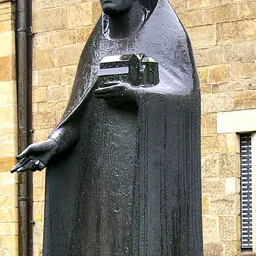
Legacy In 2013 a statue of al-Tabari was revealed at the Mazandaran University of Medical Sciences.
Don’t just read it —
keep it.
Full-length biographies made to live with: read them, listen on the way to work, watch them tonight.
- E-book
- Audio
- Video
Instant download · yours to keep · every purchase keeps this site free
Important facts
People in Ali ibn Sahl Rabban al-Tabari's life
Named in this biography and alive at the same time

Related people
Same field, nearest in time




Contemporaries
People whose lives overlapped Ali ibn Sahl Rabban al-Tabari's


Frequently asked questions
Who was Ali ibn Sahl Rabban al-Tabari?
Persian scholar and physician
When was Ali ibn Sahl Rabban al-Tabari born?
Ali ibn Sahl Rabban al-Tabari was born in 838 in Amol.
When did Ali ibn Sahl Rabban al-Tabari die?
Ali ibn Sahl Rabban al-Tabari died in 874 in Baghdad.
What was Ali ibn Sahl Rabban al-Tabari's occupation?
Ali ibn Sahl Rabban al-Tabari was a philosopher, physician, psychologist, scientist and scholar.
What nationality was Ali ibn Sahl Rabban al-Tabari?
Ali ibn Sahl Rabban al-Tabari was Arab.
Sources & further reading
· Wikipedia: Ali ibn Sahl Rabban al-Tabari
· DBpedia: Ali ibn Sahl Rabban al-Tabari
Cite this page
APA: Biography.guide. (2026). Ali ibn Sahl Rabban al-Tabari. https://biography.guide/ali-ibn-sahl-rabban-al-tabari/
MLA: "Ali ibn Sahl Rabban al-Tabari." Biography.guide, https://biography.guide/ali-ibn-sahl-rabban-al-tabari/.
Chicago: "Ali ibn Sahl Rabban al-Tabari." Biography.guide. https://biography.guide/ali-ibn-sahl-rabban-al-tabari/.
Data last updated: 2026-09-20 · Spot an error? Report a correction.
Page generated 2026-09-27 05:16 UTC