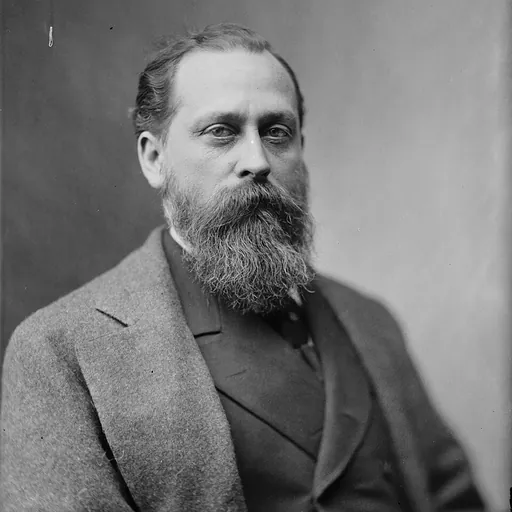
About Alfred Moore Waddell
Lived 1834 – 1912 (aged 77). Alfred Moore Waddell was an American politician, lawyer and editor.
Family and education Waddell was born in Hillsboro, North Carolina, to Hugh Waddell, a prominent lawyer and president of the North Carolina Senate in 1836, and Susan Moore. He was the great-great-great-grandson of General Hugh Waddell, and great-grandson of both Brigadier General Francis Nash and U. S. Supreme Court Justice Alfred Moore. He attended Bingham's School and Caldwell Institute before enrolling in the University of North Carolina at Chapel Hill, graduating in 1853. After being admitted to the bar, he began practicing law in Wilmington in 1855. While he was a good lawyer, he was said to have not liked being one. Waddell also wedded a third time, marrying Gabrielle de Rosset, in 1896.
Publisher In July 1860, Waddell purchased the most influential Whig newspaper in the Cape Fear region, the Wilmington Daily Herald, and used it as a platform to promote his views opposing secession. He left publishing for good, and returned to practicing law, in 1883. However, he would go on to author, and publish, several books including a biography of his great-great-grandfather, a historical work on the Cape Fear Region, and an autobiography published in 1908, "Some Memories of My Life."
Waddell resigned in 1864 due to poor health.
Political career In 1856, Waddell supported the American Party and opposed secession in the years leading up to the Civil War. In 1860, he was a delegate to the Constitutional Union National Convention.
In 1870, Waddell ran for Congress as a Conservative Democrat. He was elected to the 42nd United States Congress; he was re-elected three times, serving on the Ku Klux Klan committee and as the chairman of the Committee on Post Offices and Post Roads during his final term. Democrats developed a plan to restore "home rule," which was a return to the antebellum status quo. They began circumventing legislation by taking over the state's judiciary, and adopted 30 amendments to the state constitution including lowering the number of judges on the state supreme court, putting the lower courts and local governments under the control of the state legislature, rescinding the votes of certain types of criminals, mandating segregated public schools, outlawing interracial relationships and granting the General Assembly the power to modify or nullify any local government.
However, in that region, poor white cotton farmers, fed up with the capitalism of big banks and railroad companies, had aligned themselves with the labor movement. They had turned on the Democratic Party, founding The People's Party (also known as The Populists). As the US plunged into an economic depression, the Populists banded with black Republicans who shared their hardships, forming an interracial coalition with a platform of self-governance, free public education and equal voting rights for black men, called the Fusion Coalition.
In the 1894 and 1896, the Fusion party won every statewide office, including the governorship. This shift of power horrified white Democrats, who sought to capitalize on some cracks between the Fusion alliance, of black Republicans and white Populists, that began to show in 1898.
Rise to leadership
Democratic Party Chairman, Furnifold Simmons, was tasked with developing a strategy for the Democrats 1898 campaign. He decided to build a campaign around the issue of white supremacy.
Simmons created a speakers bureau, stacking it with talented orators who he could deploy to deliver the message across the state.
Waddell aligned with the Democrats and their campaign to "redeem North Carolina from Negro domination."
In a packed Wilmington auditorium, while sharing the stage with 50 of the city's most prominent white men, such as Robert Glenn, Thomas Jarvis, Cameron Morrison and Charles Aycock, Waddell declared that white supremacy was the only issue of importance for white men, and advocated punishment for race-traitors. However, Waddell set himself apart from the other speakers through his rousing ability to incite through propaganda, which he cemented with a blistering closing to his speech when he proclaimed, "We will never surrender to a ragged raffle of Negroes, even if we have to choke the Cape Fear River with carcasses."
Democrats won the election in Wilmington by 6,000 votes, a sizable shift from the Fusion Party's 5,000-vote edge just two years prior. However, the Fusion Party remained intact in Wilmington, the North Carolina city with the greatest concentration of black wealth and economic power. He proclaimed, to the raucous crowd of 600, that the U.S. Constitution "did not anticipate the enfranchisement of an ignorant population of African origin," that "never again will white men of New Hanover County permit black political participation" that "the Negro stop antagonizing our interests in every way, especially by his ballot," and that the city "give to white men a large part of the employment heretofore given to Negroes." At the same time, black newspapers all over the state were also being destroyed. In addition, blacks, along with white Republicans, were denied entrance to city centers throughout the state.
It is estimated that, by the end of the day, Waddell's orders led to the murder of between 60 and 300 black people, and to the banishment of about 20 more.
"Race riot"
Wilmington coup, described in the Richmond Planet. Nov. 19, 1898 On November 26, 1898, Collier's Weekly published an article in which Waddell wrote about the government overthrow entitled, "The Story of The Wilmington, North Carolina, Race Riots"
Despite vowing to "choke the Cape Fear River with carcasses," and the fact that some members of the white mob posed for a photograph in front of the charred remnants of "The Daily Record," Waddell painted himself in the article as a reluctant non-violent leader – or accidental hero – "called upon" to lead under "intolerable conditions." He painted the white mob not as murderous lawbreakers, but as peaceful, law-abiding citizens who simply wanted to restore law and order. He also portrayed any violence committed by whites as either being accidental or executed in self-defense, effectively laying blame on both sides:
Waddell's account, and his effective label of "race riot," ignored the fact that the overthrow was a carefully planned conspiracy, turned the coup into an event that "spontaneously happened," helped usher in the Solid South, and set the precedent for the application of the term "race riot," that is still used today. He defined the historical narrative of the coup.
Death
Waddell died in Wilmington in 1912. Newspapers reported that he suffered an "attack of angina pectoris" or a heart attack. His funeral was held in Saint James' episcopal Church in Wilmington. He is buried in Oakdale cemetery, Wilmington.
Don’t just read it —
keep it.
Full-length biographies made to live with: read them, listen on the way to work, watch them tonight.
- E-book
- Audio
- Video
Instant download · yours to keep · every purchase keeps this site free
Important facts
People in Alfred Moore Waddell's life
Named in this biography and alive at the same time


Related people
Same field, nearest in time




Contemporaries
People whose lives overlapped Alfred Moore Waddell's




Frequently asked questions
Who was Alfred Moore Waddell?
lawyer and American military officer (1834–1912)
When was Alfred Moore Waddell born?
Alfred Moore Waddell was born on 16 September 1834 in Hillsborough.
When did Alfred Moore Waddell die?
Alfred Moore Waddell died on 17 March 1912 in Wilmington.
What was Alfred Moore Waddell's occupation?
Alfred Moore Waddell was a politician, lawyer and editor.
What nationality was Alfred Moore Waddell?
Alfred Moore Waddell was American.
Sources & further reading
· Wikipedia: Alfred Moore Waddell
· DBpedia: Alfred Moore Waddell
Cite this page
APA: Biography.guide. (2026). Alfred Moore Waddell. https://biography.guide/alfred-moore-waddell/
MLA: "Alfred Moore Waddell." Biography.guide, https://biography.guide/alfred-moore-waddell/.
Chicago: "Alfred Moore Waddell." Biography.guide. https://biography.guide/alfred-moore-waddell/.
Data last updated: 2026-09-20 · Spot an error? Report a correction.
Portrait: Wikimedia Commons · author & licence
Page generated 2026-09-27 04:57 UTC