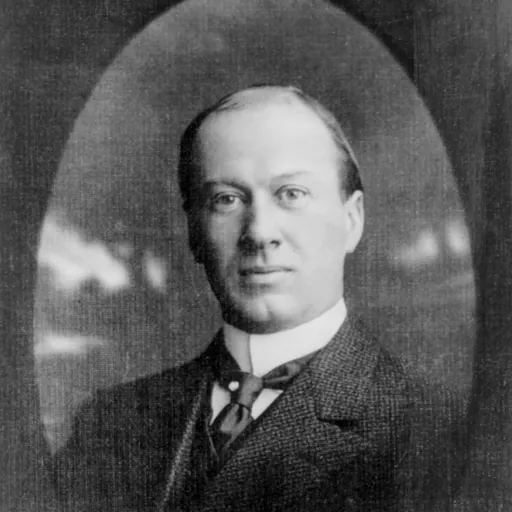
About Alfred Irénée du Pont
Lived 1864 – 1935 (aged 70). Alfred Irénée du Pont was an American entrepreneur and composer, known for Business magnate, Financier and Philanthropy.
Alfred Irénée du Pont (May 12, 1864 – April 28, 1935) was an American industrialist, financier, philanthropist and a member of the influential Du Pont family.
Alfred du Pont first rose to prominence through his work in his family's Delaware-based gunpowder manufacturing plant, E. I. du Pont de Nemours and Company (now known as DuPont), in which for many years he served as a director of the board and Vice President of operations.
Following an acrimonious departure and a brief dip in personal fortunes, he embarked on business of his own, investing in land and banking in Florida. He died a multimillionaire, with the bulk of his fortune sustaining the Alfred I. duPont Testamentary Trust.
Early years
Alfred du Pont was born in the Brandywine Valley region of Delaware, where his great-great-grandfather Pierre Samuel du Pont de Nemours had immigrated with his sons after the French Revolution. His great-grandfather Eleuthère Irénée du Pont had founded E. I. du Pont de Nemours and Company in 1802. His grandfather was Alfred V. du Pont. The son of Éleuthère Irénée du Pont II, a partner in the family's gunpowder business, and Charlotte Shepard Henderson, Alfred I. du Pont had two older sisters and two younger brothers. When du Pont was 13, his mother, who had a history of mental illness, was committed to an asylum following an episode of hysteria. Within a week, she died. The du Pont children were orphaned a month later when Éleuthère followed, a victim of tuberculosis. Most of the over 200 patents he registered were related to this work.
Du Pont married his cousin Bessie Gardner (1864–1949) in 1887, and she was the mother of his first four children. Beyond that, Eugène du Pont and other family members largely ignored du Pont, excluding him from the company board.
In 1902, upon the death of Eugène du Pont, the three senior partners considered selling the company to competitor Laflin & Rand Powder Company.
Du Pont's relationship with his second wife, Mary (Alicia) Heyward Bradford (1875–1920), had already been the subject of family scandal, as family members had remarked on the close relationship of the two even before Alicia Bradford's marriage to du Pont's secretary, George Amory Maddox. Maddox and his wife lived close to du Pont and were frequently visited by him; du Pont and Bradford, who had borne a daughter in the meantime, left their spouses at around the same time and were married two weeks after Bradford's divorce was final. Du Pont's adoption of Bradford's daughter, Alicia Maddox, brought fresh gossip to the family, who largely rallied in support of his first wife, which in turn inspired du Pont to file several lawsuits against family members and friends for slander, all of which were dropped in due time.
Du Pont gave Bradford a new home built on in Wilmington, Delaware. Construction of the Nemours Mansion and Gardens occurred between 1909 and 1910.
Lawsuit and departure from E.I. du Pont de Nemours Through the early 1910s, Alfred du Pont was engaged in fierce debate over the future of the family's business with Coleman and Pierre du Pont, whose support for du Pont's first wife had extended to building her and her children a home after their eviction from Swamp Hall. The struggle became bitter after Coleman du Pont decided to leave the company for health concerns in 1914. This secret and swift transaction gave Pierre du Pont, 60 percent ownership of DuPont Securities and, thereby, considerable control over the family business. While the value of the shares greatly increased due to the success of the company during World War I, Alfred du Pont and other minority shareholders launched a lawsuit against Pierre du Pont, alleging that he had acted as an agent of the E.I. du Pont de Nemours company, who should be rightful holders of the shares.
The suit was extremely well publicized and acrimonious. In 1916, shortly after company shareholders voted to remove Alfred du Pont from its board of directors, the United States District Court found that Pierre du Pont had operated in bad faith, ordering a stockholder vote to determine if the stockholders (aside from those who owned the disputed shares) wished to purchase the disputed shares. By a share ratio of 33:13, shareholders did not, and, accordingly, in 1918, the court dismissed the action.
No longer involved in running E.I. du Pont de Nemours, du Pont instead began to invest in newspapers, as a publisher of which he successfully opposed T. Coleman du Pont's bid for the presidency and Henry A. du Pont's third run for the Senate. But his life was about to change with his third marriage.
Du Pont had been corresponding with Jessie Ball, 20 years his junior, since the time of their meeting in 1898 when she was 14. She also helped mend rifts between du Pont and the estranged children of his first marriage.
Relocation and later life
Du Pont and his third wife had already made several trips to Florida on their motor yacht, Nenemoosha, when Pierre du Pont was named Tax Commissioner of Delaware in 1925. Harboring hard feelings against his cousin, Alfred du Pont and Jessie Ball du Pont moved to Jacksonville, Florida in 1926, where they established permanent residency. his estate was valued at over $56 million, which, after estate taxes of $30 million, left $26 million.
The vast majority of his fortune was left in testamentary trust with Jessie named as the principal trustee with complete discretion regarding use of any money, but in reality, she deferred business decisions to her brother, who took control of the assets, which included the large Florida landholdings of the St. Joe Company and industrial interests, including the Florida East Coast Railway. Jessie preferred to handle the philanthropic activities of the trust while Edward concentrated on making money.
The fortune did not become a charitable trust until Jessie's death in 1970, which explains why $30 million in estate taxes were paid in 1935. The Alfred I. duPont Testamentary Trust's sole charitable beneficiary is the Nemours Foundation, which runs children's medical facilities in Delaware and Florida.
Beginning in the 1970s, Delaware Attorney General sued du Pont's brother-in-law Edward Ball and other trustees of the Nemours Foundation for failing to implement du Pont's mission for his Trust and for diverting its assets away from charitable needs in Delaware to fund Trust operations in Florida. This legal action led to a 1980 settlement agreement, stipulating that no more than 50% of the trust's annual distributions could be spent outside Delaware. The agreement aimed to ensure that Delaware residents received the primary benefits of duPont's philanthropy, as outlined in his will.
The case has continued into the 21st century. In 2017, Delaware Attorney General filed another lawsuit, asserting that the Nemours Foundation and the trust had breached the 1980 agreement by allocating more than the permitted 50% of funds to out-of-state operations. The lawsuit highlighted significant investments in facilities outside Delaware, including a $400 million hospital in Orlando, Florida, which was reportedly operating at a loss. Meanwhile, Delaware facilities faced budget cuts, prompting questions about the equitable distribution of resources.
In February 2025, the Supreme Court of Florida declined to hear a dispute. The decision let stand a 2024 ruling by the Florida 5th District Court of Appeal. That appellate decision affirmed that Delaware Attorney General Kathy Jennings has standing to sue over alleged violations of a 1980 agreement.
Unlike most of his family members, du Pont was not buried at the family's Du Pont de Nemours Cemetery. He is interred, along with his wife and brother-in-law, in a large mausoleum on the grounds of the Alfred I. duPont Hospital for Children, one of the first projects created with his trust.
Both Nemours and Epping Forest have been restored to their original splendor. A public school in Jacksonville, the Alfred I. duPont Middle School, is located not far from his Epping Forest estate.
Alfred du Pont was designated a Great Floridian by the Florida Department of State in the Great Floridians 2000 Program. A plaque attesting to the honor is located at the entry gate to the Epping Forest estate in Jacksonville.
An elementary school along the Concord Pike north of Wilmington, the Alfred I. duPont School was named in his honor, and opened in 1937, shortly after his death. This later grew to be the Alfred I. duPont School District (Alfred I. duPont Special School District after 1968), and helped open a number of schools now in the Brandywine School District, including Brandywine High School and Concord High School. This district was dissolved in 1978 due to federal order.
The World War II Liberty Ship was named in his honor.
Don’t just read it —
keep it.
Full-length biographies made to live with: read them, listen on the way to work, watch them tonight.
- E-book
- Audio
- Video
Instant download · yours to keep · every purchase keeps this site free
Important facts
Family & relationships
People in Alfred Irénée du Pont's life
Named in this biography and alive at the same time

Related people
Same field, nearest in time



Contemporaries
People whose lives overlapped Alfred Irénée du Pont's




Frequently asked questions
Who was Alfred Irénée du Pont?
American industrialist (1864–1935)
When was Alfred Irénée du Pont born?
Alfred Irénée du Pont was born on 12 May 1864 in Delaware.
When did Alfred Irénée du Pont die?
Alfred Irénée du Pont died on 28 April 1935 in Jacksonville, Florida.
What was Alfred Irénée du Pont's occupation?
Alfred Irénée du Pont was an entrepreneur and composer.
What was Alfred Irénée du Pont known for?
Alfred Irénée du Pont was known for Business magnate, Financier and Philanthropy.
What nationality was Alfred Irénée du Pont?
Alfred Irénée du Pont was American.
Sources & further reading
· Wikipedia: Alfred Irénée du Pont
Cite this page
APA: Biography.guide. (2026). Alfred Irénée du Pont. https://biography.guide/alfred-irenee-du-pont/
MLA: "Alfred Irénée du Pont." Biography.guide, https://biography.guide/alfred-irenee-du-pont/.
Chicago: "Alfred Irénée du Pont." Biography.guide. https://biography.guide/alfred-irenee-du-pont/.
Data last updated: 2026-09-20 · Spot an error? Report a correction.
Portrait: Wikimedia Commons · author & licence
Page generated 2026-09-27 04:57 UTC