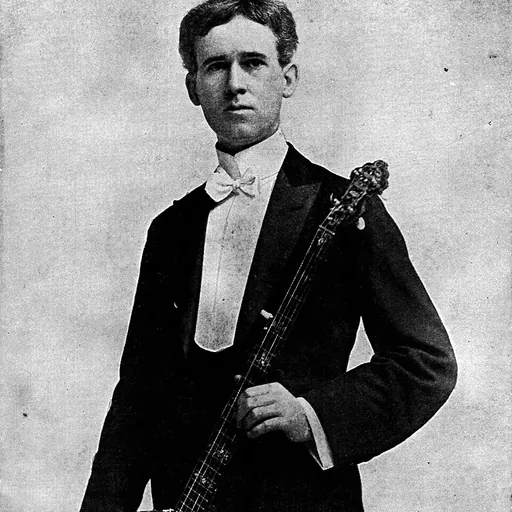
About Alfred A. Farland
Lived 1864 – 1954 (aged 90). Alfred A. Farland was a Canadian musician, composer, luthier and banjoist.
Alfred Adolphus Farland Sr. (April 10, 1864 – May 5, 1954) was a Canadian-American banjoist, playing in the classic banjo style for more than 40 years. He played the banjo wearing a tuxedo, bringing an air of sophistication to the instrument, when the 19th-century image for a banjo player tended toward the comic, the racist and the crude. He had a reputation for entertaining "cultivated audiences" with banjo adaptations of European classical music. Farland's adaptations included Bach violin sonatas, Beethoven violin sonatas, a Mendelssohn violin sonata, Brahms dances, and some of Chopin's nocturnes and waltzes. He wrote a banjo method and composed music for students to practice.
Farland was also an inventor and designed his own line of banjos with wooden rims. He held patents for banjo-related inventions, including an all-metal banjo head and an adapter to produce harp-like tones from a banjo.
Background
Alfred A. Farland, 1891 advertisement, music teacher 14 years experience Alfred Farland was the youngest of nine children, 5 boys and 4 girls, his parents natives of Canada. His family moved to the United States about 1865, They were involved in the clothing-making industry. His father was a tailor, and Alfred and his brothers (and sometimes his sisters) worked in the woolen mills that turned sheep's wool into cloth. Although he lived and died in the United States, he remained Canadian through at least 1920, becoming a citizen by 1940.
In 1880 when he was 14 years old, Alfred Farland worked as a weaver in a woolen mill in Westerly, Rhode Island. His brother, Joseph, lived nearby and also worked in the woolen mill. About 14 years later, Alfred would receive acclaim in his music-playing profession, playing the banjo, accompanied on piano by his niece Annie, Joseph's daughter.
He began to take lessons from music teachers in about 1877, when he was 13 years old. He was good enough that five years later in 1882 he was able to work professionally, working within "concert companies." However, the music was seen as vulgar by men such as S. S. Stewart, What had really impressed Stewart was Farland's adaptation of a Mendelssohn concerto, which Stewart knew to be a difficult piece on the violin, and even more difficult on the banjo. After a career in blackface, Huntley broke ground by performing in "whiteface" on the stage in 1884, eliciting the newspaper comment, "Mr. Wm. A. Huntley is the only banjo artist in the country that has ever made a success in white face." Early in his career, Stewart had included lessons for performing in blackface, but it was a small part of his larger business and magazine, both centered around a refined banjo image. and his repertoire focused on arrangements of European classical music (then contemporary music coming out of Europe) and a high level of technical skill. His performances would inspire newspapers to label him "virtuoso."
Examples cited at concerts during the summer of 1894 include the "Miserere" from Verdi's Il trovatore, Mendelssohn's Violin Concerto, Op. 64, Rossini's Overture to William Tell, Beethoven's sonatas and concertos including Sonata No. 30.
Other works played in 1894 included: Beethoven 8th Sonata; Handel "Largo"; Chopin Polonaise, Op. 40, No. 1, Nocturne, Op. 9, No. 2, Valse, Op. 64, No. 2; Moszkowski Spanish Dances, Nos.1, 2 and 3, Sonata; Schubert, Serenade; Bach, Sixth Sonata, Preludio, Minuet, Gigue; Wieniawski Second Polonaise Brilliant; Paderewski Minuet a l'Antique; Haydn Gypsy Rondo; and Mendelssohn, A Midsummer Night's Dream incidental music, Op. 61: Allegro Molto Vivace.
He also played some contemporary or folk music, including Home, Sweet Home. width1=200 image2= Alfred A. Farland endorses S. S. Stewart's Thoroughbred banjo.jpg caption2= On the final page of that journal, Alfred A. Farland endorses S. S. Stewart's Thoroughbred banjo. For about 10 years, Farland toured the United States, traveling as much as 1000 miles in a day and playing classical music on one of Stewart's banjos. Some of Farland's audience was aware of the elite instrument, commenting on it in a letter to Stewart, which was published in his journal.
Stewart in turn endorsed Farland in his journal, printing excerpts and whole pages about him, as well as Farland's concert schedule and upcoming concerts. He had his instruments made by such companies as Rettburg & Lange.
In creating his own banjo, he said that he was looking for a particular tone, one that was "mellow." In his 1902 catalog, he pointed out that the majority of metal banjo rims did not fit perfectly against the wood that lined them, and that the fit would change over time.
American Banjo Fraternity
Farland was a member of the American Banjo Fraternity and its first vice president.
Works Carnival of Venice, variations on the folk song composed by Julius Benedict, arranged for banjo and played on banjo by Alfred A. Farland. This song is an example of Farland using tremolo to get long notes from the instrument (much as the cornet or violin can naturally play.) Carnival of Venice, variations on the folk song composed by Julius Benedict, arranged/played on violin by Jan Rudenyi. Carnival of Venice - played by Herbert L. Clarke on cornet, solo with orchestra - arranged by Arban
Educational National School for the Banjo
Sheet music 1891 National Parade March 1895 Haydn, Gypsy Rondo Arranged by Alfred A.Farland. 1895 Menuet A L'antique 1895 Serenade 1897 My Old Kentucky Home Varied With Piano 1902 5th Air Varied Op. 89 No. 5 1902 La Castenara (Mexican Love Song, Castenet Dance) La Matinee Rondo 1902 La Paloma 1902 Overture To William Tell (Last Movement) 1902 Traumerei Op. 15 No. 7
Gallery
1894, Feb-March, page 6, Farland and his banjo. 1894, April–May, page 8, untitled. 1894 June–July, pages 10–12, The Banjo World. 1894, August–September, page 8, Take the elevator. 1894 October–November, page 13, The Banjo World. 1894 December-1895 January, page 11, The Banjo World. 1895 February–March, page 4, A violinist on Farland. 1895 February–March, page 4, Farland concerts.
Don’t just read it —
keep it.
Full-length biographies made to live with: read them, listen on the way to work, watch them tonight.
- E-book
- Audio
- Video
Instant download · yours to keep · every purchase keeps this site free
Important facts
People in Alfred A. Farland's life
Named in this biography and alive at the same time
Related people
Same field, nearest in time



Contemporaries
People whose lives overlapped Alfred A. Farland's






Frequently asked questions
Who was Alfred A. Farland?
musician, banjoist, composer, musical instrument manufacturer
When was Alfred A. Farland born?
Alfred A. Farland was born on 10 April 1864 in Lachine.
When did Alfred A. Farland die?
Alfred A. Farland died on 5 May 1954 in Plainfield.
What was Alfred A. Farland's occupation?
Alfred A. Farland was a musician, composer, luthier and banjoist.
What nationality was Alfred A. Farland?
Alfred A. Farland was Canadian.
Sources & further reading
· Wikipedia: Alfred A. Farland
Cite this page
APA: Biography.guide. (2026). Alfred A. Farland. https://biography.guide/alfred-a-farland/
MLA: "Alfred A. Farland." Biography.guide, https://biography.guide/alfred-a-farland/.
Chicago: "Alfred A. Farland." Biography.guide. https://biography.guide/alfred-a-farland/.
Data last updated: 2026-09-20 · Spot an error? Report a correction.
Portrait: Wikimedia Commons · author & licence
Page generated 2026-09-27 04:58 UTC